Village & City Remodeling Permits in Nassau County
Quick Answer
Nassau County contains 2 cities, 3 towns and 64 incorporated villages, and the villages and cities permit independently of the towns. If you live in a village, you file with the village, not the town. Nearly any Nassau kitchen or bathroom touching plumbing or electrical needs a permit. What it costs, and who is allowed to do it, changes at the village line.
Key Takeaways
- Nassau County's own figure: “Within Nassau County there are 2 cities, 3 towns, 64 incorporated villages and over 100 unincorporated areas.” Suffolk has 32 villages in more than twice the land area.
- The towns permit the unincorporated areas only. Nassau County's permit page tells homeowners to “call your city, town or village directly,” and North Hempstead states it administers the codes “within the unincorporated areas of the Town.”
- Garden City is the worked example. Village Code § 68-4 requires permits for “plumbing, drainage, heating, air conditioning, ventilating, refrigeration or electrical work” — so one kitchen can mean four separate permits, each priced on its own formula.
- Floral Park publishes the clearest guidance in Nassau County and is the only village in our sample that puts the cosmetic exemption in writing. Williston Park is the opposite: its fees are set by Board resolution and are on file with the Village Clerk, so you cannot learn them from the internet.
- Long Beach's 50% rule is the number that matters most in Nassau. The entire city is a FEMA flood zone, and improvements reaching 50% of a building's market value must meet new-construction requirements.
- “Do I need a permit?” has a reliable Nassau answer. “What will it cost and who may do it?” has 66 answers. Never estimate one village's fee from its neighbour.
Why Is Permitting Harder in Nassau County Than in Suffolk?
Because of a structural fact almost nobody explains to homeowners. Nassau County publishes it plainly: “Within Nassau County there are 2 cities, 3 towns, 64 incorporated villages and over 100 unincorporated areas.” Suffolk County, at more than twice the land area, contains 10 towns and 32 incorporated villages. Nassau has twice as many villages as Suffolk in less than half the space, and each village runs its own building department, as do Long Beach and Glen Cove — 66 permitting authorities operating independently of the three towns.
Suffolk's problem is that ten town departments answer the same question ten slightly different ways. Nassau's is different in kind: the department that governs your kitchen is set by a boundary that does not appear on your mail and often runs down the middle of a residential street. Two houses facing each other can file with different departments, on incompatible fee formulas, using different plumbers.
The reason is 19 NYCRR 1203.3(a)(1), which requires every authority having jurisdiction in New York State to require building permits for work that must conform to the Codes. It then lets a locality exempt eight categories, two of which matter here: “painting, wallpapering, tiling, carpeting, or other similar finish work,” and “repairs, provided that the work does not have an impact on fire and life safety.” The State mandates the permit and merely allows the exemption. In Nassau, 69 authorities each decide that for themselves.
We are not printing a list of all 64 villages. The public enumerations do not reconcile, and a list that is wrong about your village is worse than none.
If You Live in a Village, You File With the Village
That is the rule, and it holds without exception. An incorporated village is a municipal corporation with its own authority to administer the Uniform Code, and where it exercises that authority the town has no permitting role inside the village line. Nassau County's permit guidance tells homeowners to “call your city, town or village directly.” North Hempstead says the same from the other side: it administers the codes “within the unincorporated areas of the Town.”
So a homeowner in Williston Park calling the Town of North Hempstead is calling the wrong department. Our town pages — Hempstead, North Hempstead and Oyster Bay — cover the parts of each town those departments actually permit.
Garden City: What Village Permitting Actually Looks Like
Garden City is the best worked example in Nassau, because it publishes both its code and its fees. Village Code § 68-4 requires a permit for “plumbing, drainage, heating, air conditioning, ventilating, refrigeration or electrical work.” Read that against a kitchen: the sink is plumbing, the drain line is drainage, a ducted range hood is ventilation, a beverage refrigerator is refrigeration, every circuit is electrical.
§ 68-3(A) defines major construction as a new building, or an alteration that changes the certificate of occupancy. § 68-3(B) defines minor construction as an “alteration of an existing building or structure that does not change the certificate of occupancy, use or maximum occupancy therefor, but which requires multiple forms or separate areas of work.” A kitchen or bathroom inside the existing footprint is minor construction. Minor permits expire at six months, extendable to one year on demonstrated progress, and § 68-3(D) allows extensions twice, up to three months each.
Here is the part that surprises homeowners: minor does not mean one permit. The phrase in § 68-3(B) — “requires multiple forms or separate areas of work” — is the giveaway. A full Garden City kitchen can require the building permit plus plumbing plus electrical plus mechanical, each priced on its own formula under the residential schedule amended August 6, 2025.
| Garden City residential permit (schedule amended 8/6/2025) |
Published fee formula |
| Building permit | $400 for the first $1,000 + $20 per additional $1,000 |
| Deposit on the same structure | $300 |
| Plumbing permit | $275 for the first $1,000 + $20 per additional $1,000 |
| Electrical permit | $200 flat + electrical inspection fee |
| Mechanical permit | $275 for the first $1,000 + $20 per additional $1,000 |
| Additional or failed inspection | $150 each |
| Temporary certificate of occupancy, residential | $150 |
| Certificate of occupancy search | $100 per legal address |
| Work performed without permits | 3× permit fee + building permit fee(s) |
We are deliberately not handing you a total. The published schedule does not state how job value is allocated across the four trade permits. Any figure we computed would be a guess dressed up as arithmetic. What the structure does tell you: four permits, four base fees before a single additional thousand dollars is counted, and those bases alone are $400, $275, $200 and $275. Ask the Building Department at 351 Stewart Avenue how the formulas apply to your scope.
Two more provisions matter. § 68-5(A) makes routine inspections “free of charge,” excepting phased projects and “reinspection of work that was done incorrectly” — so failing an inspection is $150 a visit. And § 68-5(D)(1) imposes a “legalization fee equal to three times the application fee” on work already performed, a bill usually discovered at closing.
Six Nassau Villages, Six Different Answers
The six villages below are not a representative survey. Each was chosen because it publishes something the others do not, and together they show that a Nassau village permit is not one product with one price.
| Village |
What triggers a permit |
Published fees |
Who may do the trade work |
Rockville Centre
110 Maple Ave · (516) 678-9247 |
“Any alterations to an existing building or structure which effects: the structural design of the building; mechanical; electrical; plumbing systems,” explicitly including “Extensions to the plumbing, heating and electrical systems.” |
Filing $135; $210 first $1,000 + $20 per additional $1,000; plumbing $115 first 3 fixtures + $27 each additional; electrical $125 residential; CO plumbing $42, residential $89 |
The Village issues its own electrician and plumber licences |
Floral Park
One Pool & Garage Rd · 516-326-6319 |
Requires a permit for “Plumbing, Oil and Gas Fixtures and Piping” and “Interior Alterations - Not including cosmetic only upgrades.” Exempts “Painting, wallpapering, tiling, carpeting, or other similar finish work.” |
A fee document exists (“Permit Fees – Updated as of June 1, 2026”) but the amounts were not retrieved. Call the village. |
“All Electrical and Plumbing work must be performed by a Floral Park Licensed Plumber and/or Electrician.” |
| Mineola |
“No person shall commence the erection, construction, enlargement, alteration, repair, removal, improvement, demolition, conversion, or change in the nature of the occupancy of any building or structure… without first obtaining a separate building permit.” Non-structural ordinary repairs are exempt from fee. |
Not published. Fees are set by resolution of the Board of Trustees. Unpermitted work costs 3× the standard fee. |
Not published in the material reviewed — confirm with the village |
| Great Neck (village) |
Permit required for new, altered or renovated floor area; the fee itself is measured on that area |
“Application fee: $300. Additional fee: $3 per square foot of new, altered, or otherwise renovated floor area.” Reinspection $300. Plumbing $100 + $20 per fixture; soil, waste and vent $100. No electrical fee appears in the schedule. |
Requires that “the Village shall be added as an additional insured” plus a hold-harmless agreement |
| Williston Park |
Permit required; the code sets the requirement and leaves the price to the Board |
Not published anywhere online. § 93-2 sets fees “from time to time by resolution of the Village Board of Trustees,” and the editor's note says “The current Fee Resolutions are on file in the office of the Village Clerk.” |
Not published in the material reviewed — confirm with the village |
Kings Point
application rev. 03/2026 |
“Each addition, separate structure, and additional system or appliance requires a separate building permit.” |
General construction $500.00 base + $11 per every $1,000 of estimated construction cost, plus a $2,500 infrastructure improvement fee for alterations exceeding $100,000 |
Consumer Affairs licence for general contractors, but a Town of North Hempstead licence for plumbing and electrical |
Floral Park publishes the clearest permit guidance in Nassau County. Its standalone “When Do I Need a Permit?” guide, revised 05/16/24, is the only document in our sample that puts the cosmetic exemption in writing. It exempts “Painting, wallpapering, tiling, carpeting, or other similar finish work” and requires a permit for “Interior Alterations - Not including cosmetic only upgrades.” Every other village leaves that line to a phone call. It also states the licensing rule flatly: “All Electrical and Plumbing work must be performed by a Floral Park Licensed Plumber and/or Electrician.”
Williston Park is the exact opposite, and the finding is the absence itself. Village Code § 93-2 provides that fees are “set from time to time by resolution of the Village Board of Trustees,” and the editor's note says “The current Fee Resolutions are on file in the office of the Village Clerk.” You cannot learn the cost of a Williston Park building permit from the internet. You learn it from the Village Clerk.
Great Neck village is the only one in the sample charging by the square foot, at a “$300 application fee” plus “$3 per square foot of new, altered, or otherwise renovated floor area” — a different model from Garden City's value-based formula or Glen Cove's per-fixture plumbing charge. A large plain kitchen and a small expensive one price identically in Great Neck and very differently in Garden City.
Kings Point carries a fee nobody would think to ask about. On top of the $500 base and the $11 per $1,000, it charges an infrastructure improvement fee of $2,500 on any alteration exceeding $100,000. Kings Point also requires a Consumer Affairs licence for the general contractor but a Town of North Hempstead licence for plumbing and electrical, deferring trade licensing to the town it sits inside.
Rockville Centre issues its own electrician and plumber licences, and runs two live websites, rvcny.gov (current) and rvcny.us (legacy, still indexed). Mineola's permit lapses if work does not start within 90 days, expires at six months, is extendable 180 days, and charges 3× the standard fee for unpermitted work, the same multiplier as Garden City.
Atlantic Beach Village Code § 130-10 is the cleanest statement on Long Island that the Nassau County home improvement licence is a floor and not a ceiling. A village licence is required “in addition to the requirements of all other applicable laws,” and an applicant must first show a currently valid Nassau County Department of Consumer Affairs licence.
The Two Cities: Long Beach and Glen Cove
The City of Long Beach runs its Building Department from the third floor of City Hall, 1 West Chester Street, Long Beach, NY 11561, at 516-431-1005. Its trigger is unusually broad: a permit is required “For all plumbing,” with plumbing defined to include “water pipes; water closets; sinks; installed dishwashers; lavatories; bathtubs; shower baths.” That catches essentially every kitchen and bathroom renovation in the city. Electrical is equally direct: “All electrical work to be performed by a licensed electrician.” Contractor registration is a City Clerk function, separate from the Building Department.
Long Beach publishes no fee schedule. Its own page says “Call for current permit prices.” There is no online portal and no published certificate of occupancy policy, and we are not going to approximate any of it.
The wrong-city trap, and it catches people constantly. longbeach.gov and permitslicenses.longbeach.gov belong to Long Beach, California. They rank highly for “Long Beach building permit,” they have a full online portal, and the fees, forms and codes on them have nothing to do with New York. Long Beach, NY is longbeachny.gov, and it has no online portal. If the site you are reading has a permit portal, you are on the California city's website.
The flood rule is the single most consequential fact on this page. FEMA maps effective September 11, 2009 designate “the entire City of Long Beach as a Flood Zone.” The City's March 2025 flood bulletin states the substantial improvement standard directly: “if the cost of reconstruction, rehabilitation, addition or other improvements to a building equals or exceeds 50% of the building's market value, then the building must meet the same construction requirements as a new building,” and a residence damaged past that threshold “must be elevated above the base flood elevation.” The same bulletin instructs residents: “Do not start work without contacting the Building Department first.” Long Beach is CRS Class 7, which gives eligible policyholders a 15% flood insurance discount.
Now the honest framing, because this rule gets misrepresented in contractor marketing. A standalone bathroom renovation in Long Beach will usually not reach 50% of the home's market value, and nothing about a ground-floor bathroom automatically requires a house to be elevated. But the test is market-value based, not room based. A gut renovation, a kitchen and a bathroom in the same season, or substantial work on an older or lower-value structure genuinely can reach it. The accurate statement: in Long Beach the 50% rule decides whether your renovation is a renovation or a rebuild, and the Building Department makes that determination before you start.
The City of Glen Cove runs its Building Department at 9 Glen Street, Glen Cove, NY 11542, at (516) 676-4448, Monday to Friday 9 to 5, by appointment only. It presents a contradiction worth publishing rather than smoothing over. City Code § 111-9(A)(1) states that no person, firm or corporation shall commence the “erection, construction, enlargement, alteration, removal, improvement, demolition, conversion or change in the nature of the occupancy of any building or structure… without first obtaining a separate building permit.” The website is narrower: “if it involves structural changes, it requires a permit.”
Those two statements do not cover the same ground. A bathroom renovation that moves no walls is unambiguously an alteration under § 111-9(A)(1), and arguably not a structural change under the website's gloss. The code governs. Note the word “separate” as well: Glen Cove requires a separate plumbing application regardless, at $25.00 per fixture under the schedule amended December 23, 2024.
| Nassau's two cities |
City of Long Beach |
City of Glen Cove |
| Building Department | 3rd floor, City Hall, 1 West Chester Street, Long Beach, NY 11561 · 516-431-1005 | 9 Glen Street, Glen Cove, NY 11542 · (516) 676-4448 · Mon–Fri 9–5, by appointment |
| Permit trigger | “For all plumbing,” with plumbing defined to include water pipes, water closets, sinks, installed dishwashers, lavatories, bathtubs and shower baths | § 111-9(A)(1): any alteration requires a “separate building permit.” The website is narrower and says structural changes |
| Published fees | Not published. “Call for current permit prices.” No fee schedule, no portal | Plumbing $25.00 per fixture; certificate of occupancy $250.00; electrical meter permit $200.00; amendment plus added value $20.00 per $1,000 residential (amended 12/23/2024). The base alteration fee did not extract cleanly — call |
| Who may do the work | “All electrical work to be performed by a licensed electrician.” Contractor, electrician and plumber registration is a City Clerk function | Nassau County Home Improvement licence for the contractor; “Plumbing Application… may only be complete only by a City of Glen Cove Licensed Plumber” |
| The rule that changes the project | The 50% substantial improvement rule. The entire city is a FEMA flood zone under maps effective September 11, 2009. CRS Class 7, 15% flood insurance discount | The code and the website disagree. Drawings must be wet-signed and sealed by a licensed architect or engineer; a blank check for fees is on the checklist |
| Online portal | None | None published |
Glen Cove's application checklist, dated 2020, also calls for “Drawings to be Wet Signed and Sealed by a licensed Architect / Professional Engineer,” a current survey, the Nassau County Assessor's sheet, an Underwriters Certificate or equal for new electrical, and a blank check for the fees. Confirm every line of a six-year-old checklist before you rely on it.
How Do You Find Out Which Nassau Building Department Covers Your Address?
The honest answer starts with an admission: there is no single official “which Nassau village am I in?” address lookup. No county page takes an address and returns a village name with a building department phone number. That absence is why so many homeowners call the wrong office first. What does exist, ranked:
1. Your property tax bill — the definitive practical test. Incorporated villages levy their own taxes, and a village tax appears as its own separate line with the village's name on it. Billed a village tax, you live in that village and that village is your building department. No village line, and you are in an unincorporated area where the town is your department.
2. The Nassau County Land Records Viewer at lrv.nassaucountyny.gov, searchable by address, integrating assessment roll data, district information and tax maps with county GIS. The district information is where the answer lives — we are not claiming it prints an explicit “village” field, because we did not confirm that.
3. The New York State GIS Clearinghouse Civil Boundaries data, villages layer. Authoritative statewide boundary data, and the right source if you need a defensible boundary, but a GIS dataset rather than a consumer lookup.
4. The US Census Geocoder, which returns an “Incorporated Place” for a submitted address. In Nassau an incorporated place is a village or one of the two cities. We describe the tool rather than write it up as a tested procedure, because we have not run it end to end for a Nassau address.
5. Call the town. Call Hempstead, North Hempstead or Oyster Bay, give the address, and ask whether they permit it. If the town says it is not their jurisdiction, you are in a village and they will tell you which one.
Your Mailing Address Is Not Your Jurisdiction
This trap produces more wrong assumptions in Nassau than anything else. ZIP codes and post office names were drawn for mail delivery, not for municipal government. They were never intended to describe who administers the building code at your address, and in Nassau they routinely do not.
“Great Neck” is a mailing address, not a jurisdiction. Nassau County's village list includes Great Neck, Great Neck Estates, Great Neck Plaza, Kensington, Kings Point, Lake Success, Russell Gardens, Saddle Rock and Thomaston — nine separate incorporated villages, alongside unincorporated Town of North Hempstead area, largely sharing “Great Neck” mailing addresses. Each has its own building department, its own fee schedule and its own answer on who may legally do your plumbing. Great Neck village charges $3 per square foot; Kings Point charges a $500 base plus $11 per $1,000 and sends you to the Town of North Hempstead for a plumbing licence.
We name the Great Neck cluster because it is verified, and we are not generalising it to other Nassau mailing addresses — an unverified example is exactly the kind of confident error that sends someone to the wrong counter. If your mailing address is shared by more than one municipality, run the tax bill test above.
What Generalises Across Nassau, and What Does Not
The findings split cleanly into two piles. The first is short and genuinely reliable planning information. The second is where every estimate goes wrong.
| Safe to rely on anywhere in Nassau |
Changes village by village — only “confirm with your village” is honest |
| If you live in a village, you file with the village. The town permits the unincorporated areas. |
How the fee is calculated. Four incompatible models turned up in six villages: per square foot, per $1,000 over a base, per fixture, and flat. You cannot estimate a Nassau village permit fee from a neighbouring village, ever. |
| Touch plumbing or electrical and you need a permit. True in every Nassau jurisdiction examined. |
Whether fees are published at all. Garden City, Rockville Centre, Great Neck, Kings Point and Glen Cove publish. Mineola, Williston Park and the City of Long Beach do not. |
| Purely cosmetic work generally does not need a permit — but only Floral Park says so in writing. |
Whose trade licence counts: the village's, the town's or the county's. Three different answers inside one six-village sample, and a plumber licensed in Rockville Centre is not licensed in Floral Park. |
| The Nassau County home improvement licence is the starting point, not the finish line (Atlantic Beach § 130-10). |
Whether each trade needs its own permit, and how many permits one kitchen becomes. |
| Permits expire, and roughly six months is the norm for interior alteration work. |
What the trigger word is — “alteration,” “structural change,” “improvement,” “interior alterations not including cosmetic only upgrades.” |
| Unpermitted work costs multiples to legalise. Garden City and Mineola both charge 3×. |
Fees you would never think to ask about: Kings Point's $2,500 infrastructure improvement fee, Garden City's $300 deposit, Great Neck's $300 reinspection. |
| Your village will require to be named on your contractor's insurance. |
Permit turnaround time. No Long Island jurisdiction publishes one. A contractor quoting a guaranteed number is inventing it. |
That is the whole finding, reduced to one line: in Nassau County, “do I need a permit?” has a reliable answer — almost always yes if plumbing or electric is involved. “What will it cost and who's allowed to do it?” has 66 different answers. Anyone who tells you otherwise has worked in one village and assumed the rest match it.
What Does the Work Itself Cost, and Who Handles It?
Permit fees are a small line inside a much larger number. Our planning ranges run from about $12,000 for a surface bathroom refresh to $250,000 and above for high-end custom kitchen work; the detail is in our kitchen remodel cost guide and bathroom remodel cost guide. See also kitchen remodeling, bathroom remodeling, kitchen remodeling in Nassau County and bathroom remodeling in Nassau County.
Our own carpenters and project managers run your job start to finish. Electrical and plumbing are performed by licensed Nassau and Suffolk trade contractors we've worked with for years — we schedule them, we coordinate the inspections, and we're accountable for the result. Greene Group Construction holds Nassau County HIC #EF-65498 and Suffolk County HIC #HI-72958, and no village or city trade licence.
Permit questions get urgent in one scenario. When a bathroom or kitchen is rebuilt after a failed supply line or a leaking shower pan, the subfloor, joists and ceiling below need assessing before anyone talks about tile — and in Long Beach that collides directly with the 50% rule. We run water damage restoration and insurance claims support as real service lines, so documentation, mitigation and the rebuild sit under one contract. Structural work runs through our general contracting division, and debris leaves with our own junk removal and cleanout crews.
This page is general information about published Nassau County village and city requirements, not legal, code, tax or insurance advice. Village fee schedules are amended by Board resolution, city checklists go stale, and flood determinations are made case by case by the department with jurisdiction. Confirm current requirements with your own village or city building department before you rely on any of this. Where a figure is not published above, it is because it is not published — not because we could not be bothered to estimate it.
Nassau County Village & City Permit FAQ
Which building department covers my address in Nassau County?
There is no single official address lookup that names your Nassau village, which is the root of the confusion. The definitive practical test is your property tax bill: villages levy their own taxes as a separate line, and unincorporated areas do not. After that, the Nassau County Land Records Viewer at lrv.nassaucountyny.gov is searchable by address and the district information is where the answer lives. The New York State GIS Clearinghouse Civil Boundaries villages layer is authoritative but is a GIS dataset rather than a consumer tool, and the US Census Geocoder returns an Incorporated Place for an address. The simplest method is to call the town: if the town says it is not their jurisdiction, you are in a village, and they will tell you which one.
Do I need a permit to remodel a bathroom in a Nassau County village?
In every Nassau village we examined, yes, if the work touches plumbing or electrical. Garden City requires permits for plumbing, drainage, heating, air conditioning, ventilating, refrigeration or electrical work. Rockville Centre requires one for any alteration affecting the structural design, mechanical, electrical or plumbing systems, explicitly including extensions to those systems. Floral Park requires a permit for plumbing fixtures and piping and for interior alterations not including cosmetic only upgrades. A bathroom is almost entirely plumbing and electrical, so it lands on the permit side nearly everywhere. Confirm with your own village before you start.
Do I need a permit to remodel a kitchen in a Nassau County village?
Cabinets, countertops, backsplash tile, flooring and paint are generally treated as finish work, but Floral Park is the only Nassau village we found that puts that exemption in writing, exempting painting, wallpapering, tiling, carpeting or other similar finish work. Anything past the finishes normally needs a permit. Moving a sink, adding an island sink, running a gas line, adding circuits or taking out a wall all pull in the permit, and in Garden City a single kitchen can require the building permit plus separate plumbing, electrical and mechanical permits, each applied for and priced separately.
How many incorporated villages are in Nassau County?
Nassau County states that within Nassau County there are 2 cities, 3 towns, 64 incorporated villages and over 100 unincorporated areas. Suffolk County, at more than twice the land area, has 32 incorporated villages. Nassau therefore has twice as many villages as Suffolk in less than half the space, and because each village and each city permits independently of the towns, there are 66 permitting authorities in Nassau outside the three town building departments. That is the structural reason Nassau permitting is harder than Suffolk permitting.
What does a Garden City building permit cost for a kitchen or bathroom?
Garden City publishes a residential fee schedule amended August 6, 2025. The building permit is $400 for the first $1,000 of value plus $20 per additional $1,000, with a $300 deposit on the same structure. Plumbing is $275 for the first $1,000 plus $20 per additional $1,000. Electrical is $200 flat plus the electrical inspection fee. Mechanical is $275 for the first $1,000 plus $20 per additional $1,000. An additional or failed inspection is $150 each and a temporary certificate of occupancy is $150 residential. The schedule does not publish how job value is allocated across the four trade permits, so we do not publish a worked total. Ask the Building Department at 351 Stewart Avenue how it applies the formulas to your scope.
Do I need a permit to remodel in the City of Long Beach, and what is the 50 percent flood rule?
The City of Long Beach requires a permit for all plumbing, and it defines plumbing to include water pipes, water closets, sinks, installed dishwashers, lavatories, bathtubs and shower baths. That definition catches essentially every kitchen and bathroom renovation. Separately, FEMA maps effective September 11, 2009 designate the entire City of Long Beach as a Flood Zone, and the City's March 2025 flood bulletin states that if the cost of reconstruction, rehabilitation, addition or other improvements to a building equals or exceeds 50% of the building's market value, then the building must meet the same construction requirements as a new building. A standalone bathroom renovation will usually not reach half a Long Beach home's market value, but the test is market value based, so a gut renovation or several rooms in one season genuinely can reach it. The Building Department makes that determination, and the bulletin says do not start work without contacting the Building Department first. Call 516-431-1005.
Does the City of Glen Cove require a permit for a bathroom renovation that moves no walls?
Glen Cove's code and its website do not read the same way, and the difference matters. City Code section 111-9(A)(1) states that no person, firm or corporation shall commence the erection, construction, enlargement, alteration, removal, improvement, demolition, conversion or change in the nature of the occupancy of any building or structure without first obtaining a separate building permit. The website is narrower and summarises the rule as: if it involves structural changes, it requires a permit. A bathroom that moves no walls is an alteration under the code but arguably not a structural change under the website gloss. The code governs, and Glen Cove requires a separate plumbing application regardless, at $25.00 per fixture under the schedule amended December 23, 2024. Call the Building Department at (516) 676-4448 before assuming the website gloss protects you.
Is a Nassau County home improvement contractor licence enough to work in a village?
It is the starting point, not the finish line. Atlantic Beach Village Code section 130-10 states it most cleanly: a village licence is required in addition to the requirements of all other applicable laws, and an applicant must first show a currently valid Nassau County Department of Consumer Affairs licence. Trade licensing then splits three ways in a single county. Rockville Centre issues its own electrician and plumber licences. Floral Park states that all electrical and plumbing work must be performed by a Floral Park licensed plumber or electrician. Kings Point requires a Consumer Affairs licence for general contractors but a Town of North Hempstead licence for plumbing and electrical. Glen Cove requires a City of Glen Cove licensed plumber. A plumber licensed in one Nassau village is not automatically licensed in the next one.
 Kitchen — Quartz Waterfall Island
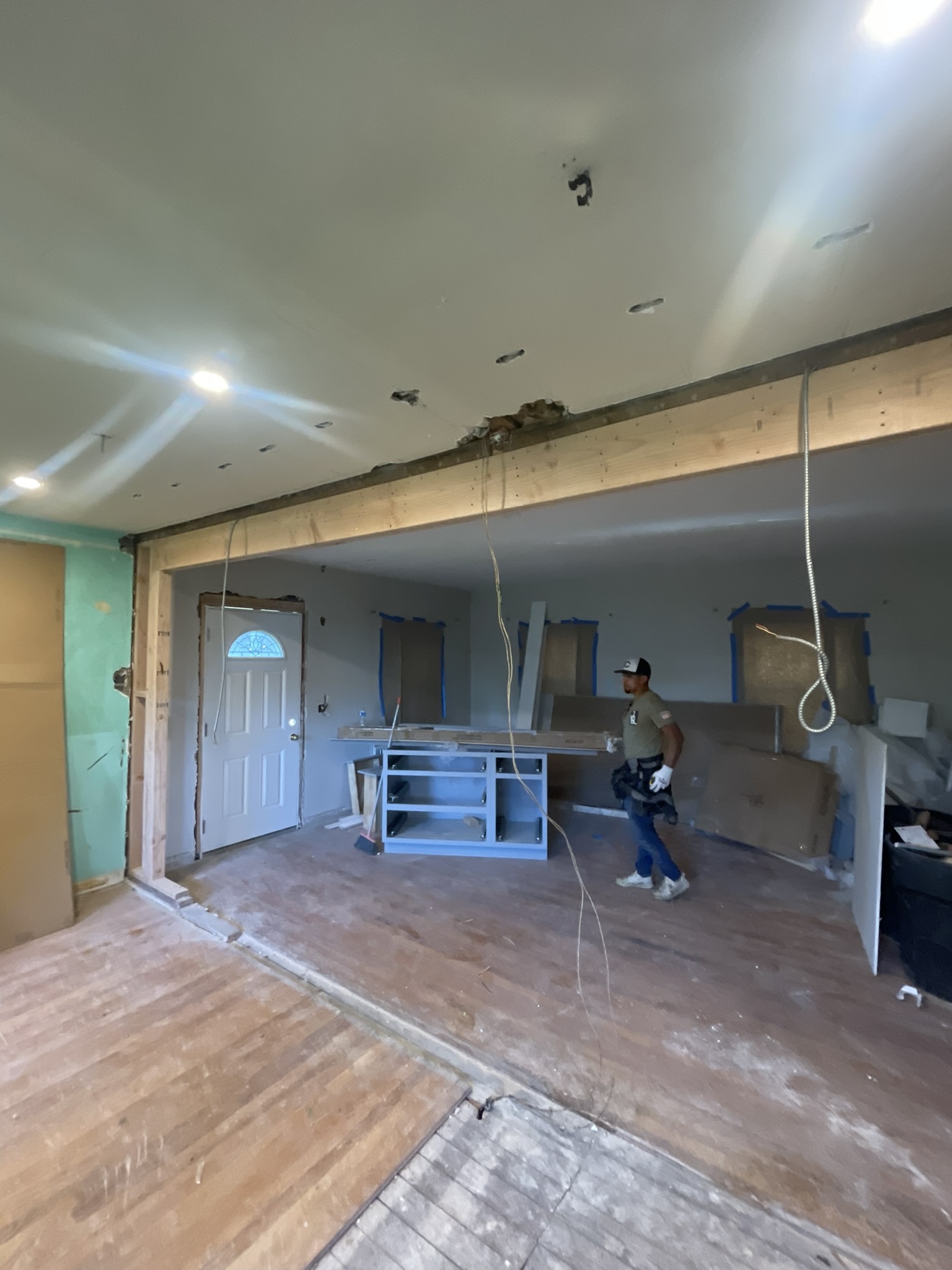 Kitchen In Progress
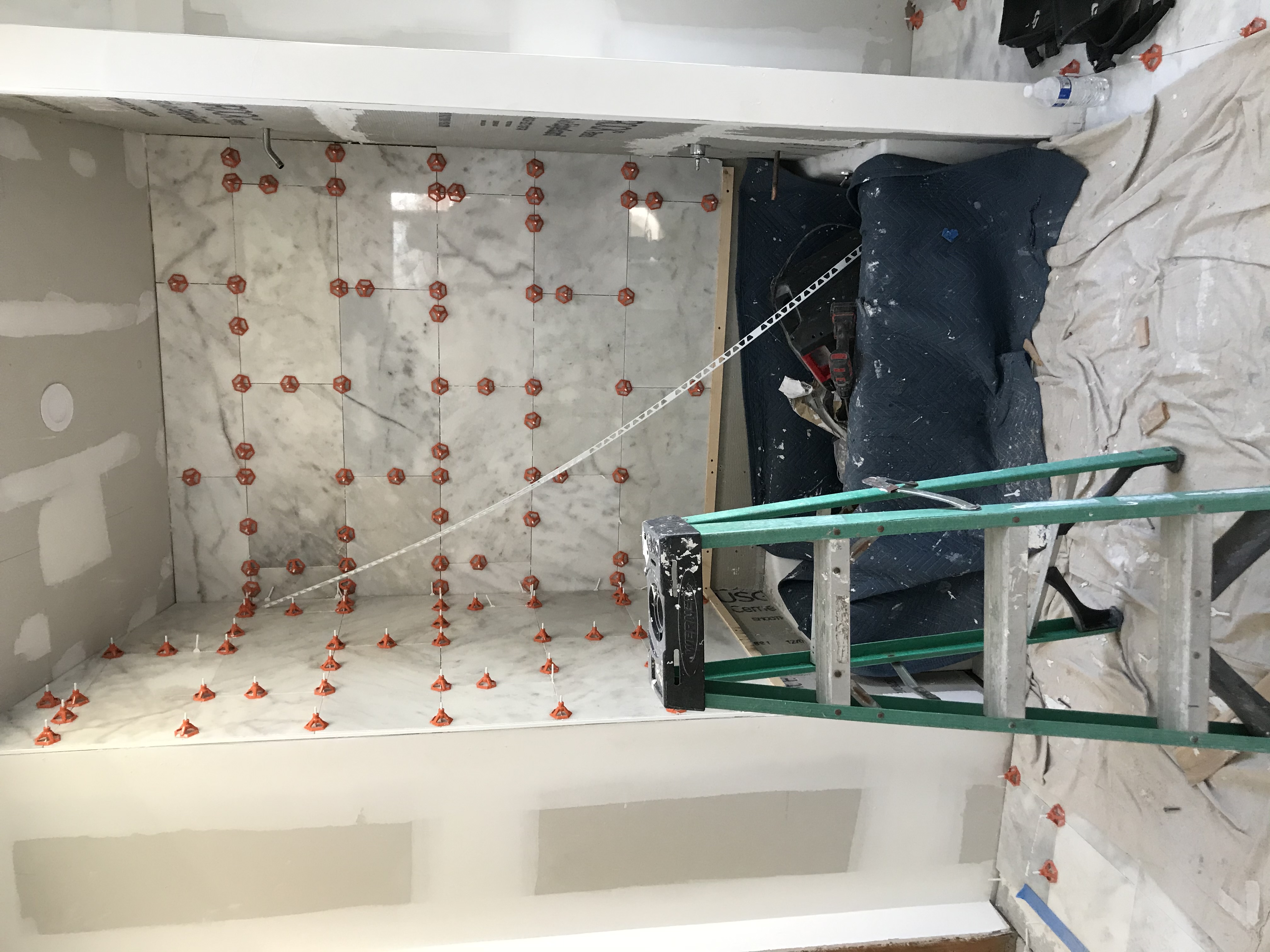 Shower Tile Going In
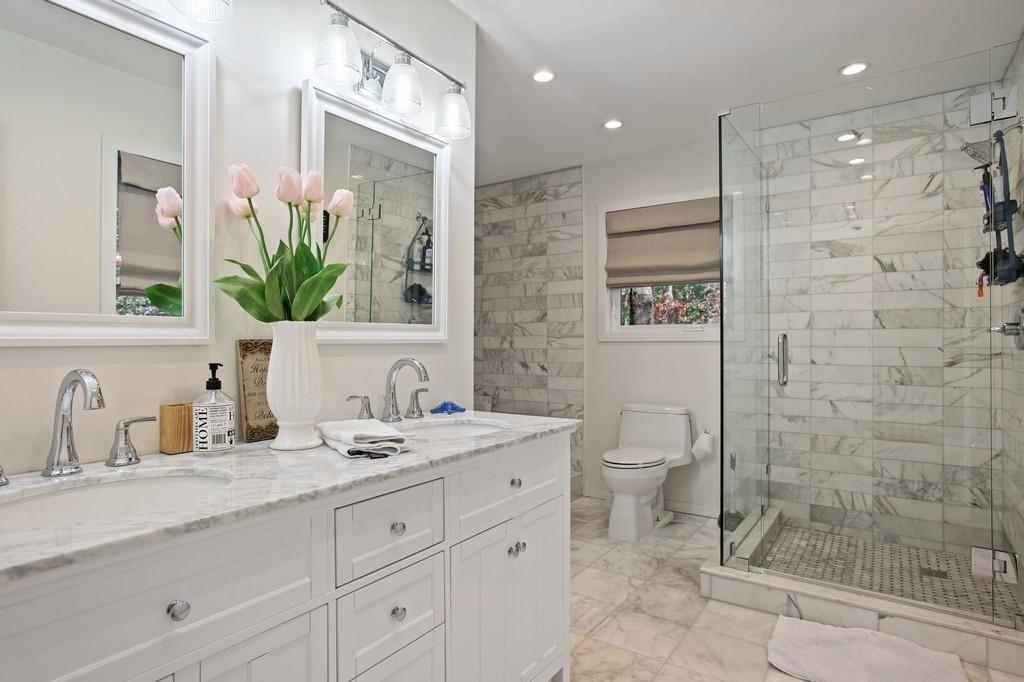 Finished Marble Bath