Bathroom Remodeling on Long Island
Quick Answer
Bathroom remodeling on Long Island runs roughly $12,000 for a surface refresh to $140,000 and up for high-end custom work, with a midrange full remodel at $25,000 to $50,000. Greene Group Construction is a licensed general contractor in Quogue holding Nassau HIC #EF-65498 and Suffolk HIC #HI-72958, and we also run water damage restoration, mold remediation and insurance-claims rebuilds.
Key Takeaways
- A bathroom packs more plumbing into less floor area than any other room in a house. When a pan or supply line fails, the real question is the subfloor, the joists and the ceiling below.
- We are already the water damage, mold and insurance-claims company on this domain, so a bathroom that failed and a bathroom being rebuilt are one company's job here.
- Adding a bathroom is a construction job — framing, structure, plumbing rough-in, and in Suffolk a wastewater question that gates the project before anyone picks tile.
- Permits genuinely vary by town. Under 19 NYCRR 1203.3(a)(1) New York requires permits for regulated work and only allows localities to exempt cosmetic finish work.
- Nothing in the residential code requires grab bars in a single-family bathroom. Blocking costs about $40 in lumber at rough-in and cannot be added later without opening the wall.
- New York skipped the 2020 NEC — Long Island moved from the 2017 to the 2023 NEC on December 31, 2025.
Why Does Water Decide Who Should Remodel Your Bathroom?
A bathroom is built to have water sprayed at it and drained through it several times a day for decades. It also packs more plumbing into less floor area than any other room. Insurance Institute for Business & Home Safety research found faulty supply lines, flanges and fill valves behind 78 percent of toilet water-damage incidents and faulty supply lines behind 44 percent of sink incidents. Pans crack, grout and caulk joints fail, supply lines let go, tub surrounds separate at the deck. A second-floor bathroom leaking a cup a day for four years shows up as a stain on the kitchen ceiling below, and by then the damage is not in the bathroom at all.
That changes what the job is. When we open a failed bathroom the first questions are not tile format and vanity width. They are whether the subfloor at the toilet flange has gone soft, whether the plywood under the shower pan has delaminated, how far moisture traveled along the joists, and what the ceiling assembly below looks like. Those answers set the scope. Finishes come afterward.
This is where we are structurally different from a bathroom remodeling company. Greene Group Construction runs water damage restoration and mold remediation as real service lines, alongside insurance claims work. The moisture readings, the drying, the demolition and the debris hauling are ours, and so is the rebuild. If a leak or flood is why your bathroom needs work, our guide to a bathroom rebuild after a leak or flood walks through what a homeowners policy generally covers, the New York claim deadlines that apply, and what to document before anything gets torn out. A homeowner whose shower pan failed does not need a mitigation vendor, then a mold contractor, then a remodeler arriving eight weeks later to a scope nobody wrote down. That handoff is where coverage gets lost.
We are not aware of another Long Island bathroom remodeler that covers insurance-funded bathroom rebuilds end to end. Most of what we build is still an ordinary, chosen renovation with nothing wrong behind the wall. But when demolition does find something, that is a Tuesday here rather than a subcontractor search.
What Does a Bathroom Renovation Actually Involve?
A bathroom is the most trade-dense room per square foot in a house. Forty square feet can carry supply and waste plumbing, a dedicated circuit, GFCI protection, exhaust ducted outdoors, waterproofing, tile and glass. Each stage below gates the next.
1. Scope and budget. The question that sets the price is whether anything moves. Pick a tier, then set a contingency on top of it.
2. Hazard screening. Asbestos and lead get addressed before anything is disturbed, not after. On an older Long Island house that is not optional.
3. Permits. Scope decides whether a permit is required; your town decides what it involves. In several Long Island towns the licensed plumber files the plumbing permit and performs the work.
4. Demolition and assessment. The room comes out to studs and subfloor, then everyone stops and looks. What is found here is what the rest of the schedule is built around.
5. Framing and rough-in. Structural work first, then supply and waste, then wiring. Grab-bar blocking and niche framing happen now, because after this the wall closes. Rough-in inspection follows.
6. Waterproofing, backer and tile. Cement board, fiber-cement or glass-mat gypsum in the wet areas, then the membrane and pan detail, then tile. Nobody sees this stage, and it decides whether the bathroom is sound in fifteen years.
7. Fixtures, trim and closeout. Vanity, toilet, valve trim, glass, lighting, hardware. Then final inspection, the electrical certificate and permit closeout, which matters at resale.
One thing about staffing is worth saying plainly. Our own carpenters and project managers run your job start to finish. Electrical and plumbing are performed by licensed Nassau and Suffolk trade contractors we've worked with for years — we schedule them, we coordinate the inspections, and we're accountable for the result. Demolition, debris hauling, restoration and cleanout are handled by our own crews.
What Does a Bathroom Remodel Cost on Long Island?
These ranges are triangulated from Zonda's 2025 Cost vs. Value data for the New York metro market and the published tiers of Long Island bathroom contractors. They are planning ranges, not a quote.
| Tier |
Range |
What It Is |
Timeline |
| Surface refresh |
$12,000 – $25,000 |
Fixtures, vanity, paint, re-tile in place. Nothing moves. |
1–2 weeks |
| Midrange full remodel |
$25,000 – $50,000 |
Everything replaced, layout essentially unchanged. Zonda's New York metro midrange figure of $30,376 sits inside this band. |
3–5 weeks |
| Major / gut renovation |
$50,000 – $85,000 |
Down to studs and subfloor. Layout changes, plumbing moves, hidden conditions surface. |
5–8 weeks |
| Upscale |
$85,000 – $140,000 |
Stone, custom glass, radiant floor, high-end fixtures. Zonda's New York metro upscale figure of $90,686 sits inside this band. |
8–12 weeks |
| High-end custom / East End |
$140,000+ |
Fully bespoke. |
12+ weeks |
Planning ranges as of July 2026. Not a quote. Zonda publishes a New York metro market, not a Long Island one.
Zonda's report covers the New York metro market; Nassau and Suffolk are not separate Cost vs. Value markets, so any source showing a Long Island-specific index is presenting something it does not have. New York metro jobs also cost more while recouping less: Middle Atlantic midrange is $30,158 at 79.9% recouped, against $30,376 at 76.5% here.
One cost driver has a date on it. Section 232 covers imported kitchen cabinets and bathroom vanities at 25%, with the scheduled increase to 50% deferred to January 1, 2027 (Proclamation 11000, 91 FR 1039). That deferral is finite, which makes vanity selection one of the few genuinely time-sensitive decisions in a bathroom budget.
The full treatment — the labor-versus-materials split, how many working days you are actually without that bathroom, and every tariff exposure line by line — is on our Long Island bathroom remodel cost guide.
Is Adding a Bathroom Different From Remodeling One?
Completely. Remodeling is a finishing job wrapped around existing plumbing. Adding a bathroom is a construction job: framing and often structural modification, a waste line that has to reach the stack at the right fall, new supply and venting, a new circuit, a floor assembly that can carry a filled tub, and across most of Suffolk County a wastewater question that gates the project.
Planning ranges for additions, on the same sourcing basis as the table above: a half bath inside the existing footprint runs $25,000 to $45,000 over 4 to 6 weeks; a full bath inside the existing footprint runs $40,000 to $75,000 over 6 to 10 weeks; and a full bath that adds square footage runs $70,000 to $130,000 and up over 10 to 16 weeks. Zonda's New York metro reference points for additions are $70,419 midrange and $126,509 upscale.
Septic caveat, and it applies to every addition number above: in Suffolk County an addition may trigger New York State Department of Health-approved I/A OWTS requirements. That is a separate scope with its own SCDHS review, and we do not fold a placeholder for it into a bathroom number. Suffolk's Septic Improvement Program offers a $20,000 county grant, and the New York State Septic System Replacement Program offers up to $25,000. The county publishes those two amounts separately.
Does Adding a Bathroom Trigger a Septic Upgrade in Suffolk County?
The trigger is bedrooms, not bathroom count. Under Suffolk County Sanitary Code §760-603(28), a “New or Expanded Single-Family Residence” includes the addition of one or more bedrooms beyond the number previously approved by the Department's Office of Wastewater Management. Suffolk sizes residential systems off the approved bedroom count, so a second or third bathroom by itself does not increase the design flow the Department assigns to the house. Where a new bathroom can actually go, why a basement bath usually needs a sewage ejector pump, and what each scope costs are covered on our Long Island bathroom addition guide.
A second door in the same definition catches bathroom additions in practice. An addition “requiring the addition or modification of Sewage disposal facilities” is pulled in regardless of bedroom count, so if the work forces the tank or a leaching pool to move, it counts. Separately, §760-603(25) defines Major Reconstruction as reconstruction cost exceeding 50% of the market value of the existing structure, excluding land. The exemptions at §760-614.D and §760-614.E turn on those same facts.
For context, roughly 74% of Suffolk County is unsewered, on approximately 380,000 individual systems, per the Suffolk County Countywide Wastewater Management District Feasibility Study of May 15, 2020. Nassau is structurally different: its Department of Health has jurisdiction over realty subdivisions of five lots or more and commercial systems at 1,000 gallons per day or more, and for an individual home it directs owners to the local building department.
Article 6 is amended periodically. Confirm the current requirements with the Suffolk County Department of Health Services Office of Wastewater Management before you rely on any of this for your project. The full treatment is on our Suffolk County bathroom remodeling page. This is general information, not legal, code or health-department advice.
What Is the Difference Between a One-Day Bath Installer and a General Contractor?
Long Island has a well-established one-day bath category, and it deserves a fair description. These companies fit an acrylic or composite liner over the existing tub, add a matching wall surround, swap the valve trim and door, and finish in one or two days. They are fast because the product is engineered for speed and the catalog is fixed. For a sound bathroom with a dated tub, no leak history and no layout change, that is a legitimate product.
It is also, by design, a surface. Speed comes from not opening anything, and not opening anything means not discovering anything. That trade stops being academic the moment there is water in the subfloor, a wall that needs to move, a bathroom to add rather than resurface, or a claim to scope and document.
| What Comes Up |
One-Day Liner Installer |
Full-Service General Contractor |
| Tub or surround is dated, everything else is sound |
Strong fit. One to two days, fixed price, minimal disruption. |
Also possible, but slower and pricier than the job requires. |
| Soft subfloor, or a stain on the ceiling below |
Out of scope. The floor stays closed. |
Moisture readings, floor and ceiling opened, joists assessed, repair priced. |
| Layout change, wall move, tub alcove to curbless shower |
Not offered. |
Framing, structural review, relocated waste and supply, permit filed. |
| Adding a bathroom where there was none |
Not offered. |
Full construction scope, including the Suffolk wastewater question. |
| Mold behind the surround |
Not a remediation service. |
Remediation and rebuild under one contract. |
| Carrier-funded rebuild after a water loss |
Retail purchase model, not a claims model. |
Documentation, scope, mitigation and rebuild by the same company. |
Read that table as a routing tool. If your situation is the top row, hire the fast option. If it is any row below, the fast option cannot reach the problem.
Do You Need a Permit to Remodel a Bathroom on Long Island?
The useful answer starts with why the answer varies. 19 NYCRR 1203.3(a)(1) requires every authority having jurisdiction in New York State to require building permits for work that must conform to the Codes. It then allows localities to exempt eight categories, two of which matter here: “painting, wallpapering, tiling, carpeting, or other similar finish work,” and “repairs, provided that the work does not have an impact on fire and life safety.” So the state mandates permits for regulated work and merely permits localities to exempt cosmetic work. Each town decides how far to take that option, which is the real mechanism behind “it depends on your town.”
The Town of Islip publishes the clearest guidance on Long Island. Islip states that no building permit is required for painting, wallpaper, tile, carpet or cabinets. A permit is required for new fixtures or gas piping, and for fixture replacement “if roughing or new piping is involved” — and in that case the licensed plumber must file the permit and perform the work. Electrical work requires a certificate from the New York Board of Fire Underwriters or an approved third-party inspection agency. That draws a clean line: re-tiling a shower and hanging a vanity in the same spot is finish work; moving the shower drain, adding a second sink or running a new circuit is not.
The two counties diverge structurally. Nassau is three towns — Hempstead, North Hempstead and Oyster Bay — plus the cities of Long Beach and Glen Cove and roughly 64 incorporated villages, many requiring a separate permit for each trade. Suffolk is ten independent town building departments: Babylon, Brookhaven, East Hampton, Huntington, Islip, Riverhead, Shelter Island, Smithtown, Southampton and Southold. No Long Island jurisdiction publishes a permit turnaround time, so call the department, ask about the current queue and schedule with float.
We file permits as part of the contract, and the town-by-town detail lives on the county pages: Nassau County and Suffolk County. Department-level detail for each individual building department, including what every town publishes and what it does not, sits on our Long Island remodeling permits hub. This is general information, not legal or code advice.
What Hidden Conditions Turn Up Behind a Long Island Bathroom Wall?
Much of Long Island's housing stock dates to the postwar build-out, so many of the bathrooms being remodeled here were built with materials that carry legal consequences today.
Asbestos. New York State Industrial Code Rule 56 governs asbestos work. §56-1.3(a) exempts owner-occupied single-family dwellings where the owner performs the work, and New York State Department of Labor guidance is explicit that if the owner hires a contractor, the exemption does not apply. §56-5.1 requires a survey by a certified asbestos inspector before work subject to the standard begins. Your neighbor can rip out his own 1962 bathroom; the moment he pays someone to do it, Rule 56 applies. Suspect materials include floor tile, mastic, pipe insulation and joint compound — so the walls are suspect, not only the floor.
Lead. The EPA Lead Renovation, Repair and Painting Rule applies to housing built before 1978. Anyone paid to perform work disturbing paint in those homes must be certified, and firms cannot advertise or perform covered renovations without firm certification. The minor-repair exemption is six square feet of disturbed paint per room on interior work, which a bathroom gut passes immediately. Penalties exceed $49,000 per violation per day. Ask any contractor bidding a pre-1978 bathroom to show their firm certification.
Rotted subfloor. The most common condition and the least discussed, because it cannot be found before demolition and it changes the number. Leakage at a toilet flange, shower pan or tub deck soaks the plywood, then the joists. Sometimes it is one sheet of subfloor; sometimes it is sistering joists and rebuilding the ceiling assembly downstairs.
| Hidden Condition |
Where It Shows Up |
What It Costs You In Time |
| Asbestos-suspect materials |
Floor tile, mastic, pipe insulation and joint compound in pre-1980s bathrooms |
A certified inspector's survey before demolition begins, plus compliant handling if positive. Finding it early costs far less than finding it mid-demolition. |
| Pre-1978 lead paint |
Any home built before 1978, including painted trim and casings |
No added days if your contractor is already certified for containment. A stop-work discovery mid-job costs days plus a scramble to find a certified firm. |
| Rotted subfloor |
At the toilet flange, under the shower pan, at the tub deck |
Typically 1 to 3 extra days for cut-out and replacement, more if joists are involved and the ceiling below has to be opened, dried and rebuilt. |
| Mold in the wall cavity |
Wet walls, behind tub surrounds, under vanities |
Remediation and drying before reconstruction. Inside one contract here; a separate vendor usually means an added scheduling gap. |
| Exhaust ducted into an attic |
Second-floor and top-floor bathrooms |
Re-routing the duct to a compliant exterior termination, plus repair of what the moisture has already done to the sheathing. |
None of this is a reason to avoid remodeling an older Long Island bathroom. It is a reason to hire a contractor whose business already includes demolition, remediation and structural repair. This is general information, not legal or code advice.
What Changed in the Electrical Code for Long Island Bathrooms?
Something happened on December 31, 2025 that most homeowners and a fair number of contractors have not caught up with. New York skipped the 2020 National Electrical Code entirely. The 2020 Uniform Code referenced the 2017 NEC; the 2025 Uniform Code references the 2023 NEC, effective December 31, 2025. Long Island moved two code cycles in one night. The 2025 Residential Code of New York State derives from the 2024 IRC.
The change that matters most in a bathroom is the scope of GFCI protection. Under NEC 210.8(A), the 2017 language covered 125-volt, 15- and 20-ampere receptacles; the 2023 language covers 125-volt through 250-volt receptacles supplied by single-phase branch circuits rated 150 volts or less to ground. Bathrooms are 210.8(A)(1) in both editions. The 2023 edition adds a narrow exception for a factory-installed receptacle inside an exhaust fan assembly that is not readily accessible.
Three provisions shape the rest of the wiring. 210.11(C)(3) requires at least one 120-volt 20-amp branch circuit for bathroom receptacles with no other outlets, except that where it serves a single bathroom, other equipment in that bathroom may share it. 406.9(C) keeps receptacles out of the tub or shower space and within 3 feet horizontally of any outside edge, to 8 feet above the rim. 210.52(D) requires a receptacle within 3 feet of each basin and did not change. Bathrooms are not on the AFCI list in 210.12(B), but extending a hallway or bedroom circuit to feed new bathroom lighting brings AFCI in.
How Hot Can a Long Island Shower Legally Get?
The anti-scald requirement is one of the most commonly half-reported rules in bathroom content, and all three of its details matter. Under IRC P2708.4, individual shower and tub-shower valves must be balanced-pressure, thermostatic or combination type, conforming to ASSE 1016/ASME 112.1016/CSA B125.16 or ASME A112.18.1/CSA B125.1. They must be equipped with a means to limit the maximum setting to 120°F. That limit is field-adjusted per the manufacturer's instructions, meaning it is a step someone physically performs at trim-out rather than a factory setting you can assume. And the code is explicit that in-line thermostatic valves shall not be utilized for compliance with this section.
Two related items belong with it. Water-resistant gypsum board, commonly called greenboard, shall not be used where there is direct exposure to water; backers for tile in tub and shower areas are cement board, fiber-cement or glass-mat gypsum. Greenboard behind shower tile is not compliant, and it is still found regularly behind failed Long Island showers.
Ventilation runs opposite to how it is usually written. Mechanical exhaust is 50 cfm intermittent or 20 cfm continuous, discharging directly outdoors — not into an attic, crawl space or other area inside the building — with terminations at least 3 feet from property lines, gravity air intakes, operable windows and doors. The code baseline is a window with 3 square feet of glazing, half openable; the fan is the exception that relieves you of the window.
Can You Build a Bathroom That Works as You Age?
Nassau County is 20.5% aged 65 and over and Suffolk is 20.1%, per Census QuickFacts V2025, and owner-occupancy is high on both sides of the line at 81.9% and 82.2%. That produces long-tenured owners in houses they intend to stay in, with bathrooms built to 1950s and 1960s assumptions.
The honest starting point is a correction, because marketing in this category is frequently wrong. The Americans with Disabilities Act does not apply to private single-family residences. Nothing in New York's residential code requires grab bars, grab-bar blocking or a minimum door width in a single-family bathroom renovation. The truthful version is more useful anyway, and it is about timing rather than compliance: solid blocking behind the finished wall costs roughly $40 in lumber while the studs are open, and it cannot be added afterward without opening the wall. Forty dollars now, or a demolition later.
The same logic runs through the rest of it. A curbless shower is a framing and drainage decision made at rough-in, and door width is a framing decision. A comfort-height toilet, a hand-held shower on a slide bar, lever handles and a slip-resistant floor can all be changed later. Decide the structural ones now, even if the need is a decade away. Real clearances, the curbless-shower framing detail, and the funding programs that exist in New York are on our accessible bathroom remodeling guide.
Funding exists and is worth asking about. New York's Access to Home program funds roll-in showers, handrails and doorway widening within income limits; homeowners apply through Local Program Administrators rather than the State, and the Community Development Corporation of Long Island (CDCLI) at (631) 471-1215 serves both counties. Availability changes by funding round, so call to confirm. RESTORE serves homeowners aged 60 and over at or below 100% of area median income. For veterans, VA HISA is the realistic tool for a single accessible bathroom and expressly covers use of essential lavatory and sanitary facilities, including roll-in showers. New York Medicaid CFCO covers environmental modifications with limits a care manager confirms, and IRS Publication 502 lists bathroom modifications and grab bars as qualifying medical capital expenses, so the cost may be deductible as a medical expense — ask your tax advisor. This is general information, not legal, tax or benefits advice.
Long Island Bathroom Remodeling FAQ
What does a bathroom remodel cost on Long Island?
Plan on $12,000 to $25,000 for a surface refresh, $25,000 to $50,000 for a midrange full remodel, $50,000 to $85,000 for a gut renovation, $85,000 to $140,000 for upscale work, and $140,000 and up for high-end custom. These ranges are triangulated from Zonda's 2025 Cost vs. Value data for the New York metro market and published Long Island contractor tiers. They are planning ranges, not a quote.
How long does a bathroom renovation take on Long Island?
A surface refresh runs 1 to 2 weeks, a midrange full remodel 3 to 5 weeks, a gut renovation 5 to 8 weeks, upscale work 8 to 12 weeks and high-end custom 12 weeks and up. How many working days the room itself is out of service is a different number, and no industry source publishes it, so we derive it on our cost guide.
Do I need a permit to remodel a bathroom on Long Island?
It depends on scope and on your town. Under 19 NYCRR 1203.3(a)(1) every authority having jurisdiction in New York must require a building permit for work that has to conform to the Codes, and localities may exempt categories including painting, wallpapering, tiling, carpeting and similar finish work. The state requires the permit and merely allows the exemption, which is why the answer varies town to town.
Does adding a bathroom in Suffolk County trigger a septic upgrade?
The trigger in Suffolk County Sanitary Code Section 760-603(28) is bedrooms, not bathrooms and not fixture count. Suffolk sizes residential systems off the approved bedroom count, so a second or third bathroom by itself does not increase the design flow the Department assigns to the house. A separate clause does pull in any addition requiring the addition or modification of sewage disposal facilities.
What is the difference between a one-day bath installer and a full-service bathroom contractor?
A one-day installer fits an acrylic liner or wall system over the existing tub and surround, usually in one or two days, from a fixed catalog of sizes and finishes. That is a real service for a bathroom that is sound and staying where it is. A general contractor opens the wall and the floor, which is what you need once there is water in the subfloor, a wall to move or a claim to run.
Can homeowners insurance pay for a bathroom rebuild?
A sudden and accidental water loss, such as a burst supply line or a failed shower pan that soaks the subfloor and the ceiling below, is commonly a covered peril, while long-term seepage and deferred maintenance commonly are not. Coverage is decided by your policy and your carrier, not by a contractor. Greene Group Construction runs restoration, mold remediation and insurance-claims work alongside remodeling.
Does building code require grab bars in a home bathroom?
No. The Americans with Disabilities Act does not apply to private single-family residences, and nothing in New York's residential code requires grab bars or a minimum door width in a single-family bathroom renovation. The useful fact is about timing: solid blocking behind the finished wall costs roughly $40 in lumber while the studs are open, and it cannot be added later without opening the wall again.
How do I verify a Long Island bathroom contractor is licensed?
Ask for the county Home Improvement Contractor license number and verify it with the issuing county. Suffolk County Code Chapter 563 legally requires that number to appear in a contractor's advertising, so an ad without one is itself a warning sign. Greene Group Construction holds Nassau County HIC #EF-65498 and Suffolk County HIC #HI-72958.
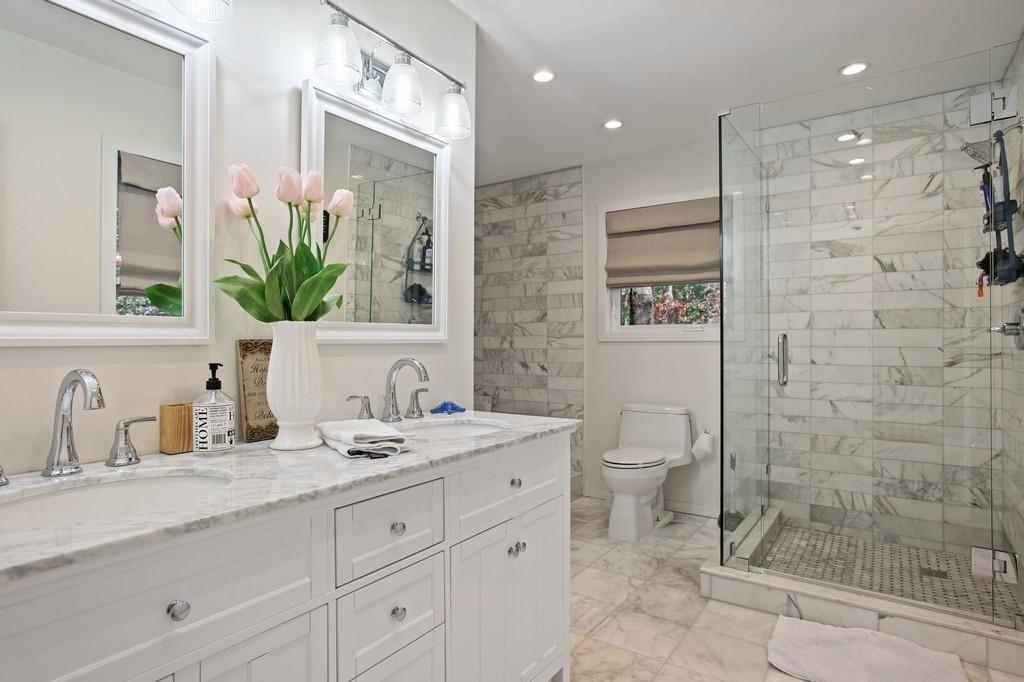 Marble Master — Walk-In Glass Shower
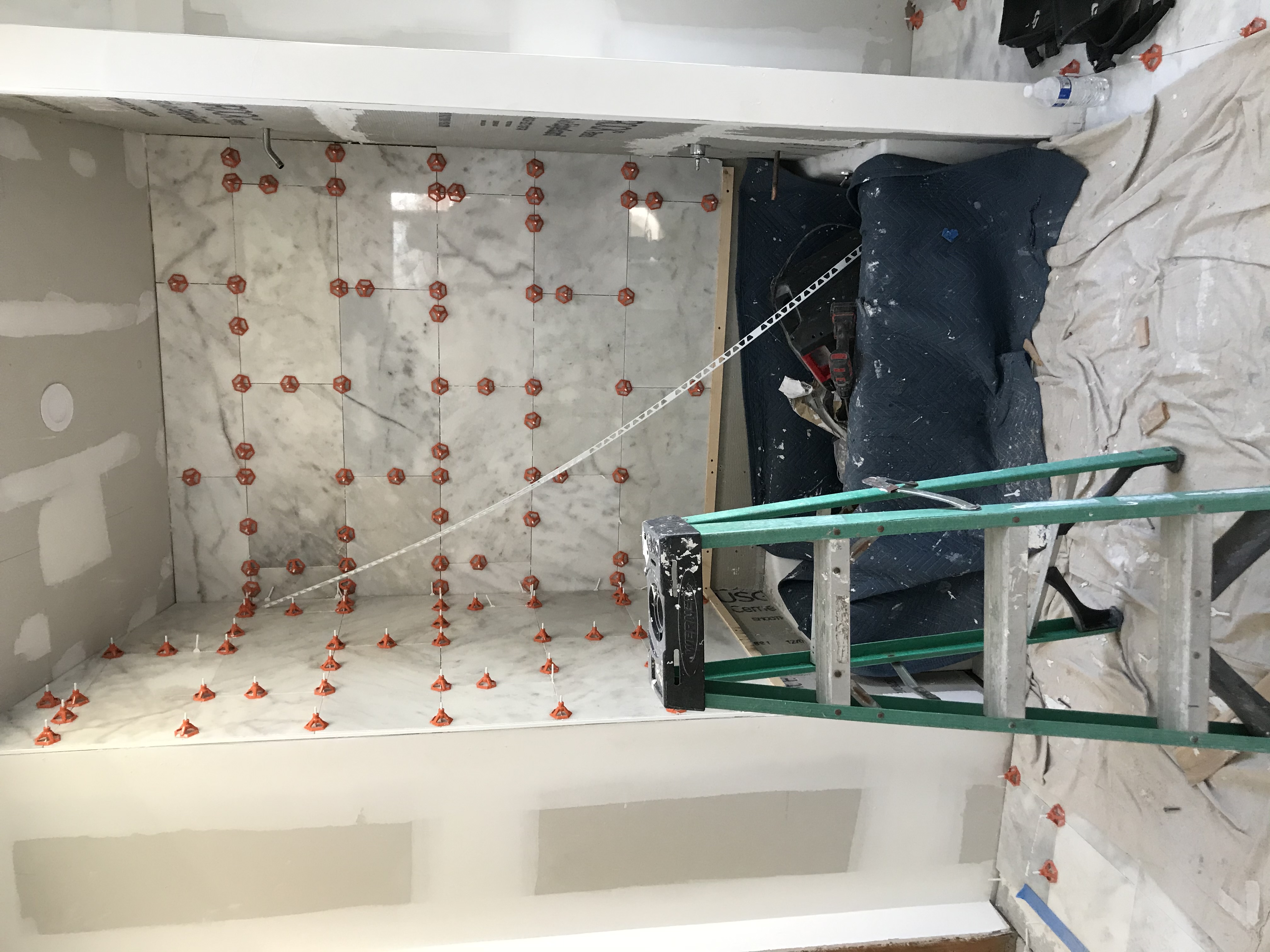 Shower Tile Going In
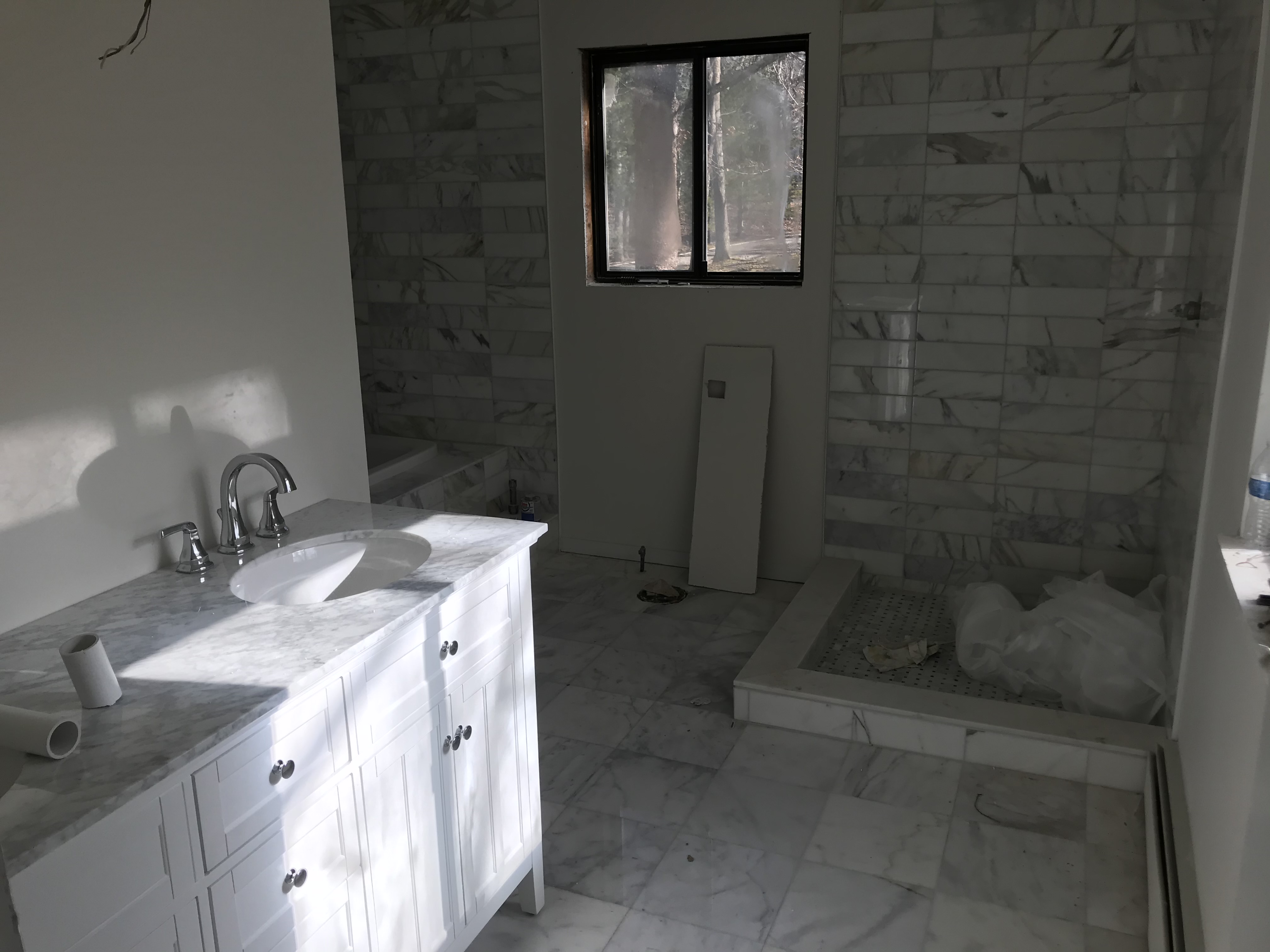 Vanity & Shower Base Set
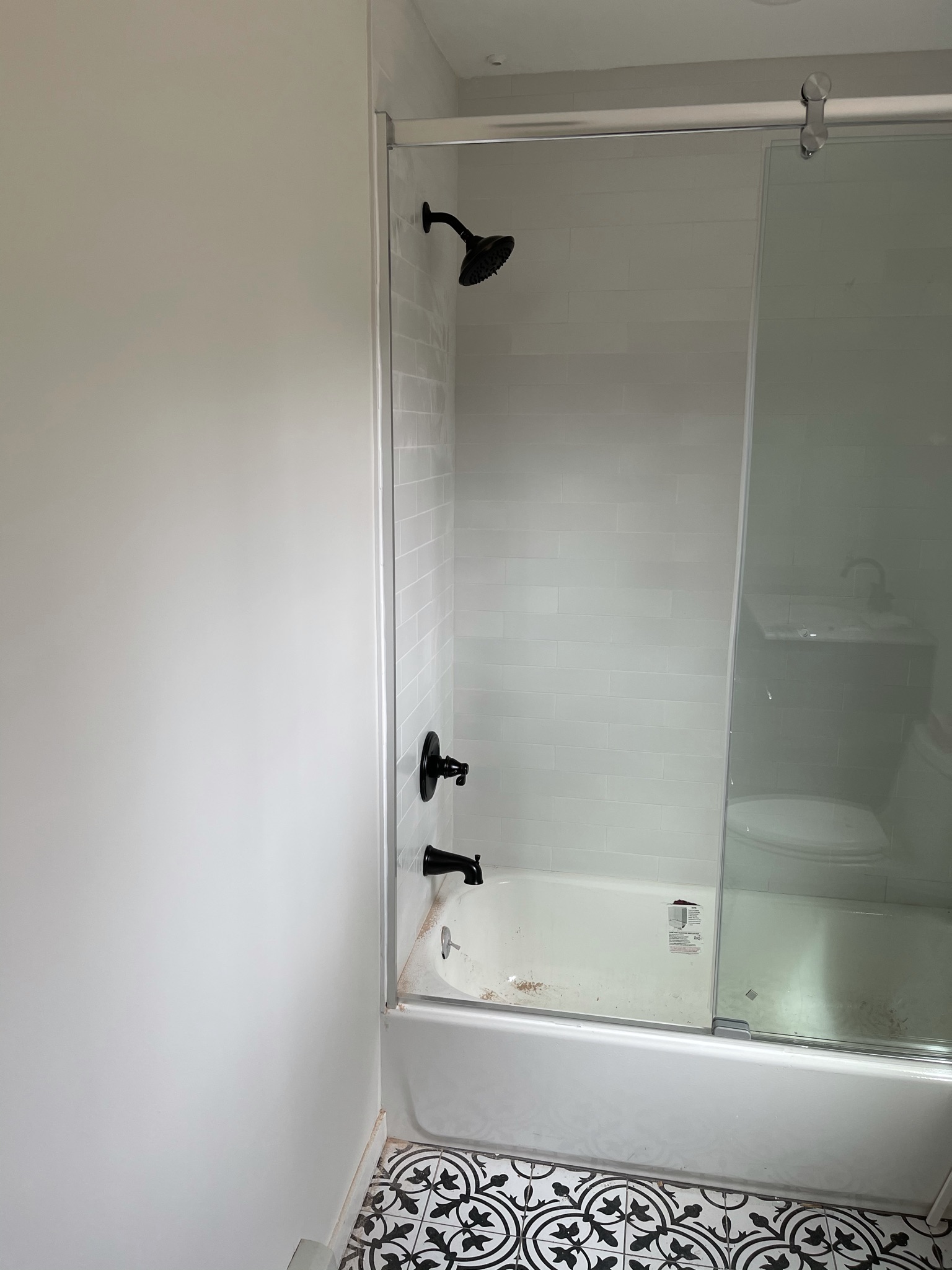
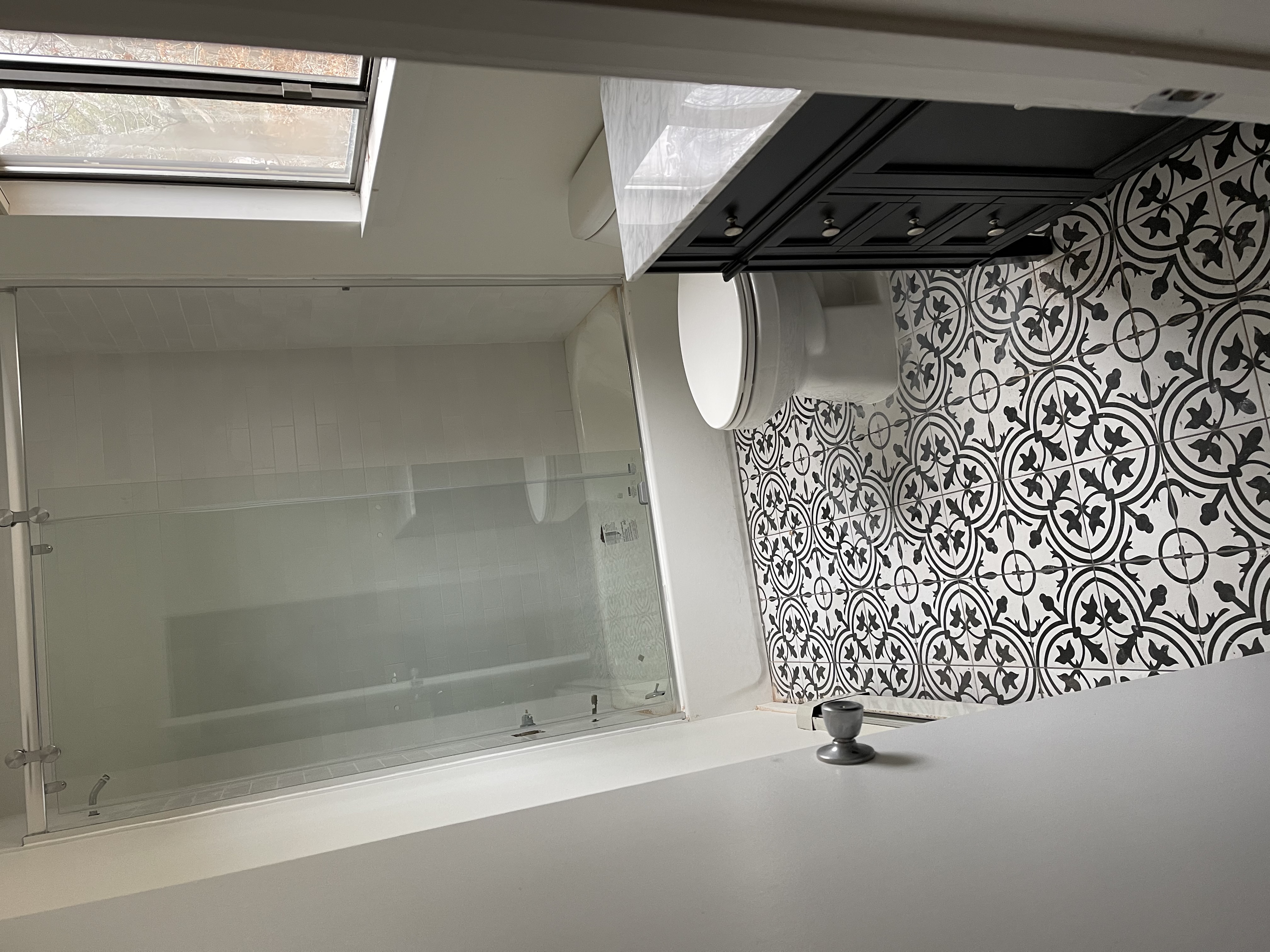 Frameless Glass & Subway Tile
 Hexagon Mosaic Floor