Remodeling Permits on Long Island
Quick Answer
Across all twelve Long Island building departments examined, work that touches plumbing or electrical requires a permit. Purely cosmetic work — paint, tile, carpet, cabinets — generally does not, but only Islip, Floral Park and Shelter Island publish that exemption in writing. New York's 19 NYCRR 1203.3(a)(1) requires the permit and only allows the exemption, which is why the answer varies by town.
Key Takeaways
- The state requires the permit; the exemption is optional. 19 NYCRR 1203.3(a)(1) obliges every authority having jurisdiction to require permits for regulated work, then lets localities exempt eight categories. Most localities never published their choice.
- Not one Long Island jurisdiction publishes a permit turnaround time. Verified across all twelve. A guaranteed number of days is an invented number.
- Most jurisdictions publish no fee schedule either. Smithtown, Islip, North Hempstead, Garden City, Rockville Centre, Great Neck, Kings Point and Glen Cove do. Babylon, Brookhaven, Hempstead, Long Beach, Williston Park, Floral Park, Mineola, East Hampton, Southampton, Riverhead, Southold and Shelter Island do not.
- Your address decides your rulebook, not your mailing address. Nassau has 3 towns, 2 cities and exactly 64 incorporated villages. Suffolk has 10 towns and 32 villages. Villages permit independently.
- Trade licensing is a layer cake. The county home improvement licence is the floor. Six towns require their own plumber's licence on top of it, three require their own electrician's licence, and many villages require their own again.
- Legalizing unpermitted work costs a multiple. Islip triples, Babylon doubles residential filings made after work starts, Smithtown triples plus $150 an item, Garden City and Mineola both triple.
Why Does the Permit Answer Change From Town to Town?
Because New York State wrote it that way, and the sentence that explains it is one almost nobody quotes. 19 NYCRR 1203.3(a)(1) requires every authority having jurisdiction to require building permits for work that must conform to the Codes. That word is must. The regulation then lists eight categories a locality may exempt, two of which decide the fate of most kitchen and bathroom projects: “painting, wallpapering, tiling, carpeting, or other similar finish work,” and “repairs, provided that the work does not have an impact on fire and life safety.”
Read those two provisions together and the whole structure of Long Island permitting falls out of them. The State mandates the permit for regulated work and merely allows the exemption for cosmetic work. Every town, village and city on Long Island decides for itself whether to take that option, and whether to write down what it decided. That is why the answer genuinely varies from one town line to the next. It is not that departments are being unhelpful or inconsistent. The exemption is discretionary by design, and most localities simply never published theirs.
Which turns “do I need a permit?” into a question with a real answer only once you know which department has jurisdiction over your address. That is what the rest of this page is for.
How Many Building Departments Are There on Long Island?
More than most homeowners expect, and the imbalance between the two counties is the single most useful structural fact here. Nassau County publishes that within its borders there are 2 cities, 3 towns, 64 incorporated villages and over 100 unincorporated areas. The three towns are Hempstead, North Hempstead and Oyster Bay; the two cities are Long Beach and Glen Cove. Suffolk County has 10 towns and 32 incorporated villages, per the Suffolk County Village Officials Association.
So Nassau has twice as many incorporated villages as Suffolk in less than half the land area. Every one of those villages runs its own building department, sets its own fees, and in several cases issues its own plumber's and electrician's licences. A village half a mile from another village can have a different application, a different fee model and a different answer on who is legally allowed to connect your dishwasher.
The practical consequence is the same in both counties: your address, not your mailing address, decides the rulebook. ZIP codes and post office names were drawn for mail delivery, not for municipal government, and they cut across village lines constantly. Nassau County's own permit guidance tells homeowners to call their city, town or village directly, and the Town of North Hempstead states that it administers the codes within the unincorporated areas of the Town. The quickest test available to you is your property tax bill. Villages levy their own taxes; if a village tax appears as its own separate line item, that is your building department.
| Structure |
Nassau County |
Suffolk County |
| Towns with their own building department | 3 — Hempstead, North Hempstead, Oyster Bay | 10 — Babylon, Brookhaven, East Hampton, Huntington, Islip, Riverhead, Shelter Island, Smithtown, Southampton, Southold |
| Cities | 2 — Long Beach and Glen Cove | None |
| Incorporated villages, each permitting independently | 64 (Nassau County) | 32 (Suffolk County Village Officials Association) |
| Unincorporated areas covered by the town | Over 100 (Nassau County) | The balance of each town outside its villages |
| Who you file with if you live in a village | The village | The village |
Long Island Permit Rules Compared: All Twelve Jurisdictions
This is the table the rest of the cluster is built on. Each row links to the full page for that jurisdiction. Where a cell says Not published, that is the finding rather than a gap in our research: the jurisdiction does not put the information in front of homeowners, and the honest response is to name the department and tell you to call it. The pattern of blanks across this table is itself the most useful thing on this page.
| Jurisdiction |
Publishes a cosmetic-work exemption? |
Publishes a fee schedule? |
Own trade licence required? |
Permit life |
Penalty for filing late |
| Town of Islip |
Yes — paint, wallpaper, tile, carpet, cabinets, dated 6/16/2025 |
Yes — effective May 1, 2024 |
Yes — Town master plumber |
1 year, up to 3 renewals (§ 68-24D) |
3× current fee under 4 years old; 1.5× at 4+ years, $100 minimum |
| Town of Babylon |
Not published |
Not published — set by Town Board resolution |
Yes — Town master or restricted master plumber |
180 days, extensions of 180 days each |
Residential fees doubled; commercial tripled |
| Town of Smithtown |
Not published — non-structural ordinary repairs exempt, no itemisation |
Yes — in its own code, § 112-11, amended 2-3-2026 |
No town plumber or electrician licence |
Six months with two 3-month extensions; a separate section of the same chapter says one year |
3× the regular permit fee plus $150 per item |
| Town of Huntington |
Not published |
Two official fee pages that disagree |
Yes — Town master or limited plumber; no town electrician licence |
Not published |
3× the amount established |
| Town of Brookhaven |
Not published — minor repairs to existing plumbing exempt under § 85-12(B) |
Not published online |
None found |
1 year; demolition permit 90 days |
Not published |
| Town of Southampton |
No cosmetic list — § 123-8 exempts work with no perimeter or structural change from the building permit |
Not published |
May require a Town licence — confirm |
Not published |
Not published |
| East Hampton, Town and Village |
Not published |
Not published apart from card and e-check surcharges |
May require a Town licence — confirm |
Not published |
Not published |
| Riverhead, Southold & Shelter Island |
Shelter Island yes — painting, wallpapering and similar finish work, plus nonstructural work under $10,000. Riverhead and Southold not published |
Not published for any of the three |
Shelter Island may require a Town licence — confirm |
Not published |
Not published |
| Town of Hempstead |
Not published — § 86-9A exempts ordinary repairs which are not structural in nature, without itemising them |
Not published |
Yes — Town master plumber and Town master electrician |
Work must commence within 90 days; deemed abandoned if not complete within one year |
Not published; unlicensed electrical work carries a fine up to $1,000 and/or 30 days, each day a separate offense |
| Town of North Hempstead |
Not published |
Yes — the best-published in Nassau |
Yes — Town plumber and Town electrician licences |
Not published |
Legalization applications charged at 2× the normal fee |
| Town of Oyster Bay |
Not published — the code exempts like-for-like fixture replacement |
Yes, but the schedule is dated effective June 1, 2019 |
Yes — Town master plumber and Town master electrician |
Plumbing permits 1 year, renewable (§ 180-28) |
Unlicensed plumbing $3,000–$5,000 first, $5,000–$7,500 second, $7,500–$10,000 subsequent |
| Nassau villages, Long Beach & Glen Cove |
Floral Park yes — painting, wallpapering, tiling, carpeting or other similar finish work. Most others not published |
Garden City, Rockville Centre, Great Neck, Kings Point and Glen Cove do. Mineola and Williston Park set fees by resolution and do not publish them |
Often the village's own; Kings Point defers plumbing and electrical to the Town of North Hempstead |
Garden City minor permits six months, extendable; Mineola six months and lapses if work does not start within 90 days |
Garden City 3× the application fee; Mineola 3× the standard fee |
Read down the columns rather than across the rows and the shape of the problem appears. Three of twelve publish a cosmetic-work exemption. Six publish a usable fee schedule. Five never publish a permit life. And in the column that homeowners ask about most — how long it takes — there is no column at all, because there is nothing to put in it.
What Nobody on Long Island Publishes: Turnaround Time
Not one Long Island jurisdiction publishes a permit turnaround time. We checked all twelve, from the Town of Islip to the City of Long Beach, and the closest anything comes to a commitment is the Town of Hempstead's § 86-12A, which says the inspector “shall approve or disapprove the application within a reasonable time” and attaches no number to the phrase. No town code, no village fee schedule, no departmental FAQ anywhere in this cluster states how many days or weeks a residential alteration permit takes.
That matters because the number is quoted constantly. A contractor who tells you a Long Island kitchen permit takes three weeks, or a bathroom permit six to ten weeks, is not reading it off a published source, because there is no published source. He is estimating from his own recent experience at best, and inventing it at worst. Neither is a commitment your project schedule should be built on, and neither is something the department is bound by.
What to do instead is straightforward. Call the department that covers your address before you set a start date. Ask specifically what the current queue looks like for a residential alteration of your type, ask whether plan review and the trade permits run in sequence or in parallel, and then schedule with float. Order long-lead items such as cabinetry and shower glass on their own timeline rather than off an assumed permit date. If a department is running long, you want to know that in the design phase, not the week the demolition crew is booked.
The same honesty applies to fees. Most Long Island jurisdictions do not publish a fee schedule at all. The ones that publish a current schedule are the Town of Smithtown, uniquely inside its own code at § 112-11 as amended February 3, 2026; the Town of Islip, effective May 1, 2024; the Town of North Hempstead; the Village of Garden City, amended August 6, 2025; the Village of Rockville Centre; the Village of Great Neck; the Village of Kings Point; and the City of Glen Cove. The Town of Oyster Bay publishes a schedule too, but it is dated effective June 1, 2019, which is seven years old as of July 2026 and should be confirmed rather than relied on. The Town of Huntington publishes two official fee pages that contradict each other, which is a genuinely useful thing to know before you budget.
Against those, the jurisdictions that publish no building permit fee schedule you can read: Babylon, whose code says only that the amount “shall be as may be determined from time to time by the Town Board”; Brookhaven, which publishes fee schedules for Planning, Highway, the Zoning Board of Appeals and Fire Prevention but not for the Building Division; Hempstead; Long Beach, whose own page says to call for current permit prices; Williston Park and Mineola, both of which set fees by Board of Trustees resolution held at the village clerk's office; Floral Park, which references a fee document without publishing the amounts; East Hampton; Southampton; Riverhead; Southold; and Shelter Island. That is not a research failure. That is the state of municipal publishing on Long Island in 2026, and pretending otherwise is how homeowners end up with a budget that is wrong before the first wall opens.
Do You Need a Permit to Remodel a Kitchen or Bathroom on Long Island?
Here is the part that does generalise. Across every jurisdiction examined, work that touches plumbing or electrical means a permit. That claim survives all twelve. Run a gas line to a range, move a sink so the drain and vent have to be re-run, add a second sink to an island, add a bathroom fixture, or take out a load-bearing wall to open a kitchen, and you are filing somewhere. The trigger language differs — Huntington requires a plumbing permit for installation, repair or modification with no published minor-repair exemption, while Brookhaven exempts “minor repairs to existing plumbing systems” without defining what minor means — but the direction is the same everywhere.
Purely cosmetic work generally does not require a permit. That is the honest general answer, and it comes with a caveat this cluster takes seriously: only the Town of Islip, the Village of Floral Park and the Town of Shelter Island say so in writing. Islip's permit sheet dated June 16, 2025 states that no permit is required for finish work such as paint, wallpaper, tile, carpet and cabinets. Floral Park's guide exempts “Painting, wallpapering, tiling, carpeting, or other similar finish work,” and requires a permit for “Interior Alterations — Not including cosmetic only upgrades.” Shelter Island exempts painting, wallpapering and similar finish work, equipment replacement matching original specifications, and minor repairs not involving structural changes or building system alterations, and adds a dollar threshold that is unusual on Long Island: no building permit is required for nonstructural work at a total cost not exceeding $10,000.
Everywhere else, the exemption is an inference. It is a reasonable reading of a code that exempts “ordinary repairs which are not structural in nature” — the phrase used by Hempstead, Smithtown and the Village of Southampton — that new cabinet doors and a tile backsplash fall inside it. But an inference is not a permission. The department that would enforce it has not written it down, which means the determination remains theirs, and a homeowner who assumes it has assumed a risk that costs a multiple of the permit fee to unwind. Where your scope sits on the line, the phone call is the answer.
| Scope |
The usual answer across the twelve |
Who actually publishes it |
| Cabinets, countertops, backsplash tile, flooring, paint, in the existing layout | Generally no permit | Islip, Floral Park and Shelter Island in writing. Everywhere else it is an inference |
| Gas line run to a range, cooktop or dryer | Permit required | Islip names gas piping explicitly; Huntington's plumbing permit covers natural gas and LP piping; North Hempstead's gas trigger covers a range swap |
| Sink, toilet or tub relocated so soil, waste or vent piping changes | Permit required | Consistent across every jurisdiction examined, including Oyster Bay, whose code otherwise exempts like-for-like replacement |
| Fixture replaced in place on existing lines | Varies, and this is the row that catches people | Islip turns on whether roughing is involved; Oyster Bay's code exempts it while the Town's portal lists it; North Hempstead requires a permit for replacement fixtures outright; Huntington publishes no exemption at all |
| New or extended electrical circuits, new lighting, new receptacles | Permit or a filed inspection, everywhere | Smithtown requires a Building Department permit for the electrical work itself; most others require a certificate from an approved inspection agency |
| Load-bearing wall removed to open a kitchen | Permit required | Islip names it; every jurisdiction's alteration language reaches it |
| Unfinished basement space converted to a new bathroom | Permit required | Islip names completing unfinished spaces; in Suffolk this scope can also reach the county Health Department |
Who Is Allowed to Do the Work? Trade Licensing Is a Layer Cake
The county home improvement contractor licence is the floor, not the ceiling. Suffolk County HIC and Nassau County HIC are where the requirement starts, and in a large part of Long Island it does not stop there. Six towns require their own plumber's licence on top of the county licence: Islip, Babylon, Huntington, Hempstead, North Hempstead and Oyster Bay. Three towns require their own electrician's licence: Hempstead, North Hempstead and Oyster Bay. And many Nassau villages require their own again, so that a plumber licensed in one village is simply not licensed in the next one over.
Now the counterintuitive part, and it is worth knowing before you interview contractors. Nassau County exempts plumbers and electricians from the county home improvement licence, on the basis that they are people required by state or local law to obtain a standard of competency — they are separately licensed already. So a Nassau plumber legitimately holding no county home improvement licence is normal, not a warning sign. He still needs a local licence nearly everywhere he works. The question to ask a plumber is not whether he holds the county HIC; it is whether he holds the licence issued by your town or village.
Both counties also regulate how licence numbers appear in advertising, which gives you a free verification tool. Suffolk County Code Chapter 563 requires the Suffolk home improvement licence number in all advertising. Nassau's equivalent is a Department of Consumer Affairs rule rather than a county code chapter: Nassau County DCA Rules and Regulations Rule 2(a) provides that “All display advertising and promotional literature shall contain the licensee's license number as printed on the license,” and Rule 11 requires a copy of the licence at every job site and in every vehicle. A contractor advertising in either county without a visible licence number is telling you something.
| Licensing layer |
Who requires it |
What it does not cover |
| County home improvement contractor licence | Suffolk County and Nassau County, for the general contractor | Does not substitute for any town or village trade licence |
| Town plumber's licence | Islip, Babylon, Huntington, Hempstead, North Hempstead, Oyster Bay | Is not transferable between towns; a licence from the next town over does not count |
| Town electrician's licence | Hempstead, North Hempstead, Oyster Bay | Huntington expressly defers to the Suffolk County Plumbing and Electrician Licensing Board instead |
| Village trade licence | Many Nassau villages, including Rockville Centre and Floral Park, which issue their own | Kings Point is the exception that proves the rule: it requires a Town of North Hempstead licence for plumbing and electrical |
| Electrical inspection agency | Nearly every jurisdiction requires a certificate from an approved third-party agency | Only the Town of Oyster Bay publishes a current named roster of approved issuers, revised 12/15/2025 |
Our own carpenters and project managers run your job start to finish. Electrical and plumbing are performed by licensed Nassau and Suffolk trade contractors we've worked with for years — we schedule them, we coordinate the inspections, and we're accountable for the result. Greene Group Construction holds Suffolk County HIC #HI-72958 and Nassau County HIC #EF-65498. We do not hold any town-level trade licence, and in jurisdictions such as Islip, where the town-licensed master plumber must both perform the work and schedule the inspections, that plumber files the plumbing permit and owns its inspection calendar.
How Long Does a Permit Last, and What Happens When It Lapses?
A permit is a clock, and the clocks run at different speeds. One year from issuance is the most common term. Islip sets it at § 68-24D with up to three renewals, Brookhaven states that a building permit is valid for one year and a demolition permit for 90 days, and Oyster Bay's plumbing permits run a year and are renewable under § 180-28. Babylon is the shortest of the towns at 180 days, extended in 180-day increments, and its code does not cap how many extensions may be taken. Villages tend to run shorter still: Garden City's minor permits expire at six months and are extendable to a year on demonstrated progress, and Mineola's expire at six months and lapse outright if work has not started within 90 days. Hempstead runs the clock from both ends, requiring work to commence within 90 days of issuance under § 86-13A and treating a project not completed within one year as abandoned under § 86-13C.
Smithtown is the honest exception, and we publish the problem rather than picking a side. Chapter 112 sets a six-month term with up to two three-month extensions and a renewal at half the original fee, while § 112-11E of the same chapter states that permits expire one year from issuance. Both sentences sit in the same chapter of the same code. Ask the Building Department which one governs your permit rather than assuming the longer figure applies to you.
The reason any of this matters at the end of a job is the certificate. Nearly every jurisdiction in this cluster requires a certificate of occupancy or a certificate of completion before altered space may be used, and that certificate is what proves to a buyer, a title company or a lender that the work was legal. An expired permit and an open file tend to surface years later, during a sale or a refinance, and by then the legalization multiple in the table above is what applies. Closing a permit out is considerably cheaper than reopening one.
Can a Kitchen or Bathroom Remodel Raise Your Property Taxes?
An improvement can raise an assessment, and New York's Home Improvement Exemption under RPTL § 421-f is the statewide offset. It exempts 100% of the increase in year one, declining 12.5 percentage points a year across years two through eight. The improvement must exceed $3,000, the greater portion of the building by square footage must be at least five years old, ordinary maintenance does not qualify, and — the part that matters on Long Island — the exemption is opt-in by locality.
Adoption is verified for Islip, Huntington, Brookhaven, Babylon, Hempstead, North Hempstead and Oyster Bay. Islip adopted it at Chapter 48F, Local Law No. 1 of 1994; Huntington at Local Law 1-1994, enacted January 25, 1994; Brookhaven at Local Law 1-1999, effective January 22, 1999, with a March 1 filing deadline on form RP-421f. Adoption by the Town of Smithtown could not be confirmed either way, so ask the Smithtown Assessor rather than assuming in either direction.
One statutory change is worth knowing about because stale pages still reflect the old rule. The $750,000 special-assessing-unit provision was repealed effective January 1, 2026, and the current statutory cap is $80,000, which is the figure adopted in Islip, Huntington and Brookhaven. Nassau County homeowners should call Nassau County Assessment at (516) 571-1500 for the figure that applies to them and for the current filing window. This is general information, not tax, legal or code advice.
Find Your Building Department
Twelve pages, each one built from the jurisdiction's own code and published documents, each one saying plainly where that jurisdiction publishes nothing. Start with the department that covers your address.
Suffolk County
- Town of Islip — publishes the clearest permit exemption on Long Island, in writing, with a fee schedule and a penalty structure beside it.
- Town of Babylon — the strictest plumbing licence rule in Suffolk, and fees double if you file after the work has started.
- Town of Smithtown — the only town with a current itemised fee schedule in its own code, and it permits electrical work separately.
- Town of Huntington — no minor-repair plumbing exemption at all, and its two official fee pages disagree with each other.
- Town of Brookhaven — the plumbing exemption lives in the zoning chapter, not the building chapter, and Mastic Beach is no longer a village.
- Town of Southampton — exempts work with no perimeter or structural change from the building permit, while the electrical and plumbing filings still stand on their own.
- East Hampton, Town and Village — the Town has no summer moratorium; the Village restricts summer Saturday work to noon until 4:00 p.m.
- Riverhead, Southold and Shelter Island — Riverhead bans Sunday and legal-holiday work year-round, and Shelter Island exempts nonstructural work under $10,000.
Nassau County
- Town of Hempstead — the widely-quoted four-month deadline is a zoning rule for Town Board approvals and does not govern an interior remodel.
- Town of North Hempstead — the strictest application package in Nassau, but it waives the survey for interior-only work.
- Town of Oyster Bay — the highest plumbing penalty on Long Island, and the only published roster of approved electrical inspection agencies.
- Nassau villages, Long Beach and Glen Cove — 64 villages each setting their own fees, and the entire City of Long Beach sits in a flood zone.
This page is general information about published municipal requirements in Nassau and Suffolk County, not legal, code or tax advice. Codes, fee schedules, forms and departmental guidance change, and several of the documents behind this cluster carry effective dates from 2019 through 2026. Confirm current requirements with the building department that has jurisdiction over your address before you rely on any of this.
What the Permit Costs Next to What the Work Costs
Permit fees are a small line inside a much larger number, and on most jobs the schedule risk matters more than the fee. Our published planning ranges run from about $12,000 for a surface bathroom refresh through to $250,000 and above for high-end custom kitchen work; the detail sits in our Long Island kitchen remodel cost guide and our bathroom remodel cost guide. For the full service picture on either room, start at kitchen remodeling or bathroom remodeling. For how the departments compare within each county, see kitchen remodeling in Suffolk County, bathroom remodeling in Suffolk County, kitchen remodeling in Nassau County and bathroom remodeling in Nassau County.
Permit questions turn urgent in one scenario in particular. When a kitchen or bathroom is being rebuilt after a failed supply line or a leaking shower pan, the damage rarely stops at the finishes, and the subfloor, joists and the ceiling below need assessing before anyone talks about tile — which means a scope that started as cosmetic has become structural, and the permit question changes with it. Greene Group Construction runs water damage restoration and insurance claims support as real service lines, so documentation, mitigation and the rebuild sit under one contract. Structural work runs through our general contracting division, and debris leaves with our own junk removal and cleanout crews. If you are adding a bathroom rather than renovating one, in Suffolk that scope can also reach the county Health Department — see adding a bathroom on Long Island.
Long Island Remodeling Permit FAQ
Do I need a permit to remodel a kitchen on Long Island?
It depends on the scope and on which of Long Island's building departments has jurisdiction over your address. Across all twelve jurisdictions in this cluster, work that touches plumbing, gas or electrical requires a permit. Running a gas line to a range, moving a sink, adding a second sink to an island, or taking down a wall between the kitchen and the dining room all require one. Purely cosmetic work such as cabinets, countertops, backsplash tile, flooring and paint generally does not, but only the Town of Islip, the Village of Floral Park and the Town of Shelter Island publish that exemption in writing. Everywhere else it is an inference from the code rather than published policy, so confirm your scope with your own department.
Do I need a permit to remodel a bathroom on Long Island?
A bathroom packs more plumbing into less floor area than any other room, so the permit answer turns almost entirely on the piping. Replacing a vanity in place on existing supply and waste lines is a different job from moving a toilet, adding a second sink, or converting a tub to a curbless shower, because all three mean new soil, waste or vent piping. In the Town of Oyster Bay the code exempts like-for-like fixture replacement while the Town's own portal lists replacement fixtures as a permit type, and in the Town of North Hempstead replacement fixtures need a permit outright. Retiling, repainting and changing a mirror are finish work. Confirm with the department that covers your address.
How much does a Long Island building permit cost for a remodel?
Most Long Island jurisdictions do not publish a fee schedule at all. The ones that publish a current schedule include the Town of Smithtown, in its own code as amended February 3, 2026; the Town of Islip, effective May 1, 2024; the Town of North Hempstead; the Village of Garden City, amended August 6, 2025; the Village of Rockville Centre; the Village of Great Neck; the Village of Kings Point; and the City of Glen Cove. The Town of Oyster Bay publishes a schedule dated effective June 1, 2019. The Town of Huntington publishes two official fee pages that disagree with each other. You cannot estimate a fee from a neighbouring jurisdiction, because the calculation models are incompatible: per square foot, per thousand dollars of construction cost over a base, per fixture, and flat.
How long does it take to get a remodeling permit on Long Island?
Not one Long Island jurisdiction publishes a permit turnaround time. That was verified across all twelve jurisdictions in this cluster, from the Town of Islip to the City of Long Beach. A contractor who quotes you a guaranteed number of days is inventing it. What you can do instead is call the department directly, ask what the current queue looks like for your type of application, and schedule the job with float built in. The Town of Hempstead's code says the inspector shall approve or disapprove an application within a reasonable time and attaches no day count to the phrase.
Which Long Island towns require their own plumber's licence?
The Suffolk County and Nassau County home improvement contractor licences are the floor, not the ceiling. Six towns require their own plumber's licence on top of the county licence: Islip, Babylon, Huntington, Hempstead, North Hempstead and Oyster Bay. Three of those towns also require their own electrician's licence: Hempstead, North Hempstead and Oyster Bay. Many Nassau villages require their own again, and a plumber licensed in one village is not licensed in the next. Nassau County exempts plumbers and electricians from the county home improvement licence because they are separately licensed, so a plumber legitimately holding no county licence is normal rather than a red flag.
I live in a village. Do I file with the village or the town?
With the village. Incorporated villages run their own building departments, with their own applications, their own fee schedules and sometimes their own trade licences. Nassau County contains 2 cities, 3 towns, 64 incorporated villages and over 100 unincorporated areas, per Nassau County's own published figure, and Suffolk County contains 10 towns and 32 incorporated villages per the Suffolk County Village Officials Association. Your address decides your rulebook, not your mailing address. Great Neck, for example, is a mailing address shared by several separate incorporated villages as well as unincorporated town area. The practical test is your property tax bill: if a village tax appears as its own line, you are in that village.
What happens if I remodel without a permit on Long Island?
Legalizing unpermitted work costs a multiple of what the permit would have cost. The Town of Islip charges three times the current permit fee where the work is under four years old and one and a half times at four years or older, with a $100 minimum. The Town of Babylon doubles residential permit fees where the application is filed after the work has commenced, and triples them for commercial. The Town of Smithtown charges three times the regular fee plus $150 per item for built-prior work. The Village of Garden City and the Village of Mineola both charge three times. The Town of Oyster Bay's penalty for unlicensed plumbing work runs from $3,000 to $5,000 for a first offense, $5,000 to $7,500 for a second and $7,500 to $10,000 for subsequent offenses.
Will a kitchen or bathroom remodel raise my property taxes?
An improvement can raise an assessment, and New York's Home Improvement Exemption under RPTL section 421-f is designed to soften that: 100% of the increase is exempt in year one, declining 12.5 percentage points a year across years two through eight. The improvement must exceed $3,000, the greater portion of the building by square footage must be at least five years old, ordinary maintenance does not qualify, and the exemption is opt-in by locality. Adoption is verified for Islip, Huntington, Brookhaven, Babylon, Hempstead, North Hempstead and Oyster Bay. Adoption by Smithtown could not be confirmed either way. Nassau homeowners should call Nassau County Assessment at (516) 571-1500 for the current figure. This is general information, not tax advice.
 Kitchen — Quartz Waterfall Island
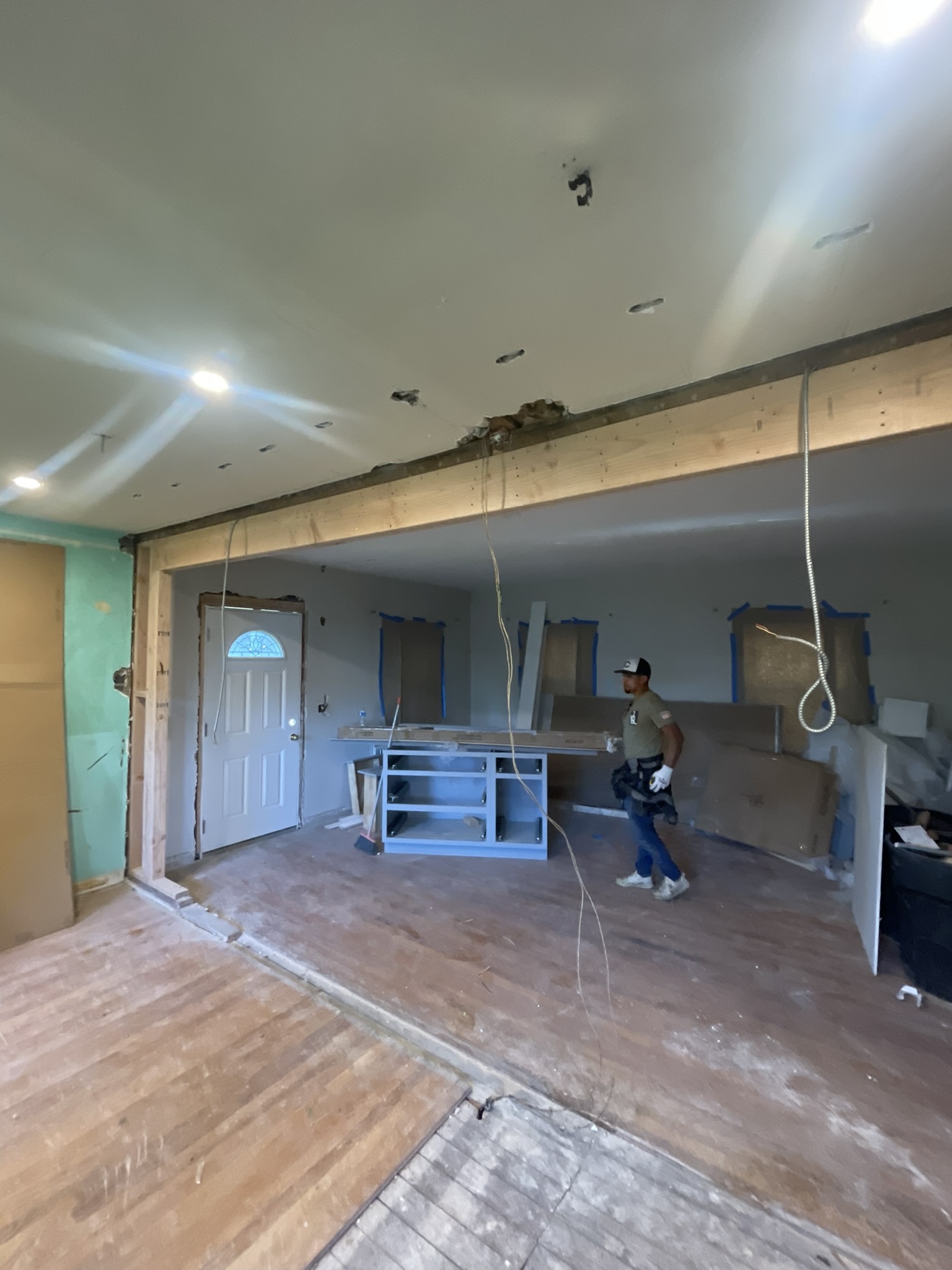 Kitchen In Progress
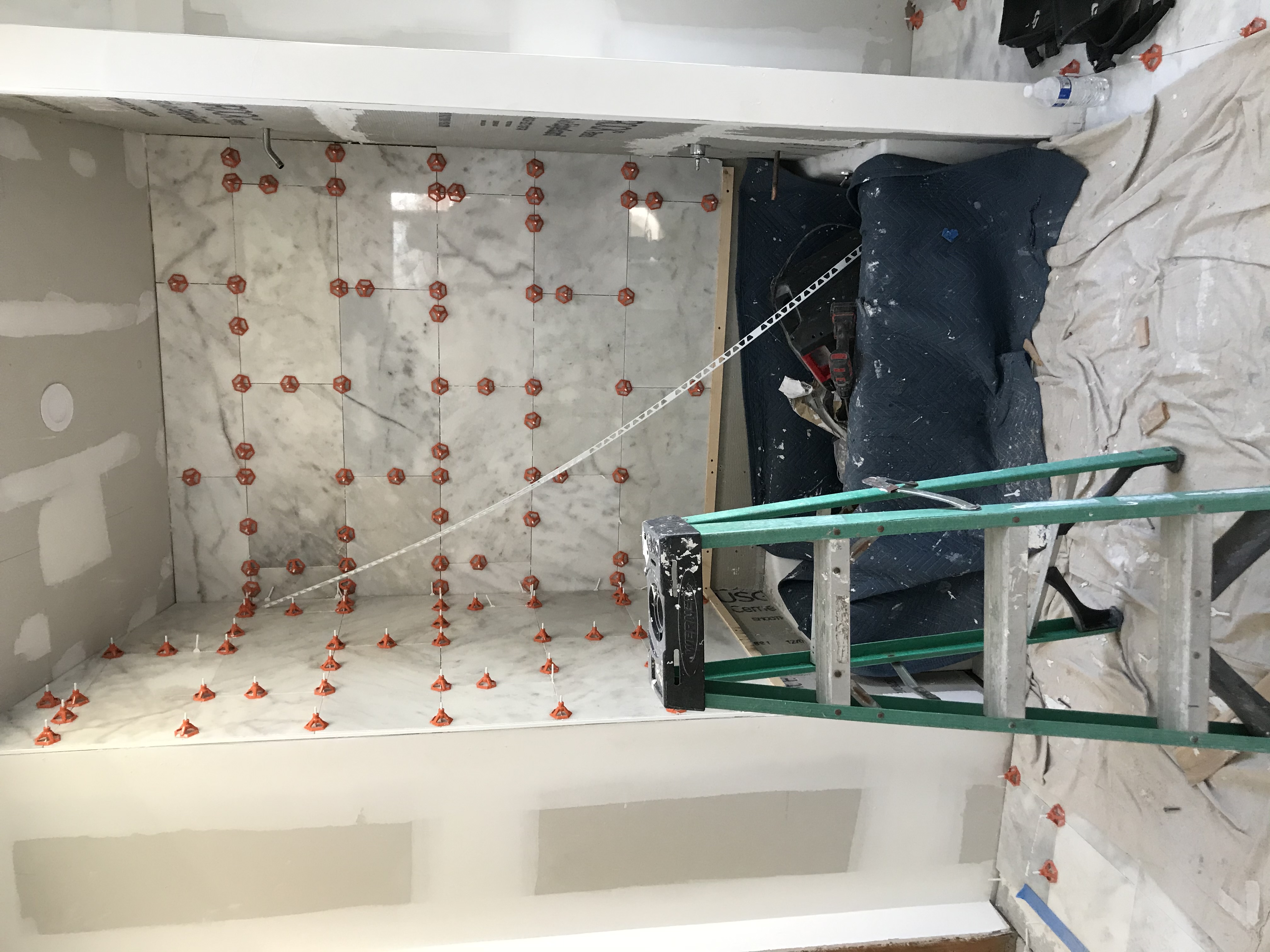 Shower Tile Going In
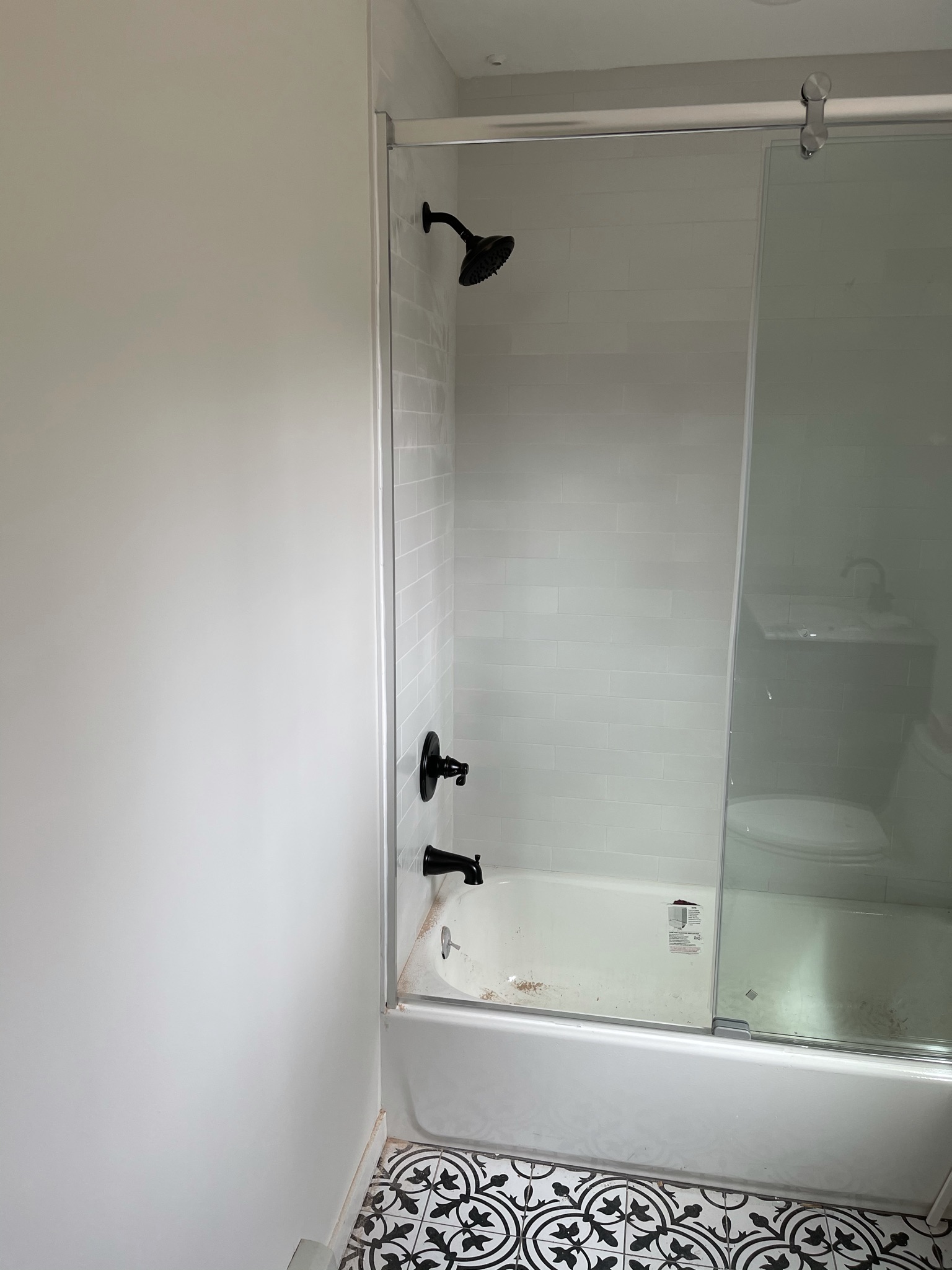 Finished Bath — Marble Top