Kitchen Remodeling Across Long Island
Quick Answer
Kitchen remodeling on Long Island is the licensed renovation of a kitchen's layout, structure, mechanicals and finishes, and it is performed by home improvement contractors licensed in Nassau and Suffolk County. A full remodel covers demolition and debris removal, framing and any structural beam work, electrical and plumbing rough-in, cabinetry, countertops, flooring, tile, lighting, appliances and finish carpentry, plus town or village permits and inspections. Greene Group Construction's observed Long Island pricing runs about $20,000–$40,000 for a cosmetic refresh, $45,000–$85,000 for a midrange full remodel, $85,000–$150,000 for a major gut and $150,000–$250,000-plus for upscale and custom work. Typical on-site duration is four to twenty-four weeks.
Key Takeaways
- One company, whole job. We run our own demolition crew and debris hauling division, do the structural work, and rebuild the kitchen. Most kitchen companies subcontract demo, rent a dumpster and hire an engineer separately.
- Most kitchen companies start when the old kitchen is already gone. We start before it — and we're still here when the wall comes out.
- Budget by tier, not by average. $20K–$40K refresh, $45K–$85K midrange, $85K–$150K gut, $150K–$250K upscale, $250K+ custom. These are our own observed Long Island numbers, not a published county dataset.
- The cheap kitchen is the one that pays for itself. Zonda's 2025 Cost vs. Value Report for the New York metro area puts a minor midrange kitchen at 103.1% recouped and a major upscale kitchen at 33.8%.
- 2026 changed the math. Imported cabinet tariffs step from 25% to 50% on January 1, 2027, and the federal 25C and 25D energy credits are dead for anything placed in service or paid for after December 31, 2025.
- Fire and water losses rebuild kitchens too. We own the restoration and insurance-claim side of this work, so a covered loss and the finished kitchen stay with one contractor.
What Does a Kitchen Remodel on Long Island Actually Include?
A kitchen remodel is not one trade. It is six to nine trades sequenced correctly inside a room your family still lives around. A full-service kitchen remodel on Long Island begins by measuring the room and confirming what the house allows: where the bearing walls run, where the plumbing stack sits, what the panel can carry, and whether the floor framing can take stone counters and a heavy island. Design follows that, not the reverse. A layout drawn without knowing where the stack is becomes a change order the week demolition starts.
From there the work runs in a fixed sequence. Demolition and debris removal. Structural framing and beam installation if walls are coming out. Rough electrical and plumbing, inspected before anything closes. Insulation, drywall and paint. Cabinets, then countertop templating and fabrication, then flooring, backsplash, fixtures, appliances and trim. Final inspection closes the permit. Every one of those handoffs is where a job stalls when different companies own different pieces.
What separates a refresh from a gut is whether the layout moves. Keeping the sink, range and refrigerator in place while replacing cabinets, counters and flooring keeps mechanical work minimal and the schedule short. Moving the sink to an island, relocating gas, or opening a wall between the kitchen and the dining room converts the project into structural and mechanical work with permits, inspections and engineering attached. Both are legitimate projects, but they are not the same budget.
Why Hire a General Contractor Instead of a Kitchen Showroom?
This is the core of it. Greene Group Construction is a construction, restoration and cleanout company that also builds kitchens. That is not a caveat, it is the advantage. We run an in-house demolition crew and our own junk removal and debris hauling division, so the old kitchen leaves your driveway in our trucks instead of sitting in a rented dumpster waiting on a pickup window. We have a construction team that frames, sets beams and handles load paths. A cabinet showroom cannot follow us there.
Most kitchen companies start when the old kitchen is already gone. We start before it — and we're still here when the wall comes out. That sentence is the whole difference. The typical Long Island kitchen company's scope begins at a clean, empty, structurally finished room and ends when the cabinet doors are adjusted. Everything before it, and everything structural, belongs to someone else — so the homeowner ends up general contracting by default, chasing the demo sub, the dumpster company and the engineer, and absorbing every gap between them.
Here is exactly how the trades work on our jobs, because licensing precision matters in Nassau and Suffolk. Our own carpenters and project managers run your job start to finish. Electrical and plumbing are performed by licensed Nassau and Suffolk trade contractors we've worked with for years — we schedule them, we coordinate the inspections, and we're accountable for the result. You are not managing a roster of vendors. You call one number, and one company answers for the whole job. Read more about how we run larger projects on our Long Island general contracting page.
| What the job actually needs | Greene Group (licensed GC) | Cabinet showroom | Kitchen-only install crew |
| Demolition | In-house crew, scheduled by us | Subcontracted or excluded | Often excluded from scope |
| Debris removal & hauling | Our own trucks and junk removal division | Homeowner rents a dumpster | Homeowner rents a dumpster |
| Load-bearing wall removal | Framing crew, engineered LVL or steel beam | Not offered | Not offered |
| Engineer's stamp & permit filing | Coordinated by us with the town or village | Homeowner hires separately | Homeowner hires separately |
| Electrical & plumbing | Licensed Nassau/Suffolk trade contractors we schedule | Homeowner hires separately | Homeowner hires separately |
| Fire or water damage rebuild | Restoration and insurance-claim divisions in house | Not offered | Not offered |
| Single point of accountability | One contract, one project manager | Cabinets only | Installation only |
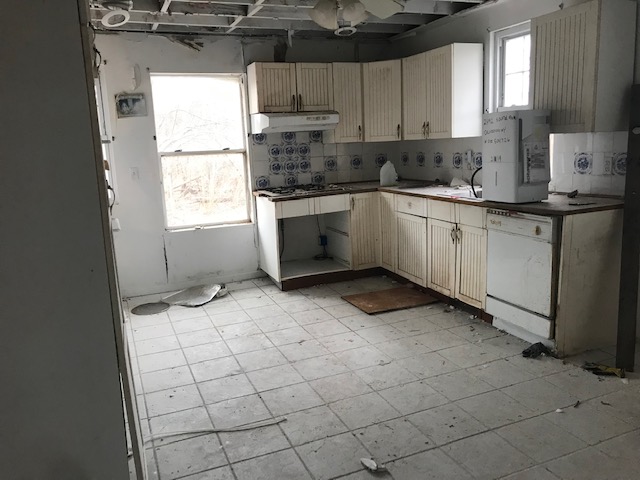 Before
Closed-off Long Island kitchen before renovation.
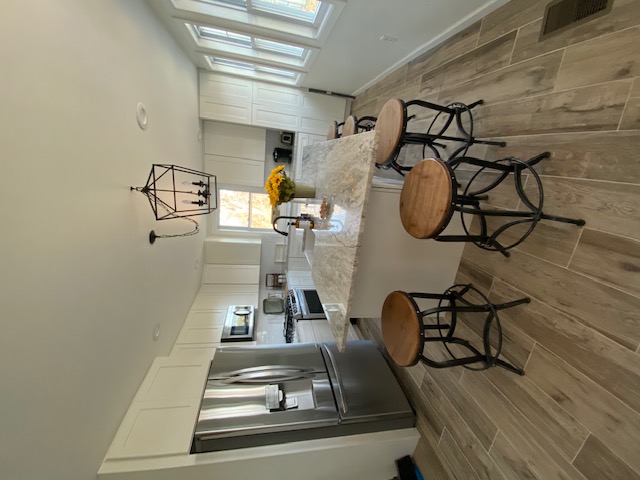 After
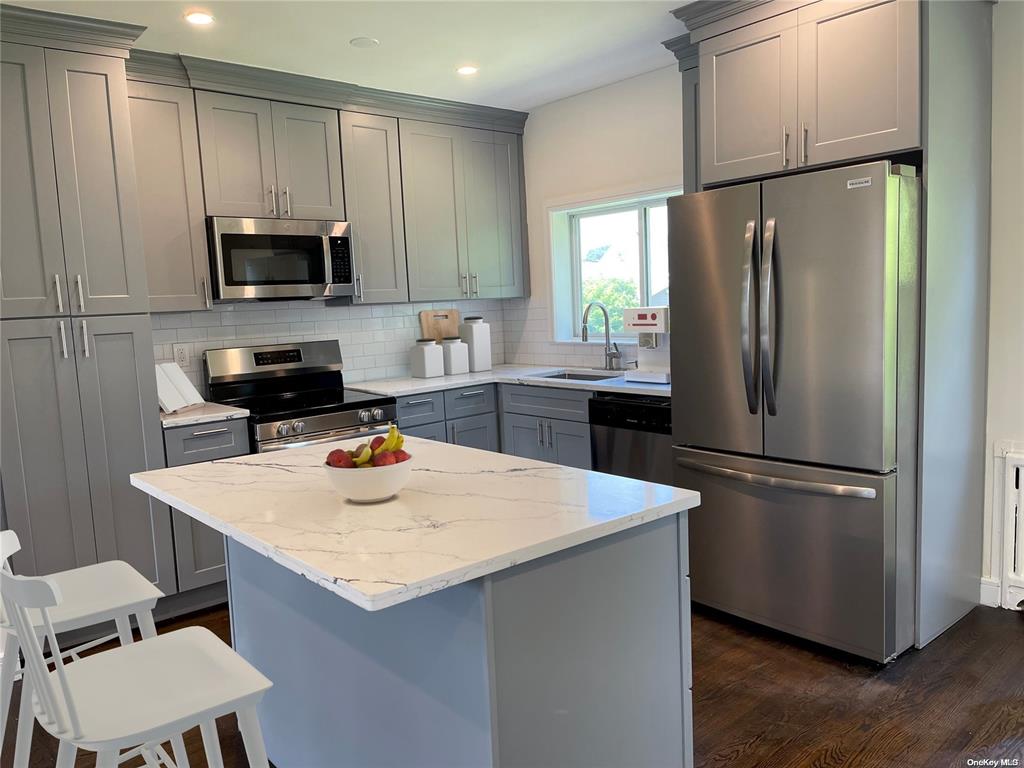
AfterThe same kitchen after a full remodel by our crews.
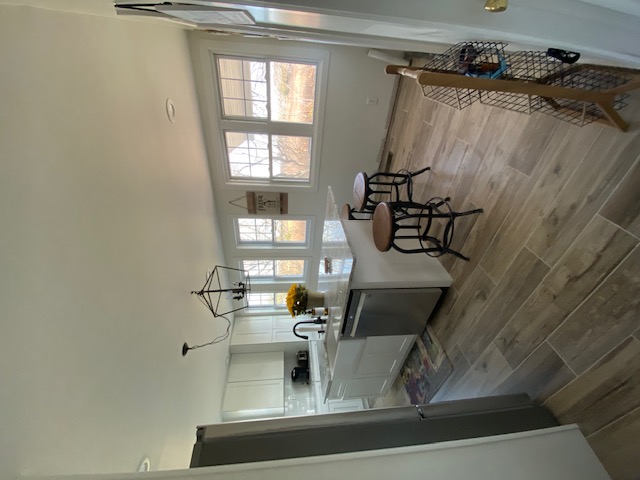 After
AfterFinished cabinetry, counters and appliances.
What Does a Kitchen Remodel Cost on Long Island?
Be careful with the averages you find online. There is no public dataset that splits kitchen remodeling cost by Nassau County versus Suffolk County, and we will say that plainly rather than invent a number to fill the gap. What follows are Greene Group Construction's own observed Long Island price bands, based on the kitchens we actually build in Nassau and Suffolk. They are ranges, not quotes, and the drivers are consistent: cabinet construction, how far the mechanicals move, whether structure changes, and countertop material.
| Kitchen remodel tier | Greene Group observed Long Island range | What it typically covers |
|---|
| Cosmetic / refresh | $20,000–$40,000 | Same layout. New cabinets or refacing, countertops, backsplash, sink and faucet, paint, lighting swap, flooring. |
| Midrange full remodel | $45,000–$85,000 | Full gut of the existing footprint, semi-custom cabinetry, quartz counters, new flooring, updated electrical and plumbing, new appliances. |
| Major / gut remodel | $85,000–$150,000 | Layout changes, wall removal with an engineered beam, relocated plumbing and gas, panel work, permits and inspections, island with utilities. |
| Upscale | $150,000–$250,000 | Custom or premium cabinetry, stone slab work, professional-grade appliance packages, integrated lighting, higher-end finish carpentry and millwork. |
| High-end custom | $250,000+ | Bespoke millwork, architectural changes, structural openings, specialty stone, full house integration on East End and waterfront properties. |
Ranges reflect Greene Group Construction's own completed Long Island projects as of July 2026 and are not a published industry dataset. No public source breaks kitchen remodeling cost out by Nassau versus Suffolk County. Final pricing depends on cabinet construction, mechanical relocation, structural scope, countertop material and the condition of what we find behind the existing walls. For a full tier-by-tier breakdown with line items, see our kitchen remodel cost guide for Long Island.
The resale question deserves an honest answer, and the honest answer is counterintuitive. Zonda's 2025 Cost vs. Value Report — the 38th annual edition, released in September 2025, with the 2026 edition expected around September 2026 — reports for the New York metro area that a minor midrange kitchen remodel costs $31,419 and recoups 103.1 percent at resale. A major midrange kitchen costs $90,252 and recoups 46.9 percent. A major upscale kitchen costs $183,172 and recoups 33.8 percent. Note the label carefully: that is New York metro, not Long Island specifically, and we are not going to pretend otherwise.
Read that table the right way. The cheap kitchen is the one that pays for itself. If you are selling in eighteen months, the minor midrange remodel is the rational project and the gut is not. If you are staying ten years, the recoup percentage is close to irrelevant. Most bad kitchen budgets on Long Island come from homeowners who spend like they are staying and justify it like they are selling.
Where Does the Money Actually Go?
Four independent sources converge on roughly the same distribution, and it holds up against our own Long Island job costing. Cabinets are the largest line at about 35 percent, which is why cabinet construction — plywood versus particleboard box, dovetail versus stapled drawer — drives your number more than any other decision. Labor runs about 20 percent, appliances about 14 percent, countertops about 10 percent, mechanical, electrical and plumbing about 9 percent, flooring about 5 percent, design and permits about 4 percent, and finishes about 3 percent.
| Budget line | Share of total | On a $65,000 midrange Long Island kitchen |
| Cabinetry | ~35% | ~$22,750 |
| Labor | ~20% | ~$13,000 |
| Appliances | ~14% | ~$9,100 |
| Countertops | ~10% | ~$6,500 |
| Mechanical, electrical & plumbing | ~9% | ~$5,850 |
| Flooring | ~5% | ~$3,250 |
| Design & permits | ~4% | ~$2,600 |
| Fixtures & finishes | ~3% | ~$1,950 |
Now the contingency, stated accurately. The National Association of Home Builders publishes contingency guidance of 10 percent, rising to 20 percent if you act as your own general contractor — but that guidance addresses new construction, not renovation of existing homes. We will not dress it up as something it is not. On Long Island's older housing stock, trade convention and our own experience both point to a larger cushion than the new-construction figure, and Greene Group's own recommendation on a house built before 1980 is to hold 15 to 20 percent back.
That is not padding. It is the knob-and-tube behind the plaster, the cast iron waste line that crumbles when it is disturbed, the rotted subfloor under a forty-year-old dishwasher leak, the header that was never installed over the original doorway. A gut kitchen in a 1955 Cape opens the house's whole history at once, and the homeowners who finish on budget are the ones who planned for it before demolition rather than discovering it on day four.
A note on allowances. Ask how appliances, tile and plumbing fixtures are handled in the contract. Allowance pricing is legitimate only when the allowance number is realistic — a low appliance allowance is how a $65,000 contract becomes an $80,000 invoice with no change to the scope.
Can You Remove a Wall to Open Up the Kitchen?
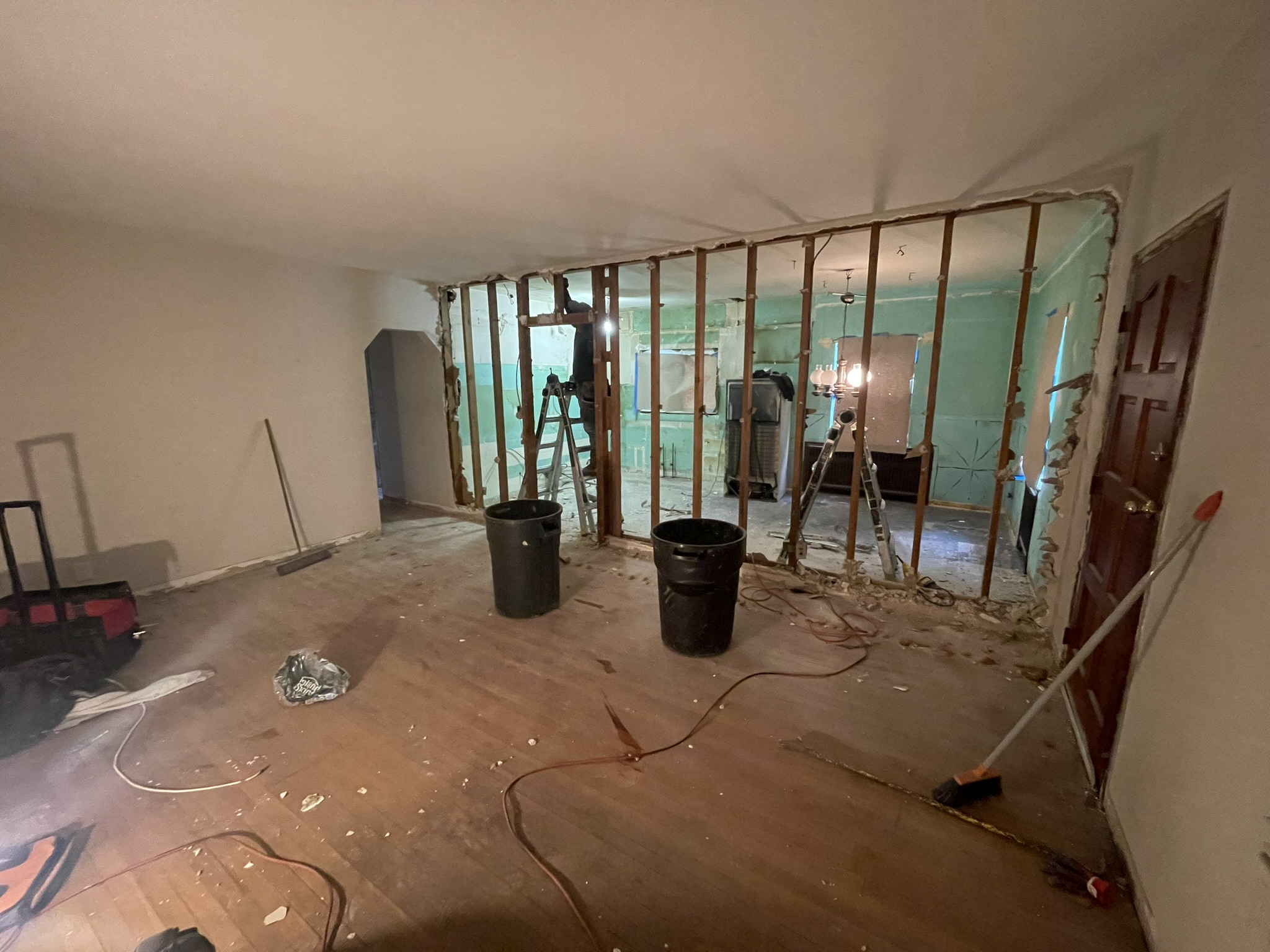
Usually, yes. This is where a licensed general contractor separates from a kitchen company, because the answer is structural, not decorative. First we determine whether the wall is load bearing: which way the joists run above it, whether a bearing point sits over it, whether it carries a second-floor load. Then we determine what runs inside it — supply lines, waste, gas, ducts, the panel feed — because relocating a waste stack often costs more than the beam itself.
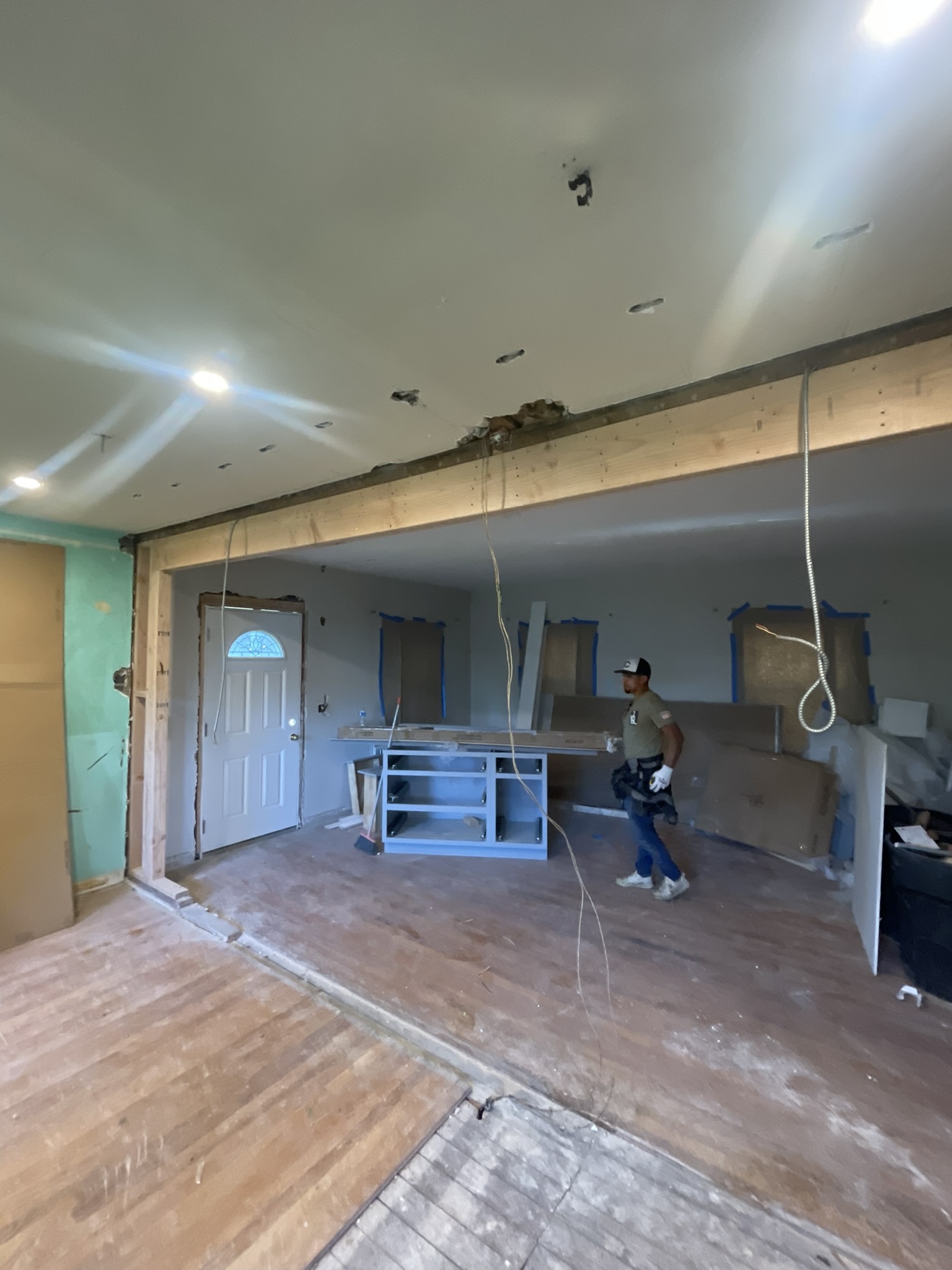
When a bearing wall comes out, the load has to go somewhere. On most Long Island kitchen openings that means an engineered LVL beam, sized and stamped by a licensed engineer, carried on properly sized posts with a continuous load path down through the framing to the foundation or a new footing. Where the span is long or the available depth is shallow, a steel beam does the same work in less height. The engineer's stamp is not optional paperwork; it is what the building department reviews and the inspector signs off on.
The detail nobody warns you about is head height. In an eight-foot-ceiling ranch — and Long Island has tens of thousands of them — a dropped beam hanging below the ceiling line eats four to twelve inches across the opening. A flush beam, framed up into the joist bays with hangers, keeps the ceiling flat. It costs more and takes more labor, and in an eight-foot room it is almost always worth it. We tell you which one your house needs before you sign anything.
What If Fire or Water Destroyed Your Kitchen?
Kitchens are where most residential fires start and where a surprising share of water losses end up. A grease fire, a failed dishwasher supply line, a burst pipe during a January freeze, an ice dam draining above the cabinets — on Long Island these happen constantly, and the homeowner is suddenly running two projects: an insurance claim and a kitchen rebuild. Almost every LI kitchen remodeler handles the second half and leaves the first half to you.
We own both. Greene Group runs a full restoration division, including fire and smoke damage restoration and water damage restoration, alongside our insurance claims support work. That means emergency response, containment and drying, controlled demolition, debris removal in our own trucks, documented scope and photographs for the carrier, and then the same company builds the finished kitchen back. One contract covers the loss and the rebuild instead of a restoration company handing you a gutted room and wishing you luck.
Set expectations correctly on coverage. Insurance pays to restore what was lost, not to upgrade it. If your 1994 oak cabinets burned, the carrier owes you comparable cabinets, not the custom inset package you have been saving photos of. Most insurance kitchens become a covered rebuild plus a homeowner-funded improvement allowance, and the smart move is to decide that upgrade scope before the rebuild starts, while the walls are open and the incremental cost is lowest.
Do You Need a Permit to Remodel a Kitchen on Long Island?
Usually yes, and the honest complication is that there is no single answer. Long Island has no unified building department. Nassau contains three towns and two cities plus dozens of incorporated villages; Suffolk contains ten towns plus its own villages. Between them, well over eleven independent building departments can have jurisdiction over a kitchen, each with its own forms, fee schedule, review standards and inspection queue. The Town of Hempstead Building Department does not operate like the Town of Huntington, and a village inside either may run its own process entirely.
As a general rule: a like-for-like cosmetic replacement in the same layout often does not require a permit, while moving walls, relocating plumbing or gas, adding or altering circuits, changing the structure, or altering an exterior opening does. Electrical work almost always requires an electrical inspection through an approved third-party agency regardless of the permit path. Anything structural requires stamped drawings.
Here is the part most contractor websites will not say: fees and turnaround times across Long Island jurisdictions are largely unpublished. Many towns and villages do not post a current kitchen-scope fee schedule online, and almost none publish an honest average review time. Any page telling you "the permit costs $250 and takes two weeks on Long Island" is guessing. We call the specific building department for your address, confirm the requirement and the current queue, and build that timeline into your schedule before demolition is booked. Our Long Island remodeling permits hub records what each department actually publishes on triggers, fees and trade licensing, and says plainly where nothing is published at all. Town-specific detail lives on our Nassau County kitchen remodeling and Suffolk County kitchen remodeling pages. How far apart those processes really are shows up fastest when you compare a village like Garden City against a town department like Huntington or an East End jurisdiction like East Hampton.
What Changed in 2026 That Affects Your Kitchen Budget?
Cabinet tariffs have a real deadline. As of July 2026, the Section 232 tariff on imported kitchen cabinets and vanities is 25 percent. The scheduled increase to 50 percent was deferred to January 1, 2027 by Proclamation 11000, published at 91 FR 1039 on January 9, 2026. If your cabinet package is imported — and a large share of stock and semi-custom lines are — ordering after that date is the difference between 25 percent and double it. That is the only genuine urgency in kitchen remodeling right now, and unlike most "act now" pitches it has a Federal Register citation behind it.
The federal energy tax credits are gone. Under Public Law 119-21, IRC Section 25C provides no credit for property placed in service after December 31, 2025, and IRC Section 25D provides no credit for expenditures made after December 31, 2025. The distinction matters: prepaying a 25D project in 2025 does not preserve the credit if the expenditure falls after the cutoff. Competitor pages across Long Island are still advertising a 30 percent credit and a $3,200 annual cap for 2026 work. Those pages are simply wrong, and budgeting around them will leave a hole.
The electrical code changed on December 31, 2025. New York adopted the 2025 Uniform Code, which incorporates the 2023 National Electrical Code, effective that date. The practical kitchen consequence is the island receptacle rule. Under 2023 NEC 210.52(C)(2), an island receptacle is now conditional rather than mandatory: the code reads that if a receptacle outlet is installed to serve an island countertop, it shall be installed in accordance with 210.52(C)(3). The 2020 square-footage mandate was deleted. To be precise about what the code does not say: there is no requirement in the text to rough in for a future installation. We design island power around how you will actually use the island, and around what your inspector will approve.
Also on the horizon. Quartz trade actions, the 421-f home improvement property tax exemption, and state and utility rebates each get their own dedicated page rather than half-numbers here.
How Long Does a Kitchen Remodel Take — and How Long Are You Without a Kitchen?
These are two different questions and homeowners conflate them constantly. Total duration includes design, selections and lead time. On-site duration is the weeks our crews are in your house. Days without a working sink and stove is shorter than both, and it is the number you actually feel.
| Project type | Design & ordering (before demo) | On-site construction | Without a working sink & stove |
| Cosmetic refresh, same layout | 2–5 weeks | 4–6 weeks | ~2–3 weeks |
| Midrange full remodel | 4–8 weeks | 8–10 weeks | ~3–5 weeks |
| Major gut with layout change | 6–10 weeks | 10–14 weeks | ~5–8 weeks |
| Structural opening + island relocation | 8–12 weeks (engineering + permit) | 14–18 weeks | ~6–9 weeks |
Cabinet lead time is the dominant variable and always has been. Stock cabinetry arrives in two to three weeks, semi-custom in six to ten, true custom millwork in twelve to twenty. A schedule that looks aggressive on paper usually assumed cabinets would arrive on time. We order cabinets before demolition, not after — the plainest difference between a general contractor running a construction schedule and a kitchen company reacting to one.
We also stage a temporary kitchen on most gut jobs — refrigerator relocated, microwave and utility sink set up somewhere workable — and we sequence the sink and range back into service as early as the inspection order allows. Every extra week without a working kitchen is a real cost to a family.
How Do You Choose a Kitchen Contractor on Long Island?
Start with licensing, because on Long Island it is legally specific. Suffolk County requires home improvement contractors to hold a Home Improvement Contractor license and, under Suffolk County Code Chapter 563, to display that license number in advertising. Ours is HI-72958, and it appears in the trust bar at the top of this page for exactly that reason. Nassau County administers its own home improvement licensing through its Office of Consumer Affairs; our Nassau HIC number is EF-65498. Ask any contractor for the number and verify it with the county rather than trusting a logo on a website.
Then insurance. Ask for a certificate of insurance sent directly from the agent, naming you, showing general liability limits and workers compensation. Workers compensation is the one people skip and the one that matters most: an uninsured crew member injured in your kitchen is your exposure. Third, ask what the contractor self-performs versus subcontracts.
Finally, demand a written scope with specifics, not a one-page number. It should name the cabinet line and box construction, the countertop material and edge, the flooring product, the appliance allowance in dollars, who pulls the permit, who removes the debris, how change orders work, and a payment schedule tied to milestones rather than dates. A contractor who resists writing that down is telling you something. We put it in writing before demolition, and we hold the whole scope — demo, hauling, structure, mechanicals, finish — under one contract. Compare that against our Hamptons and East End kitchen remodeling approach if your project is out east, where site access and seasonal scheduling change the equation.
Kitchen Remodeling FAQ
How much does a kitchen remodel cost on Long Island?
Greene Group's observed Long Island range runs roughly $20,000 to $40,000 for a cosmetic refresh, $45,000 to $85,000 for a midrange full remodel, $85,000 to $150,000 for a major gut, $150,000 to $250,000 for upscale, and $250,000 and up for high-end custom work. No public dataset splits kitchen remodeling cost by Nassau versus Suffolk County, so treat any county-specific average you find online as an estimate rather than a measurement. Your layout, your mechanicals and your cabinet package move the number more than your zip code does. Full breakdown in our cost guide.
How long does a kitchen remodel take on Long Island?
A midrange Long Island kitchen remodel typically runs eight to ten weeks of on-site work, and a major gut with structural changes runs ten to fourteen weeks. Those figures are separate from design, selections and ordering, which commonly add four to ten weeks before demolition begins. You are usually without a working sink and stove for roughly three to six weeks of that window, not for the entire project. Cabinet lead time is the single biggest schedule variable.
Do you need a permit to remodel a kitchen in Nassau or Suffolk County?
Usually yes. Replacing cabinets and countertops in the same layout often does not require a permit, but moving walls, relocating plumbing, adding circuits or altering structure does. Nassau and Suffolk have no single building department. Each town and incorporated village issues its own permits, sets its own fees and works on its own review timeline, and most fee schedules and turnaround times are not published online. We confirm requirements with your specific jurisdiction before we schedule demolition.
Can you remove a wall between the kitchen and the living room?
Often yes. The real questions are whether the wall is load bearing and what is running inside it. A bearing wall can come out when the load is transferred to an engineered LVL or steel beam sized and stamped by a licensed engineer, with proper posts and a continuous load path down to the foundation. In a Long Island ranch or Cape with eight-foot ceilings, a flush beam preserves head height while a dropped beam costs you a few inches.
Are there still federal tax credits for kitchen upgrades in 2026?
No. Public Law 119-21 ended both residential energy credits. IRC Section 25C provides no credit for property placed in service after December 31, 2025, and IRC Section 25D provides no credit for expenditures made after December 31, 2025. Prepaying in 2025 does not preserve the Section 25D credit. Any kitchen remodeling page still advertising a 30 percent credit or a $3,200 cap in 2026 is out of date. State and utility programs are separate.
Are cabinet prices going up because of tariffs?
As of July 2026, the Section 232 tariff on imported kitchen cabinets and vanities is 25 percent. The scheduled increase to 50 percent was deferred to January 1, 2027 by Proclamation 11000, published at 91 FR 1039 on January 9, 2026. If your cabinet package is imported, ordering and taking delivery ahead of that date is the difference between the current rate and double it. Domestic and custom cabinet shops are affected differently.
Will homeowners insurance pay to rebuild a kitchen after fire or water damage?
Often yes, when the loss comes from a covered peril such as a kitchen fire, a burst supply line, an ice-dam leak or a failed appliance. Coverage pays to restore what was lost rather than to upgrade it, so most insurance kitchens end up as a covered rebuild plus a homeowner-funded improvement allowance. Greene Group handles the emergency response, the demolition, the debris removal, the documentation and the finished rebuild as one continuous job. See insurance claims and fire damage restoration.
How do you verify that a kitchen contractor on Long Island is licensed?
Ask for the license number, then verify it with the county consumer affairs office. Greene Group holds Suffolk County Home Improvement Contractor license HI-72958, which Suffolk County Code Chapter 563 requires contractors to publish in advertising, and Nassau County Home Improvement Contractor license EF-65498. Ask for a certificate of insurance naming you, showing general liability and workers compensation. Then ask for a written scope that names the cabinet brand, box construction, countertop material, who hauls the debris and who pulls the permit.
Ready to talk about your kitchen? Greene Group Construction builds kitchens across Nassau and Suffolk County, and we bring the demolition crew, the debris trucks, the framing team and the finish carpenters with us. Call
(631) 532-7346 or
request a free estimate. If your project started with a fire, a flood or a burst pipe, begin at our
water damage restoration page instead — and if the house needs to be cleared out before anything is built, that is our
junk removal and cleanout division.