Kitchen Remodeling in Nassau County
Quick Answer
Kitchen remodeling in Nassau County, New York is governed by whichever local building department holds jurisdiction over your address — the Town of Hempstead, the Town of Oyster Bay, the Town of North Hempstead, the City of Long Beach, the City of Glen Cove, or one of roughly 64 incorporated villages that permit independently of the town around them. Nassau County itself licenses home improvement contractors but does not issue building permits. Requirements differ sharply: North Hempstead demands sealed engineer or architect drawings and a RESCheck report, Oyster Bay fines unlicensed plumbing $3,000–$5,000 on a first offense, and Garden City requires a separate permit for every trade.
Key Takeaways
- Nassau County does not issue building permits. Three towns, two cities and roughly 64 incorporated villages do — and a village address is permitted by the village, not the town.
- No Nassau jurisdiction publishes permit turnaround times. Anyone who quotes you one is guessing.
- The Town of North Hempstead is the strictest: drawings signed and sealed by a New York State PE or RA, plus RESCheck.
- The Town of Oyster Bay penalizes unlicensed plumbing at $3,000–$5,000 first offense and $7,500–$10,000 after.
- There is no credible Nassau-versus-Suffolk kitchen price gap. The county difference is jurisdictional, not financial.
- Levittown's Levitt-built houses have copper radiant heat cast into the slab — that floor cannot be cut to move plumbing.
Who Handles Kitchen Permits in Nassau County?
The single most expensive misunderstanding in a Nassau kitchen project is assuming "Nassau County" issues the permit. It does not. Nassau County's role is consumer protection and contractor licensing, handled through the Office of Consumer Affairs, which issues the Home Improvement Contractor license every legitimate remodeler in the county must hold. Building permits come from a layer below that: the Towns of Hempstead, Oyster Bay and North Hempstead, the Cities of Long Beach and Glen Cove, and the roughly 64 incorporated villages scattered across all three towns.
That last group is where homeowners get caught. Garden City, Rockville Centre, Freeport, Lynbrook, Mineola, Great Neck, Kings Point, Old Westbury, Massapequa Park, Farmingdale and dozens more are incorporated villages. They sit geographically inside a town but permit their own construction, with their own code, their own fee schedule and their own inspectors. A homeowner in Freeport who calls the Town of Hempstead about a kitchen permit is calling the wrong office. A contractor who does not know that difference will burn two weeks discovering it. Our Long Island remodeling permits hub covers the three Nassau towns, the two cities and the village layer separately, including how to establish which one holds your address.
Suffolk County, by comparison, is ten town departments with a handful of villages. Nassau packs nearly seven times the permitting authorities into less than half the land area. This is the real difference between the two counties — and it is why we treat jurisdiction identification as step one, before drawings, before cabinets, before anything. Compare the approach on our Suffolk County kitchen remodeling page.
How Do Nassau's Three Towns Differ on Kitchen Permits?
Enormously. The three towns are not variations on one process — they are three separate regulatory regimes with different documents, different trade licenses and different penalties. The table below is the comparison no Long Island kitchen company publishes. All details verified as of July 2026; confirm current terms with the department before you file.
| Jurisdiction |
Towns / Villages Covered |
What’s Different There |
| Town of Hempstead |
Unincorporated areas incl. Levittown, East Meadow, Elmont, Franklin Square, Uniondale, Merrick, Bellmore, Wantagh, Seaford, Oceanside, Baldwin |
Work must commence within 90 days of issuance under Town Code § 86-13A, and a project not completed within one year of issuance is deemed abandoned under § 86-13C. The § 86-13D extension fee is 25% of the total permit fees, not less than $50 nor more than $120. Master Electricians must hold a Town license under Chapter 84 — penalty up to $1,000 and/or 30 days, with each day a separate offense. Online Permit Center available. |
| Town of Oyster Bay |
Unincorporated areas incl. Hicksville, Plainview, Syosset, Bethpage, Old Bethpage, Jericho, Woodbury, Massapequa, Locust Valley, Glen Head, Oyster Bay hamlet |
Master Plumbers must hold or be recognized under a Town license and carry $1M per occurrence / $2M aggregate public liability naming the Town as additional insured. Unlicensed plumbing work: $3,000–$5,000 first offense, $7,500–$10,000 subsequent. Building Division online portal launched March 2025 with progress tracking and inspection scheduling. |
| Town of North Hempstead |
Unincorporated areas incl. Albertson, Carle Place, Manhasset, Port Washington, Roslyn Heights, Searingtown, Greenvale |
The strictest package in Nassau. Construction drawings must be signed and sealed by a New York State Professional Engineer or Registered Architect. A RESCheck report is required for any renovation affecting the thermal envelope. Requires a current Nassau County HIC license copy from the GC, plus Town licenses for plumbers and electricians. General liability must name the Town with no X.C.U. exclusion. Survey exception for interior-only work. |
| City of Long Beach |
Long Beach, including the West End — permits independently of any town |
Permits required for all plumbing and electrical work. All electrical work must be performed by a licensed electrician. Contractors must register separately through the City Clerk. Permit prices are not published — the City directs applicants to call for current pricing. |
| City of Glen Cove |
Glen Cove — permits independently of any town |
Its own building department, code administration, fee schedule and contractor registration. Nothing about a Town of Oyster Bay filing carries over, despite Glen Cove sitting on Oyster Bay’s northern edge. |
| Incorporated Villages (~64) |
Garden City, Rockville Centre, Freeport, Lynbrook, Valley Stream, Mineola, Great Neck, Kings Point, Old Westbury, Roslyn, Massapequa Park, Farmingdale, Williston Park, East Williston, Westbury, Sands Point, Bayville and more |
Each village permits its own construction. Garden City is the pattern: a separate permit for each trade — plumbing, drainage, heating, A/C, ventilating, refrigeration and electrical. Code splits “minor construction” (6-month permit, extendable to 1 year) from “major.” Routine inspections are free, but legalizing unpermitted work costs 3× the application fee. |
What nobody publishes: not one Nassau County jurisdiction — not the three towns, not the two cities, not the villages we checked — publishes a permit review turnaround time. As of July 2026 there is no official number to cite. Any contractor promising “permits in two weeks in Nassau” invented it. Call the department with jurisdiction and ask about their current queue. This page is general information about local building administration, not legal, tax or code advice.
In the Town of Hempstead, the largest township in the United States by population, the pressure is on deadlines. Work must commence within 90 days of issuance under Town Code § 86-13A, and a project not completed within one year of issuance is deemed abandoned under § 86-13C, with an extension fee under § 86-13D of 25% of the total permit fees, not less than $50 nor more than $120. The other trap is electrical. A Master Electrician working in the Town must hold a Town license under Chapter 84, not merely a county or neighboring-town credential, and the penalty runs up to $1,000 and/or 30 days with each day treated as a separate offense. The Town does operate an online Permit Center, which helps.
The Town of Oyster Bay puts its teeth in plumbing. A Master Plumber must hold or be recognized under a Town license and carry $1M per occurrence and $2M aggregate public liability naming the Town as an additional insured. Unlicensed plumbing work is penalized at $3,000–$5,000 for a first offense and $7,500–$10,000 for subsequent offenses — among the steepest trade penalties on Long Island, and a real risk if a homeowner hires a plumber licensed one town over. The Building Division launched an online portal in March 2025 with application progress tracking and inspection scheduling, which has made the process noticeably more transparent than it was.
The Town of North Hempstead asks for the most before it will look at your file. Construction drawings must be signed and sealed by a New York State Professional Engineer or Registered Architect. A RESCheck energy compliance report is required for any renovation affecting the thermal envelope. The Town wants a current copy of the general contractor's Nassau County Home Improvement Contractor license, plus Town licenses for the plumber and the electrician, and general liability insurance naming the Town with no X.C.U. exclusion — the explosion, collapse and underground property damage carve-out most standard policies include by default. Interior-only work can qualify for a survey exception, which is the one place the Town gives ground.
What About Nassau's Incorporated Villages?
Roughly 64 incorporated villages give Nassau County the densest municipal fabric in New York State outside the five boroughs. For a kitchen remodel, the practical consequences are three. First, trade permits fragment. Garden City — a fair template for how the village pattern works — requires separate permits for plumbing, drainage, heating, air conditioning, ventilating, refrigeration and electrical. A gut kitchen that would be one filing in an unincorporated town becomes several.
Second, the clock is shorter and the categories are stricter. Garden City's code distinguishes "minor construction," which carries a six-month permit extendable to one year, from major work on a different track. Miss the window on a stalled project and you are refiling, not renewing.
Third — and this is the one that costs real money — unpermitted work is punished at closing, not during construction. In Garden City, routine inspections are free, but legalizing work performed without a permit costs three times the application fee. That bill typically surfaces years later, when a title search or an appraisal for a sale turns up a kitchen that never got a certificate. The cheap kitchen your neighbor got from an unlicensed guy in 2019 is the expensive one in 2026.
What Do Nassau County Kitchens Actually Look Like?
Nassau's housing stock is overwhelmingly postwar, and it sorts into four archetypes that each drive a different kitchen conversation.
| Nassau Housing Archetype |
Where You Find It |
What Drives the Kitchen Budget |
| Levitt-built capes & ranches (1947–1951) |
Levittown and the surrounding Island Trees / East Meadow fringe |
Copper radiant heating tubing cast into the concrete slab. You cannot cut that floor to relocate plumbing. Layout is planned around the existing wet wall, or the drain is rerouted overhead. Original 30–60 amp service is long gone but panel capacity is still often the constraint. |
| Center-hall & village colonials |
Garden City, Rockville Centre, Manhasset, Roslyn, Malverne |
Formal, compartmentalized floor plans. The remodel is almost always about removing a wall between kitchen and dining or kitchen and butler’s pantry — which makes it a structural job with an engineered beam, plus village trade permits. |
| Splits & hi-ranches (1955–1972) |
Massapequa, Bethpage, Plainview, Syosset, Wantagh, Seaford |
Awkward kitchen-to-den transitions across a half-level. Solutions involve railings, partial walls, floor-level transitions and relocating the range hood run. Ductwork and vent stacks buried in the split wall drive cost more than finishes do. |
| North Shore estate & near-estate homes |
Kings Point, Old Westbury, Sands Point, Roslyn, Brookville |
The high-budget end. Custom cabinetry, full-height stone, commercial-grade appliances, butler’s pantries and secondary prep kitchens. Village review is typically the most involved in the county. |
The colonials in Garden City, Rockville Centre and Manhasset present the opposite problem from the capes. Nothing is wrong with the house — it is simply drawn for a household that had a cook in a separate room. The kitchen is compartmentalized, cut off from the dining room by a wall and often from the rear yard by a pantry or mudroom. The remodel is therefore a structural conversation from day one, and because these are village addresses, it is also a multi-permit conversation. Splits and hi-ranches in Massapequa, Bethpage and Plainview have a third problem again: the kitchen sits a half-level from the den, and the transition — railings, partial walls, a step, a soffit full of duct — is where the design time and the money go.
The Levittown fact deserves its own paragraph, because it reframes every conversation in that ZIP code. Levitt built on slab with copper radiant tubing embedded in the concrete. There is no basement to run new waste lines through and no practical repair if the tubing is severed by a core drill. Any remodeler who casually proposes moving your Levittown sink to a new island has not thought about the floor. We plan those kitchens around the existing plumbing wall, or we bring the drain up and over — and we tell you which one before you sign.
Across all of this postwar stock, the constant is what opens up behind the drywall. Nassau's 1950s and 1960s houses routinely surface $3,000–$15,000 of code-update work once walls come down: undersized or obsolete panels, no dedicated small-appliance circuits, ungrounded branch wiring, and cast-iron waste lines at the end of their service life. That is not a surprise. It is a line item we expect, and we budget it as likely rather than discovering it on week three.
What Does a Kitchen Remodel Cost in Nassau County?
Here is the honest part: no credible dataset splits Long Island kitchen remodel cost by county. Not the federal surveys, not the industry cost reports, not the trade associations. Every "Nassau costs X% more than Suffolk" figure circulating online was made up by a marketing page. We will not publish one. The real county difference is jurisdictional — more permitting authorities, more separate trade permits, more town-level licensing and insurance paperwork — and it shows up as schedule complexity far more than as a price premium.
What we can give you is our own observed pricing from our own Long Island projects, labeled as exactly that.
| Tier | Typical Range | What It Covers |
|---|
| Cosmetic refresh | $20,000–$40,000 | Same footprint. Cabinet refacing or new stock boxes, counters, backsplash, sink, fixtures, flooring, lighting. |
| Midrange full remodel | $45,000–$85,000 | New cabinetry throughout, stone counters, appliance package, electrical brought to code, no walls moved. |
| Major / gut renovation | $85,000–$150,000 | Walls removed, structure engineered, plumbing and mechanicals relocated, full permit package. |
| Upscale | $150,000–$250,000 | Semi-custom or custom cabinetry, high-end appliances, expanded footprint, designer finishes. |
| High-end custom | $250,000+ | Full custom millwork, commercial-grade appliances, prep and butler’s kitchens, North Shore scope. |
Greene Group’s own observed Long Island ranges as of July 2026, not a published survey. For the full methodology, the national datasets that do exist, and where the money actually goes line by line, see our Long Island kitchen remodel cost breakdown.
On property tax exemptions: RPTL 421-f, New York's home improvement exemption, is a town-by-town opt-in — not an automatic statewide benefit. On Long Island, Islip and Huntington, both in Suffolk County, have adopted it. The subdivision that applied specifically to Nassau County was repealed effective January 1, 2026, and the bill to extend it died in committee. As of July 2026 at least one town page still advertises the old terms. We publish no dollar figure here on purpose. Confirm current status with the Nassau County Department of Assessment. This is general information, not tax advice.
Can You Remove a Wall in a Nassau Cape, Ranch or Split?
In most cases yes — but it converts a finish job into a structural one, and that changes the permit path. The wall between kitchen and dining room in a postwar Nassau house is frequently load-bearing, and even when it is not, it usually carries something: a plumbing vent stack, a heating duct, the feed to the electrical panel, or all three. Removing it means an engineered beam, new bearing points carried down through the framing to a footing, and drawings the building department will accept.
The bar for those drawings depends on where you live. In the Town of North Hempstead, construction drawings must be signed and sealed by a New York State Professional Engineer or Registered Architect — there is no informal sketch path. Villages generally expect the same standard. And where the renovation touches exterior walls, insulation or windows, North Hempstead also requires a RESCheck energy compliance report.
Slab-on-grade houses add a second constraint. In a Levittown ranch or a slab-built cape, new bearing points have to land on something adequate, and you cannot casually trench the slab for a new footing without confronting the radiant tubing question again. This is where having a general contractor who does structural work rather than subcontracting it out matters — see our general contracting services for the structural side of the business.
What If Fire or Water Destroyed Your Nassau Kitchen?
Kitchens are where most residential fires start, and where most Nassau water losses end up — a supply line behind a dishwasher, a failed refrigerator ice-maker feed, or a second-floor bathroom leak that comes through the kitchen ceiling. A damage rebuild is not the same project as a discretionary remodel. There is emergency mitigation first, then demolition and debris removal, then drying and decontamination, then a rebuild that has to satisfy both the building department and the insurance carrier.
Greene Group runs a restoration division alongside the construction side, which means one company handles the whole sequence: fire damage restoration, water damage restoration, structural repair, and the finished kitchen at the end. Debris hauling and the cleanout are ours too, through our junk removal and cleanout division — no separate dumpster vendor, no gap between the mitigation crew and the rebuild crew.
The paperwork is its own project. Scope disputes, depreciation holdbacks and supplement requests decide whether your carrier funds a code-compliant kitchen or a partial one. We document damage for the claim as we work. See our insurance claims support and the full restoration division.
How Do You Verify a Kitchen Contractor Is Licensed in Nassau County?
Two checks, not one. First, the general contractor: ask for the Nassau County Home Improvement Contractor license number in writing and verify it with the Nassau County Office of Consumer Affairs. An HIC number that only exists on a truck door is not a license. Second, the trades — because a county HIC license does not authorize plumbing or electrical work, and in Nassau those licenses are frequently issued at the town level, not the county level.
That second check is where the money is. The Town of Hempstead requires a Master Electrician to hold a Town license under Chapter 84, with penalties up to $1,000 and/or 30 days and each day treated as a separate offense. The Town of Oyster Bay requires a Master Plumber to hold or be recognized under a Town license, carry $1M/$2M public liability naming the Town as additional insured, and fines unlicensed plumbing $3,000–$5,000 on a first offense and $7,500–$10,000 after that. The City of Long Beach requires all electrical work to be performed by a licensed electrician and separate contractor registration through the City Clerk.
Here is how we are set up, plainly. Greene Group Construction holds Nassau County HIC #EF-65498 and Suffolk County HIC #HI-72958. Our own carpenters and project managers run your job start to finish. Electrical and plumbing are performed by licensed Nassau and Suffolk trade contractors we've worked with for years — we schedule them, we coordinate the inspections, and we're accountable for the result. Ask any Nassau contractor to describe their trade arrangement that specifically. The vague answers are the informative ones.
Nassau County Kitchen Remodeling FAQ
Who issues kitchen remodeling permits in Nassau County?
Nassau County itself does not issue building permits. Jurisdiction sits with the Town of Hempstead, the Town of Oyster Bay, the Town of North Hempstead, the Cities of Long Beach and Glen Cove, or one of roughly 64 incorporated villages. If your address is inside a village, the village permits your kitchen, not the town around it. Nassau County's role is licensing home improvement contractors through the Office of Consumer Affairs.
How long does a kitchen permit take in Nassau County?
No Nassau County jurisdiction publishes a permit turnaround time. Not the three towns, not the two cities, not the villages. Any contractor quoting you a specific number of weeks is guessing. What the towns do publish are deadlines that run against you: in the Town of Hempstead, Chapter 86 requires work to commence within 90 days of issuance and deems a project abandoned if it is not completed within one year.
Do I need a permit to remodel a kitchen in Nassau County?
Almost always. Swapping cabinet doors and countertops on an identical footprint may not trigger a permit, but new electrical circuits, relocated plumbing, gas line work, structural changes and window or door openings all do. In the City of Long Beach, permits are required for all plumbing and electrical work with no cosmetic exception. In Garden City and many villages, each trade requires its own separate permit.
Is a kitchen remodel more expensive in Nassau County than Suffolk County?
No credible dataset splits Long Island kitchen remodel cost by county, so any published Nassau versus Suffolk price delta was invented. The real county difference is jurisdictional, not financial. Nassau's roughly 64 incorporated villages and its town-level plumber and electrician licensing create more filings, more separate trade permits and more insurance paperwork than Suffolk's ten town departments. That shows up as schedule complexity more than as a line item.
Why can't you move the plumbing in a Levittown kitchen?
The Levitt-built capes and ranches in Levittown were constructed on concrete slabs with copper radiant heating tubing cast directly into the slab. Cutting or coring that floor to reroute a drain or supply line risks severing the heating system, and there is no practical repair once it is breached. That single construction detail is why Levittown kitchen remodels are usually planned around the existing plumbing wall rather than a new island sink.
Does Nassau County offer a property tax exemption for a kitchen remodel?
The RPTL 421-f home improvement exemption is a local option that each town adopts on its own, and terms change. The subdivision that applied specifically to Nassau County was repealed effective January 1, 2026, and the bill to extend it died in committee. On Long Island, Islip and Huntington, both in Suffolk County, have adopted 421-f. Nassau homeowners should confirm current terms directly with the Nassau County Department of Assessment.
How do I check if a kitchen contractor is licensed in Nassau County?
Ask for the Nassau County Home Improvement Contractor license number in writing and verify it with the Nassau County Office of Consumer Affairs. Then check the trade licenses separately, because a county HIC license does not cover plumbing or electrical work. The Town of Oyster Bay requires a Town plumbing license, and the Town of Hempstead requires a Town Master Electrician license under Chapter 84. Greene Group holds Nassau HIC EF-65498 and Suffolk HIC HI-72958.
Can you remove a load-bearing wall in a Nassau County ranch or split?
Usually yes, but it becomes a structural permit rather than a cosmetic job. The wall between a postwar Nassau kitchen and dining room is frequently bearing, and it often carries plumbing vents, ductwork or the panel feed. Removing it means an engineered beam, new bearing points down to the foundation, and stamped drawings. In the Town of North Hempstead, those drawings must be signed and sealed by a New York State Professional Engineer or Registered Architect.
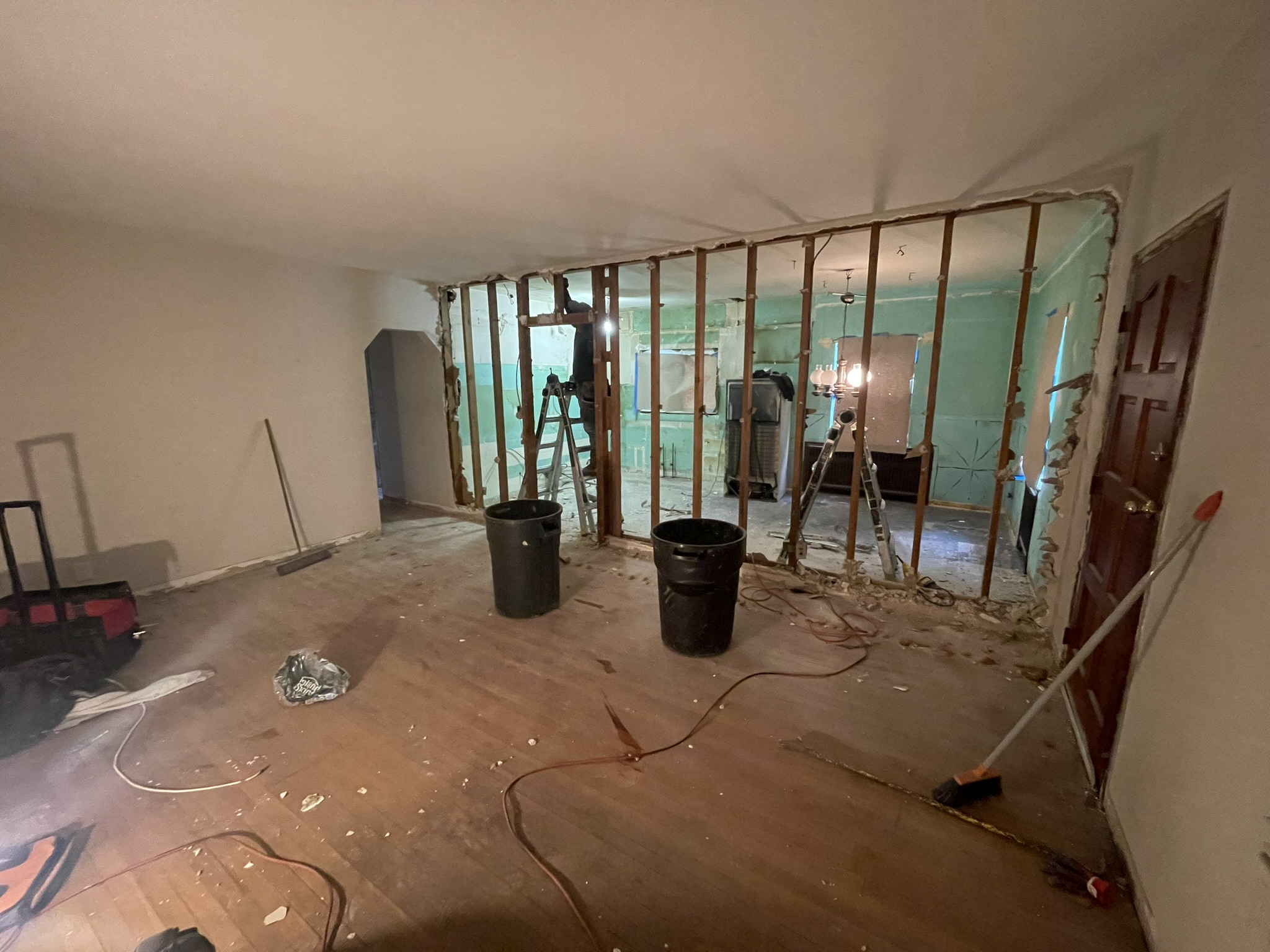 Demolition Day
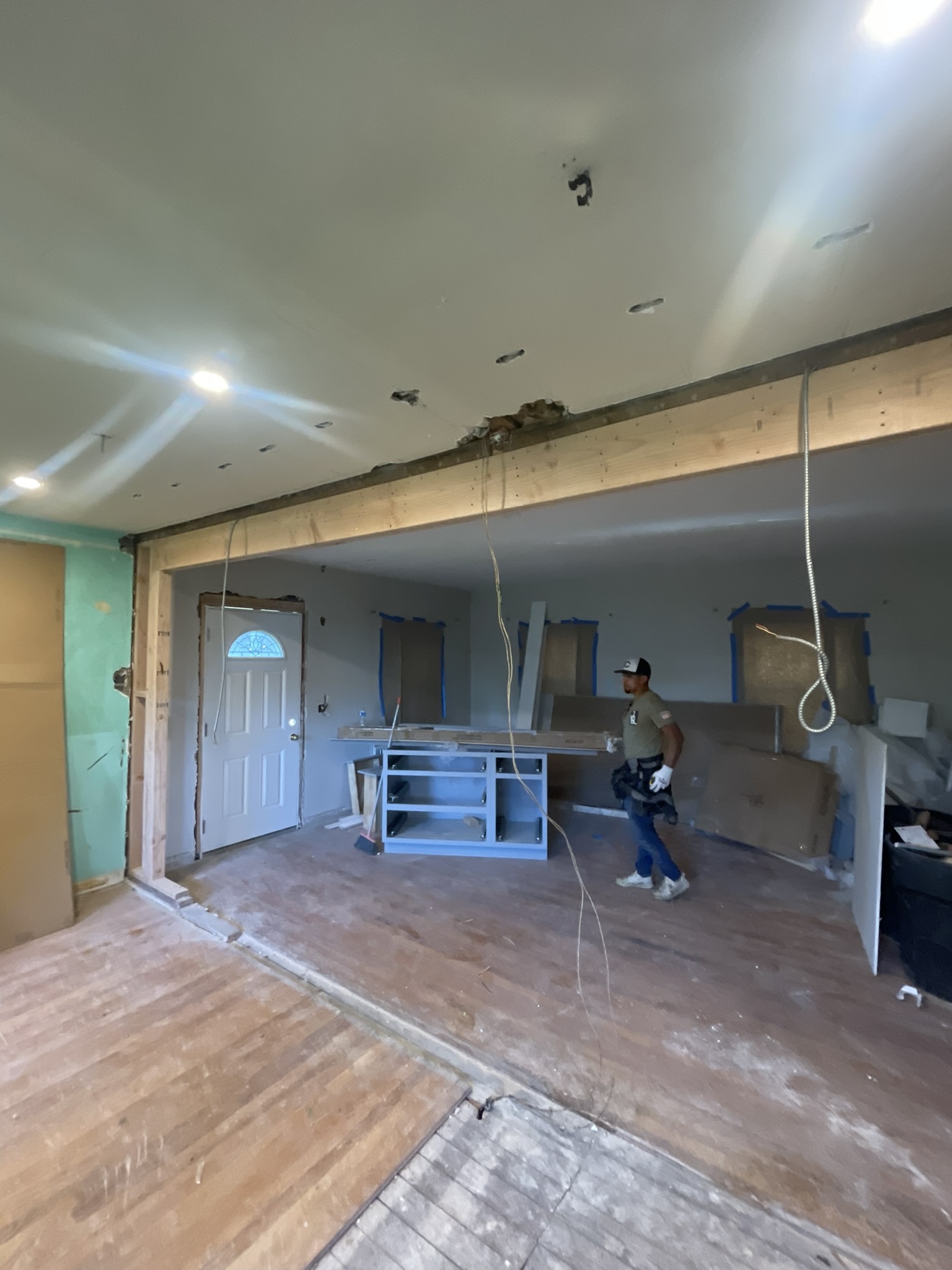 Beam Set After Wall Removal
 Ranch Kitchen, Finished
 Open Plan, Waterfall Island