What a Kitchen Remodel Really Costs on Long Island
Quick Answer
A kitchen remodel on Long Island typically costs $20,000–$40,000 for a cosmetic refresh, $45,000–$85,000 for a midrange full remodel on the existing footprint, $85,000–$150,000 for a gut renovation that moves walls and mechanicals, $150,000–$250,000 upscale, and $250,000+ for high-end custom — roughly $150 to $500+ per square foot. Those are Greene Group’s own observed ranges from our own Nassau and Suffolk projects, not a survey. For a sourced third-party comparator, Zonda’s 2025 Cost vs. Value Report puts a midrange major kitchen in the New York metro area at $90,252 and a minor midrange kitchen at $31,419. No dataset exists for Long Island specifically.
Six Things To Know Before You Budget
- The ROI inverts. A minor midrange kitchen recoups 103.1% in the New York metro area; an upscale major kitchen recoups 33.8%. The cheap kitchen pays for itself; the expensive one does not.
- Cabinets are roughly 35% of the budget. Price cabinetry first — everything else is negotiable around it.
- There is no Long Island average. No credible dataset splits kitchen cost by Nassau or Suffolk. Anyone quoting one made it up.
- Imported cabinets carry a 25% tariff as of July 2026, with a deferred jump to 50% on January 1, 2027. Domestic semi-custom and imported stock now price similarly.
- The federal 25C and 25D credits are gone for 2026, and PSEG Long Island killed its induction cooktop rebate the same day. Any page still promising a 30% credit is wrong.
- Budget 20% contingency on postwar Long Island housing stock. Opening walls on a 1950s house routinely surfaces $3,000–$15,000 of code work.
Research currency: every figure on this page was verified as of July 2026 and is attributed to a named source with its methodology stated. Two items are actively volatile and should be re-checked before you sign a contract: the Section 201 quartz safeguard (recommended by the USITC in May 2026 but not yet imposed by proclamation) and the Section 232 cabinet tariff (25% today, scheduled to rise to 50% on January 1, 2027). Tax and legal points below are general information, not tax or legal advice — consult a CPA or attorney for your situation.
How Much Does a Kitchen Remodel Cost on Long Island?
Kitchens do not price on a smooth curve. They price in tiers, and the boundary between tiers is almost never the finishes — it is whether you are moving anything. A kitchen that keeps its plumbing wall, gas line and window openings is a fundamentally cheaper project than an identical kitchen where the sink migrates to the island. The moment a wall comes down or a drain line moves, you have added structural work, mechanical rerouting, inspections and schedule. That is why two homeowners with the same cabinet list can be $40,000 apart.
The table below is Greene Group’s own pricing, drawn from our own completed Nassau and Suffolk kitchens. We are publishing it because the alternative — a vague “every project is different” — wastes your time and ours. It is not a market survey, it is not a regional average, and it does not describe what every Long Island contractor charges. It describes what we charge.
| Tier | What You Get | Typical Timeline | Typical Range |
|---|
| Cosmetic / Refresh | Existing layout kept. Cabinet refacing or new stock boxes, new countertops, backsplash, sink, faucet, flooring, lighting and paint. No walls moved, no plumbing relocated. | 4–6 weeks | $20,000–$40,000
~$150–$220/sq ft |
| Midrange Full Remodel | Same footprint, everything new. Semi-custom cabinetry, quartz or granite tops, new appliance suite, updated electrical to current code, new flooring, tile, trim and lighting design. | 8–10 weeks | $45,000–$85,000
~$220–$320/sq ft |
| Major / Gut Renovation | Walls come down, layout changes. Structural headers, relocated plumbing and gas, panel and circuit upgrades, possible wall removal to adjacent rooms, custom or high-end semi-custom cabinetry. | 10–14 weeks | $85,000–$150,000
~$300–$400/sq ft |
| Upscale | Full custom cabinetry, professional-grade appliance package, stone or specialty slab counters and backsplash, integrated millwork, designer lighting and hardware, often structural reconfiguration. | 14–18 weeks | $150,000–$250,000
~$400–$500/sq ft |
| High-End Custom | Architect-led design, bespoke cabinetry, imported or rare slab, full-house mechanical coordination, custom windows and doors, butler’s pantry or scullery, exterior implications. | 18–24 weeks | $250,000+
$500+/sq ft |
Ranges are Greene Group Construction’s own observed pricing on completed Long Island projects as of July 2026, not a market survey or a regional average. Square-foot figures are approximate and derived from the tier ranges applied to typical Long Island kitchen sizes; small kitchens carry a higher per-square-foot cost because fixed costs — permits, mobilization, appliances, plumbing — do not shrink with the room. Timelines are construction duration from demolition to punch list and exclude design, cabinet lead time and permit review.
What the National Data Says — and Why It Doesn’t Describe Long Island
Three national datasets get cited constantly in kitchen cost content, usually without anyone naming what they actually measure. All three are useful. None of them is a Long Island number, and the differences between them are almost entirely differences in methodology rather than differences in reality.
The most rigorous is Zonda’s 2025 Cost vs. Value Report, the 38th annual edition, released September 18, 2025. It surveys contractor pricing for tightly specified project scopes in defined metro areas and pairs each with a resale-value estimate from local real estate professionals. Critically, the figures below are for the New York metro area — the New York CBSA contractor-cost survey. That is not Long Island data. It is the closest defensible proxy that exists, and the honest way to use it is as a directional anchor, not as a local quote. The 2026 edition is expected around September 2026.
| Project (New York Metro Area) | Job Cost | Resale Value | Cost Recouped | National Comparator |
| Minor kitchen remodel, midrange | $31,419 | $32,384 | 103.1% | $28,458 / 112.9% |
| Major kitchen remodel, midrange | $90,252 | $42,306 | 46.9% | $82,793 / ~51% |
| Major kitchen remodel, upscale | $183,172 | $61,890 | 33.8% | — |
The Houzz 2026 U.S. Kitchen Trends Study, published January 13, 2026, surveyed 1,780 U.S. homeowners who had recently completed or were planning a kitchen project. It reports a median major kitchen remodel spend of $55,000 and a median minor remodel of $20,000, with larger kitchens at $75,000 versus $46,000 for smaller ones. That is homeowner-reported actual spend rather than priced scope, which is why it lands below Zonda’s contractor-priced major kitchen. It is national only — Houzz publishes no metro breakdown for this measure.
Angi, updated March 17, 2026, reports a national average of $26,942 with a typical range of $14,587–$41,549, and a Northeast regional range of $10,800–$40,400. Read that methodology carefully: Angi surveys its own marketplace customers. That is a self-selected sample skewed toward smaller, faster, more price-sensitive jobs booked through a lead platform. It is directional and we are telling you so. Notice that the Angi Northeast ceiling sits below Zonda’s New York-metro minor remodel figure of $31,419 — two credible sources, four-figure daylight between them, entirely because they are measuring different things.
The ROI Inversion: Why the Cheaper Kitchen Pays for Itself
This is the single most useful thing in the Zonda data, and almost nobody on the Long Island kitchen SERP writes about it: kitchen remodel ROI runs backwards. In the New York metro area, a minor midrange kitchen remodel costing $31,419 returns $32,384 at resale — 103.1% recouped. It makes money. A major midrange kitchen costing $90,252 returns $42,306 — 46.9%. An upscale major kitchen costing $183,172 returns $61,890 — 33.8%. Triple the spend, and you recoup a third as efficiently.
The mechanism is not mysterious. A buyer walking into a Long Island colonial prices the kitchen categorically: dated, updated, or high-end. Moving from dated to updated is where nearly all of the value transfer happens, and a minor remodel accomplishes it. Moving from updated to high-end is a step the market only partially pays for, because the buyer pool that values a $40,000 appliance package is much smaller than the pool that values a kitchen that simply does not look like 1987.
The practical read: if you are selling within roughly two years, the minor remodel is the financially correct project and going bigger is a donation to the next owner. If you are staying — and most of our clients are — then the major or upscale kitchen is a legitimate decision, but you should make it as a lifestyle purchase, not an investment. You are buying ten years of a kitchen you love. That is worth real money. It is just not resale money, and any contractor who tells you a $180,000 kitchen “pays for itself” is either not reading the data or hoping you won’t.
Where Does the Money Actually Go?
Across four independent sources the budget split converges tightly, which is unusual and worth trusting. Cabinets dominate, and everything downstream is effectively negotiated against them. If you understand nothing else about kitchen budgeting, understand that the cabinet decision made in week two determines what the project can afford in week ten.
| Category | Share of Budget | On a $65,000 Midrange Kitchen | Where Homeowners Overspend or Save |
| Cabinets | ~35% | ~$22,750 | The single biggest lever. Stock to semi-custom to full custom can swing $30,000 on the same layout. |
| Labor | ~20% | ~$13,000 | Long Island trades run $50–$150/hr. Complexity and access drive hours more than square footage does. |
| Appliances | ~14% | ~$9,100 | Easiest place to phase. A pro-grade suite can exceed the entire cabinet budget. |
| Countertops | ~10% | ~$6,500 | Slab selection, edge profile and seam count. See the quartz tariff note below. |
| Mechanical, electrical & plumbing | ~9% | ~$5,850 | Where postwar houses generate surprises. Rarely reducible once code is triggered. |
| Flooring | ~5% | ~$3,250 | Continuing existing hardwood is often cheaper than a new material with transitions. |
| Design & permits | ~4% | ~$2,600 | Fixed-ish. Does not scale down on a small kitchen, which is why small kitchens cost more per square foot. |
| Finishes & hardware | ~3% | ~$1,950 | Small share, high visibility. Good place to spend the last dollar. |
Two implications follow. First, small kitchens are expensive per square foot and there is no fixing it — permits, mobilization, appliance count and the rough-in barely shrink when the room does. A 90-square-foot galley and a 200-square-foot eat-in kitchen do not differ by a factor of two in cost. Second, the categories people try to cut — mechanical, permits, design — are least able to absorb cuts, because code and jurisdiction drive them, not taste.
Why Does Long Island Cost More Than the National Average?
“Long Island is expensive” is not an explanation. Here are four specific, structural reasons, each of which you can verify independently.
A metro labor and materials premium. Comparing Zonda’s New York metro figures against its national figures on identical scopes yields a derived premium of roughly 9–12%. Minor midrange: $31,419 New York versus $28,458 national. Major midrange: $90,252 versus $82,793. That is the same specified project costing about a tenth more here, before any local complication.
Trade labor rates. Long Island trades run roughly $50–$150 per hour depending on discipline and licensure. Licensed electricians and plumbers sit at the top of that band, which is exactly why gut renovations — the ones that relocate mechanicals — escalate faster here than cosmetic work does.
Permitting fragmentation. This is the underrated one. Nassau County contains roughly 64 incorporated villages, many with their own building departments, fee schedules and plan requirements. Suffolk County has ten independent town building departments, plus its own incorporated villages. A contractor working across Long Island is not learning one code process, they are learning dozens. That administrative overhead is real, it is billable, and it lengthens schedules.
Postwar housing stock. Enormous swaths of Nassau and western Suffolk are 1950s and 1960s construction — the Levittown era and everything that followed it. Those houses were built to codes that no longer exist and have typically been modified several times since. Opening the walls routinely surfaces $3,000–$15,000 of code-update work: undersized service, ungrounded branch circuits, no dedicated small-appliance circuits, galvanized supply lines, cast-iron waste, undersized headers over openings that were widened without permits. None of that is optional once it is visible, and none of it shows up in a national average.
Is a Kitchen Remodel Cheaper in Nassau or Suffolk?
Here is the honest answer, and it is the reason this page exists: no credible dataset splits kitchen remodel cost by Nassau versus Suffolk County. None. Not Zonda, not Houzz, not Angi, not the Census. Every “Nassau County average kitchen remodel cost” and “Suffolk County kitchen renovation cost” figure circulating online originates in contractor marketing with no disclosed sample size, no methodology and no date. We are not going to add another invented number to that pile.
What genuinely differs between the counties is not price, it is jurisdiction. Your permit path, fee schedule, plan requirements, inspection sequence and review queue are set by the specific village or town building department with authority over your parcel — not by the county. Two houses four miles apart, one in an incorporated Nassau village and one in an unincorporated area of the same town, can have materially different permitting experiences. That variance is real and it costs money in schedule. It just is not a county-level number.
Transparency on published fees is close to nonexistent island-wide. As of July 2026, the Town of Smithtown is the only Long Island jurisdiction we have found publishing usable residential figures:
| Town of Smithtown — Published Residential Fees | Amount |
| Residential alteration permit | $305 + $0.45 per square foot |
| Plumbing permit, first two fixtures | $55 |
| Residential certificate of occupancy | $100 |
| Permit review turnaround time | Not published — call the department |
And note that last row, because it applies everywhere: no Long Island jurisdiction publishes permit turnaround times. Not Smithtown, not Huntington, not Hempstead, not one of the 64 Nassau villages. Any contractor who quotes you a firm permit duration on Long Island is guessing. We would rather tell you to call your building department and ask than print a number we cannot support. If your project spans towns or you are unsure who has jurisdiction, our service areas page lists where we work, and county-level detail lives on our Nassau County and Suffolk County kitchen pages.
What Changed in 2026 That Affects Your Budget?
More moved in the last nine months than in the previous five years, and most Long Island kitchen pages have not been updated. Three changes matter to your number.
Cabinet tariffs. As of July 2026, imported kitchen cabinets and vanities carry a 25% Section 232 tariff, in effect since October 14, 2025 under Proclamation 10976. The scheduled increase to 50% was deferred to January 1, 2027 by Proclamation 11000, signed December 31, 2025 and published January 9, 2026 at 91 FR 1039. The practical consequence is genuinely useful buying advice: the price gap between imported stock cabinetry and domestic semi-custom lines has largely converged. The traditional reflex — import to save money — no longer reliably works. Get quotes on both. And if your project is landing near the end of 2026, understand that the 50% rate is currently scheduled to take effect January 1, 2027, which is a real reason to lock cabinet orders early.
Quartz countertops — recommended, not imposed. Write this one down carefully because it is the most volatile item on the page. In Investigation TA-201-79, the U.S. International Trade Commission found injury on April 1, 2026 by a 2–1 vote, and on May 5, 2026 recommended a four-year tariff-rate quota declining one percentage point per year, starting at 25% in-quota and 40% above-quota. As of July 2026 no presidential proclamation has been issued — USTR sought additional ITC data in early July. So nothing is imposed yet. Here is the part no competitor mentions: natural stone is expressly excluded from the scope. Granite, marble, soapstone and quartzite are outside the investigation entirely. If you are countertop shopping in 2026 and want to hedge against a safeguard that may or may not land, natural stone is the actionable move.
Federal tax credits are gone. Under Public Law 119-21, enacted July 4, 2025, IRC §25C provides no credit for property placed in service after December 31, 2025, and IRC §25D provides no credit for expenditures made after December 31, 2025. The IRS states expressly that prepaying in 2025 does not preserve §25D if installation finishes in 2026. There is no 2026 federal successor for kitchen-related items. Every Long Island contractor page still advertising a 30% credit or a $3,200 cap on a 2026 induction range or panel upgrade is misinforming homeowners — and there are a lot of them.
Are There Any Rebates or Tax Credits Left in 2026?
Some, but probably not the ones you were counting on. The headline, stated plainly: for a market-rate-income Long Island homeowner in July 2026 there is currently no induction cooktop rebate and no electrical panel upgrade rebate. PSEG Long Island discontinued its induction cooktop rebate effective December 31, 2025, confirmed in PSEG’s own rebate-requirements documentation — the same day the federal credit expired. Those two things landing together is the actual 2026 story for anyone planning an electrified kitchen.
| Program | What It Covers | Amount | Who Qualifies |
| PSEG LI — induction cooktop | Induction cooking appliances | Discontinued as of Dec 31, 2025 | Nobody — program ended |
| PSEG LI — heat pump water heater | HPWH equipment | Up to 50% of price, capped at $1,200 | All customers |
| PSEG LI — smart thermostat | Qualifying smart thermostats | $100 or $130 | All customers |
| PSEG LI — Smart Savers thermostat | Enrolled demand-response thermostat | $85 | All customers |
| PSEG LI — Level 2 EV charger | Home charger install | Up to $100 ($400 for DAC / Household Assistance Program) | All customers; higher tier income-based |
| PSEG LI — electrical panel upgrade | Service and panel upgrades | No rebate offered | — |
| NYSERDA EmPower+ / IRA HEAR | Panel upgrade up to $4,000; wiring up to $2,500; heat pump up to $8,000; HPWH up to $1,750 | Project caps $10,000 low-income / $5,000 moderate-income | Income-eligible households only |
The NYSERDA EmPower+ and IRA HEAR programs are genuinely valuable if you qualify — a $4,000 panel upgrade and $2,500 of wiring is meaningful money on a postwar house that needs both. But they are strictly income-eligible, and the overwhelming majority of homeowners asking us about kitchen budgets do not qualify. Plan your 2026 kitchen assuming you will pay full freight for the electrical work, and treat any rebate you land as upside. Program terms change; verify current eligibility directly with PSEG Long Island and NYSERDA before you rely on a number here. This is general information, not tax advice.
What Blows a Kitchen Budget on a Long Island House?
Overruns on Long Island kitchens are rarely about someone changing their mind on tile. They are about what is behind the wall of a house built in 1957. The pattern is consistent enough that we now price it as likely rather than possible.
| What We Find | Why It Happens Here | Typical Added Cost |
| Electrical service and panel undersized | 60–100 amp services on postwar stock cannot carry a modern kitchen load | $3,000–$8,000 |
| Ungrounded or shared branch circuits | Pre-1965 wiring, no dedicated small-appliance or GFCI circuits | $1,500–$5,000 |
| Galvanized supply or cast-iron waste lines | Original plumbing at end of service life; corrosion found at tie-in | $2,000–$7,000 |
| Undersized or missing headers | Prior owner widened an opening without a permit or a beam | $2,500–$9,000 |
| Subfloor rot or failed underlayment | Long-running dishwasher or sink leak found at demolition | $1,200–$6,000 |
| Asbestos-containing floor tile or mastic | Common in 1950s–70s kitchens; abatement is regulated work | $1,500–$5,000 |
| Out-of-level floors and out-of-plumb walls | Settlement plus decades of layered flooring; cabinets and stone need flat | $800–$3,500 |
Any one of these lands in that $3,000–$15,000 band. The problem is they arrive in combinations: a 1957 ranch with a 100-amp service also tends to have the ungrounded circuits and the galvanized supply, because the same crew installed all of it the same week. Contingency is not pessimism — it is arithmetic.
One more overrun source worth naming: demolition and disposal. Kitchen demo generates more debris than people expect, and C&D disposal on Long Island is not cheap. Because we also run junk removal and cleanout operations, demo and hauling sit inside one contract on our jobs instead of arriving as a separate invoice from a third party. If you are pricing other contractors, ask explicitly whether disposal is included or excluded — it is one of the most common line items to go missing from a quote.
What Should You Budget for Contingency?
Be careful with the contingency advice you find online, because most of it cites a standard that does not exist. You will repeatedly see the claim that “NAHB recommends 10–15% for homes over 30 years old.” There is no such NAHB publication. That figure circulates on remodeler blogs citing each other. We are not going to repeat it.
What the National Association of Home Builders actually publishes is a contingency figure of 10% — rising to 20% if you act as your own general contractor — and it appears in a new-construction buyers’ guide, attributed to lenders. That is a real, citable figure. It is also not about remodeling a 70-year-old kitchen, and it would be dishonest to present it as though it were.
So here is our guidance, labelled as ours: on Long Island’s postwar housing stock, Greene Group recommends holding 20% of contract value in contingency. That is company guidance and long-standing trade convention for renovation work in aged housing — not a published industry standard, and we are not going to dress it up as one. On a $65,000 midrange kitchen that means $13,000 held in reserve. On a $120,000 gut renovation it means $24,000. If your house is post-1990 or has documented, permitted electrical and plumbing updates, 10–15% is defensible. If it is a 1955 Cape that has never had the panel touched, hold the full 20%.
The contingency is not part of the budget you spend. It is the money that keeps a discovered $6,000 electrical upgrade from becoming a stalled job, a value-engineering conversation, or a lien.
What Does a Written Estimate Need to Contain?
A kitchen estimate that fits on one page is not an estimate, it is a sales tool. At minimum, insist on: an itemized scope by trade; named allowances with dollar figures for anything not yet selected (cabinets, counters, tile, fixtures, appliances); the specific model or product line where it is known; a payment schedule tied to completed milestones rather than to the calendar; a written change-order process with pricing method stated; who pulls and pays for permits; whether demolition and disposal are included; and a stated contingency or a written acknowledgement that none is included.
Then check the license, and check it in writing. Greene Group Construction’s Suffolk County Home Improvement Contractor license is HI-72958, and its Nassau County license is EF-65498. Under Suffolk County Code Chapter 563, the license number is legally required in contractor advertising — a contractor advertising without one on Long Island is telling you something before you even call.
The enforcement teeth are worth understanding. CPLR 3015(e) requires a contractor suing a consumer to plead its license name, number and issuing agency in the complaint. That provision applies to licenses issued by the New York City Department of Consumer Affairs and by the consumer-affairs authorities of Suffolk, Nassau, Westchester, Rockland and Putnam counties — so it covers all of Long Island, but it is not a blanket statewide rule and you should not repeat it as one. Case law reinforces it: in Holistic Homes, LLC v. Greenfield (2d Dep’t 2016), the court held that an unlicensed home improvement contractor may neither enforce the contract nor recover in quantum meruit — meaning they cannot even sue for the value of work actually performed. The corollary for you as a homeowner is less comforting than it sounds: an unlicensed contractor who cannot sue also frequently cannot be insured, bonded, or found. This is general information about statutes and published decisions, not legal advice; consult an attorney about your specific situation.
Finally, understand how the trades are staffed on your job. Our own carpenters and project managers run your job start to finish. Electrical and plumbing are performed by licensed Nassau and Suffolk trade contractors we’ve worked with for years — we schedule them, we coordinate the inspections, and we’re accountable for the result. Any contractor claiming every trade is employed in-house is either misdescribing their structure or misunderstanding New York trade licensure.
How Do You Bring a Kitchen Remodel In On Budget?
Decide the tier before you decide the finishes. The most expensive mistake in kitchen remodeling is drifting upward one reasonable decision at a time. Fix the tier first — refresh, midrange, gut — and then make every subsequent choice inside it.
Keep the plumbing wall if you can. The sink and dishwasher location is the highest-leverage cost decision in the project. Islands with sinks are beautiful and they are expensive, because they require a drain, a vent and often a slab or joist penetration. If the layout works without moving water, you have saved yourself an entire cost tier.
Set the cabinet number first and build down. At roughly 35% of budget, cabinetry is the only line item large enough to fix a budget problem by itself. Price stock, semi-custom and custom on your actual layout — and in 2026, price domestic against imported, because the 25% Section 232 tariff has narrowed that gap in ways that surprise people.
Phase the appliances. Appliances are about 14% of budget, they are the easiest category to buy later, and unlike cabinets they do not require the room to be open. Installing a mid-tier range now and upgrading in three years costs almost nothing extra. Moving a cabinet run in three years costs everything.
Call the building department early. Not the week before demolition. Permit path and plan requirements should be confirmed while the design is still fluid, because a requirement discovered late is a redesign, and a redesign is a schedule.
Get three line-item quotes on the same written scope. Three quotes on three different scopes tells you nothing — it is how Long Island homeowners end up comparing a $45,000 refresh against a $95,000 gut and concluding one contractor is “expensive.” Write the scope once, hand the same document to everyone. If the numbers still diverge, ask what each bidder assumed about the things behind the wall.
Kitchen Remodel Cost FAQ
How much does a kitchen remodel cost on Long Island in 2026?
On Long Island, Greene Group’s observed pricing runs $20,000–$40,000 for a cosmetic refresh, $45,000–$85,000 for a midrange full remodel on the same footprint, $85,000–$150,000 for a gut renovation, $150,000–$250,000 upscale, and $250,000+ for high-end custom — roughly $150 to $500+ per square foot. Those are our own numbers from our own jobs, not a survey.
What is the average kitchen remodel cost on Long Island?
There is no credible Long Island average. No public dataset samples kitchen remodel cost for Nassau and Suffolk specifically. Every figure circulating online comes from contractor marketing with no disclosed sample or methodology. The closest defensible proxy is Zonda’s 2025 Cost vs. Value Report for the New York metro area, which puts a midrange major kitchen at $90,252 and a minor midrange kitchen at $31,419.
How much does a small kitchen remodel cost on Long Island?
A cosmetic refresh on a small Long Island kitchen typically lands at $20,000–$40,000 over four to six weeks: cabinet refacing or new stock boxes, new counters, backsplash, sink, faucet, flooring and lighting on the existing layout. Houzz’s 2026 study put the national median minor remodel at $20,000. Moving plumbing or walls pushes a small kitchen into the $45,000+ midrange tier fast.
Does a kitchen remodel add value to my Long Island home?
It depends entirely on scope. Per Zonda’s 2025 Cost vs. Value Report for the New York metro area, a minor midrange kitchen remodel recoups 103.1% of its cost at resale. A major midrange kitchen recoups 46.9%, and an upscale major kitchen recoups 33.8%. The cheaper kitchen pays for itself. The expensive one buys you the kitchen, not the resale.
Is a kitchen remodel cheaper in Nassau or Suffolk County?
No dataset splits kitchen remodel cost by Nassau versus Suffolk, and anyone quoting a county price delta invented it. The real differences are jurisdictional: Nassau has roughly 64 incorporated villages with their own building departments, Suffolk has ten independent town departments. Permit fees, plan requirements and review queues vary building department to building department, not county to county.
Are cabinet tariffs raising kitchen remodel costs in 2026?
Yes. As of July 2026, imported kitchen cabinets and vanities carry a 25% Section 232 tariff, in effect since October 14, 2025 under Proclamation 10976. The scheduled increase to 50% was deferred to January 1, 2027 by Proclamation 11000, published January 9, 2026 at 91 FR 1039. Practical effect: imported stock cabinets and domestic semi-custom lines have converged in price.
Are there any kitchen rebates or tax credits left in 2026?
For a market-rate-income Long Island homeowner, there is currently no induction cooktop rebate and no electrical panel upgrade rebate. Federal §25C and §25D credits ended for 2026 under Public Law 119-21. PSEG Long Island discontinued its induction cooktop rebate effective December 31, 2025. NYSERDA EmPower+ still funds panel and wiring upgrades, but only for income-eligible households.
How much should I set aside for contingency on a Long Island kitchen?
Greene Group recommends 20% on Long Island’s postwar housing stock. That is our own guidance and trade convention, not a published standard. The National Association of Home Builders publishes a 10% contingency figure, rising to 20% if you act as your own general contractor, attributed to lenders in a new-construction buyers’ guide. On 1950s and 1960s houses, 20% is realistic.
Want a number for your kitchen instead of a range? We will walk your kitchen, tell you which tier it actually falls into, and put it in writing line by line — including what we expect to find behind the wall. Call
(631) 532-7346 or
request a free estimate. If your project also involves demolition, hauling or structural work, that is one contract with us, not three — see
general contracting and
kitchen remodeling. Suffolk County HIC #HI-72958.
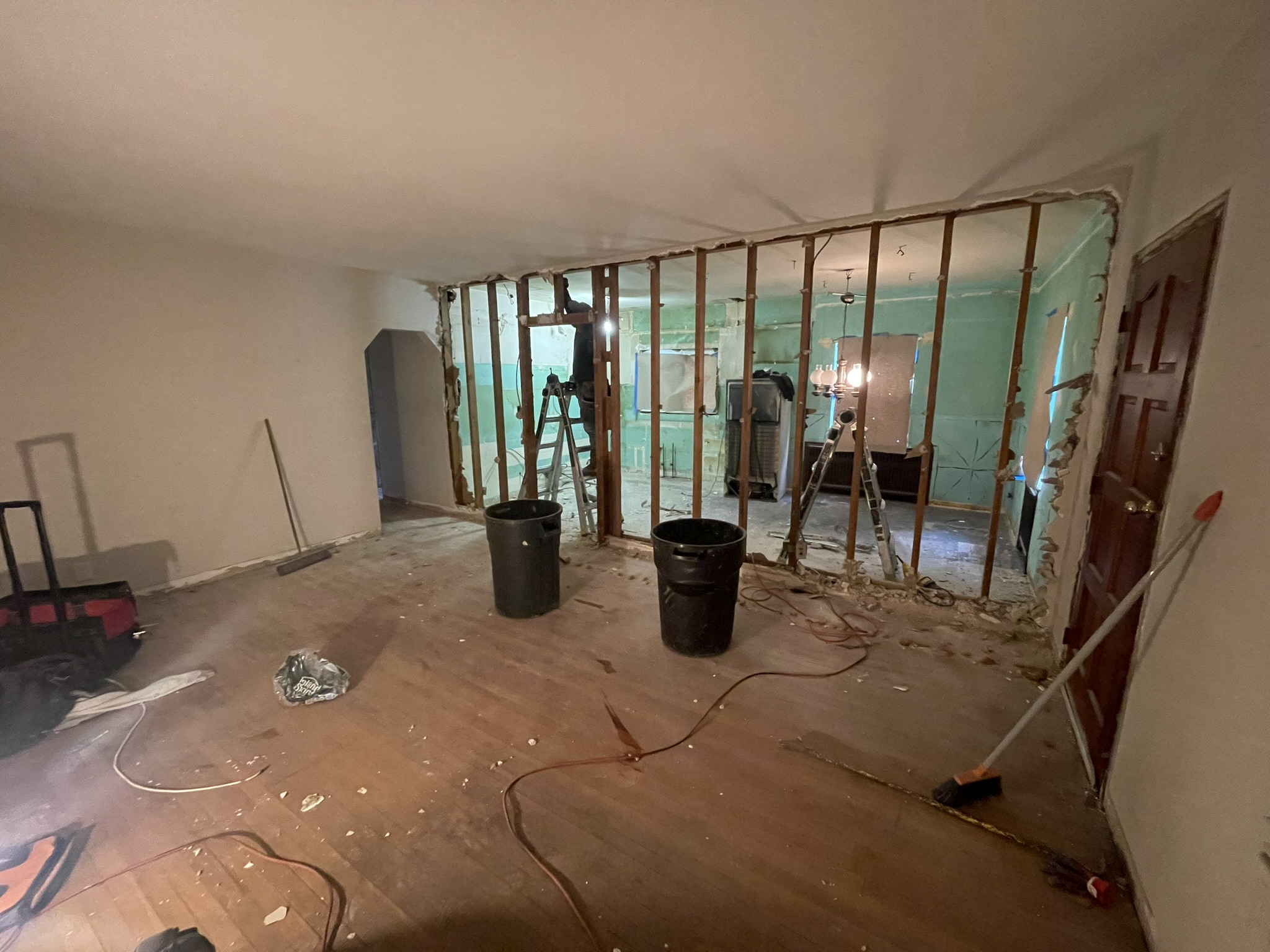 Demolition Day
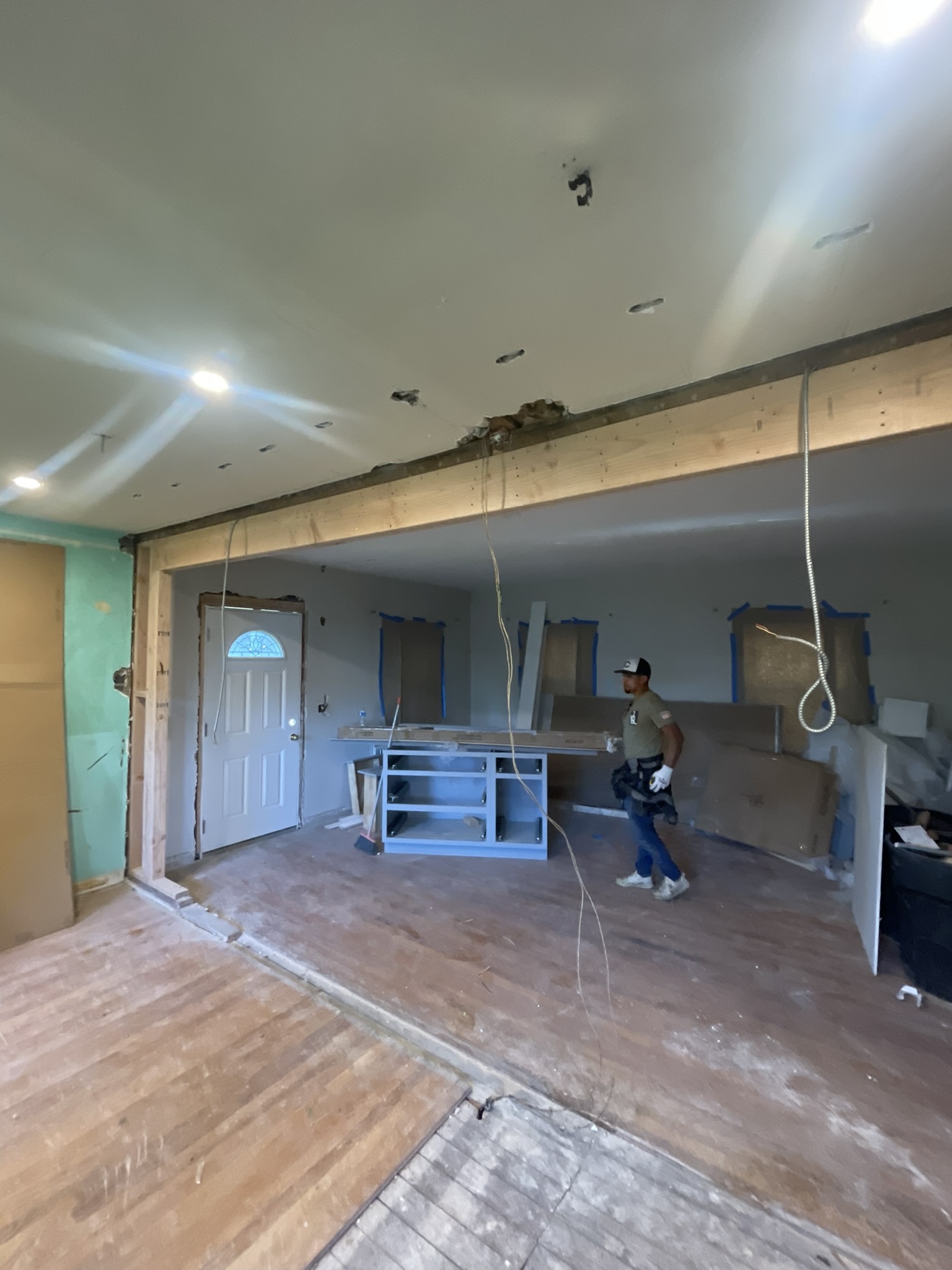 Rough-In Stage
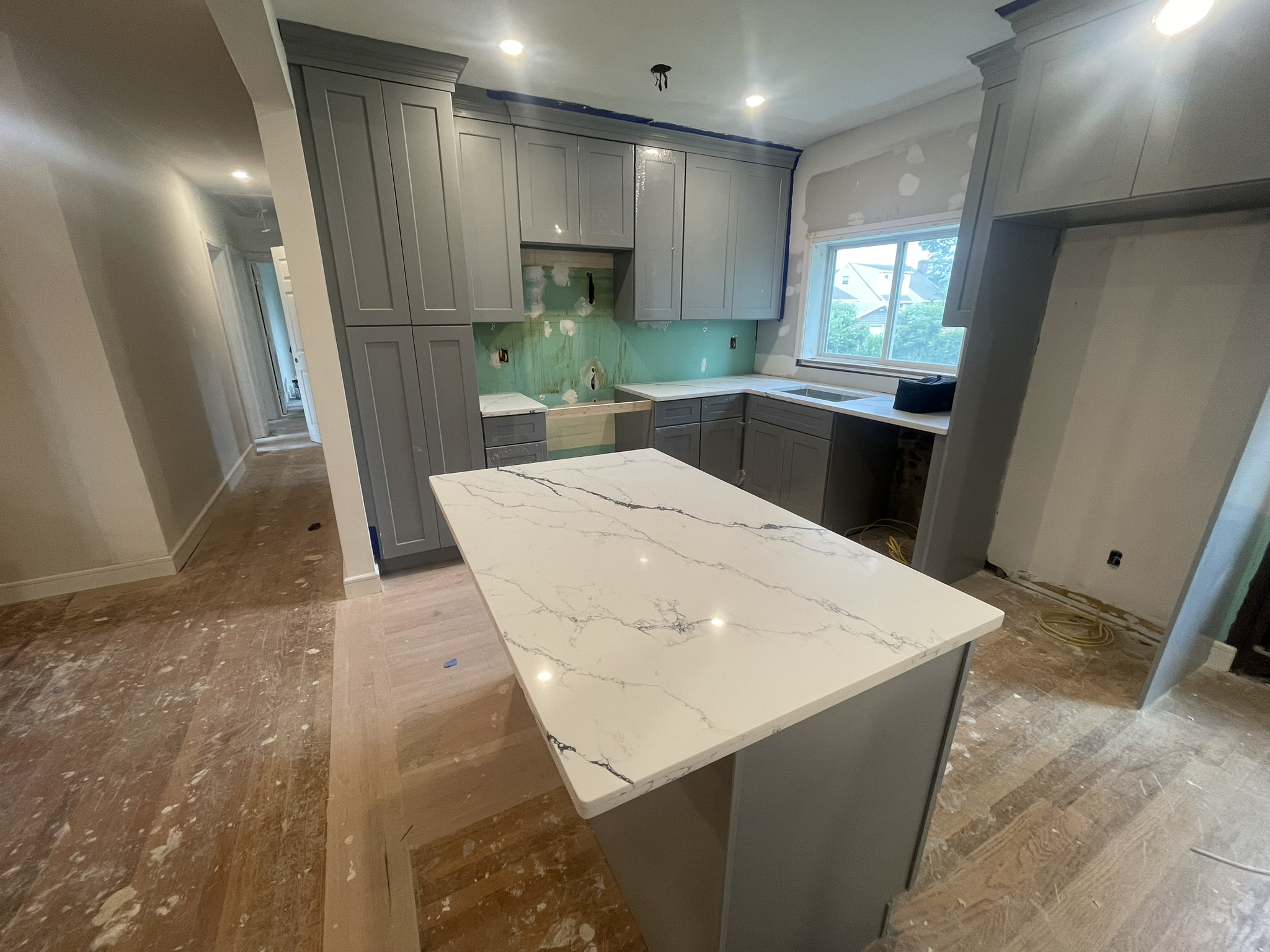 Cabinets Set
 Finished Kitchen