Remodeling Permits in the Town of Smithtown
Quick Answer
The Town of Smithtown publishes its permit fees inside its own Town Code at § 112-11, amended February 3, 2026 by Res. No. 2026-137. A residential alteration is $305 plus $0.45 per square foot, residential plumbing is $55 for the first two fixtures, and electrical work only is $100 plus electrical agency fees. Smithtown requires a Building Department permit for electrical work itself.
Key Takeaways
- You can price a Smithtown permit in advance. The itemised schedule lives in the Town Code at § 112-11 and was amended 2-3-2026 by Res. No. 2026-137 — current and quotable, not inferred.
- Electrical is the headline difference. Chapter 145 makes it a violation to install or alter electrical wiring for light, heat or power until a Building Department permit has been issued. The schedule prices it at $100 plus electrical agency fees.
- Plumbing needs a fixture drawing and its own permit. § 112-10E(1) requires a drawing showing the exact number and location of each fixture, plus a separate permit from the Chief Building Inspector.
- The code disagrees with itself on permit life. Chapter 112 says six months with up to two three-month extensions; § 112-11E says one year. Confirm which governs your permit.
- Filing after the fact is expensive. Built-prior work is charged at three times the regular permit fee plus $150 per item. Two inspections are included per category; each additional one is $50.
- Smithtown publishes no cosmetic itemisation. Chapter 112 exempts only “the performance of ordinary repairs which are not structural in nature.” There is no published cabinets-and-tile rule here.
Why Smithtown Is the Only Town You Can Budget a Permit For
Most Long Island building departments do not publish a fee schedule a homeowner can use. Babylon's code sets no amounts at all — the fee “shall be as may be determined from time to time by the Town Board.” Huntington has two official fee pages publishing different numbers for the same permit. Brookhaven publishes no Building Division schedule online. Islip does publish a fee list, effective May 1, 2024, and it is the closest thing to a peer.
Smithtown differs in kind rather than degree, because its fees are legislated rather than posted. They sit in the Town Code at § 112-11, and the schedule carries an amendment date: February 3, 2026, by Resolution No. 2026-137. You can read it, price your job against it, and see exactly when it last changed.
New York State sets the floor. 19 NYCRR 1203.3(a)(1) requires every authority having jurisdiction to require building permits for work that must conform to the Codes, while allowing localities to exempt a short list that includes “painting, wallpapering, tiling, carpeting, or other similar finish work.” The State mandates the permit and merely permits the exemption, which is why Smithtown's answer is not Islip's answer.
Do You Need a Permit to Remodel a Bathroom in Smithtown?
If the bathroom touches plumbing or wiring — and a real bathroom remodel touches both — the answer is yes, on two separate tracks. Smithtown Town Code § 112-10E(1) requires the applicant to “Submit, in writing, a detailed drawing showing the exact number and location of each plumbing fixture and heating unit to be installed” and to “Obtain a separate permit from the Chief Building Inspector.” Moving a toilet, adding a second vanity or converting a tub to a curbless shower puts fixtures in new places, and the drawing has to show them. Separately, Chapter 145 requires a Building Department permit before electrical wiring is installed or altered — which a bathroom hits the moment a new receptacle circuit goes in.
What Smithtown does not publish matters just as much. Chapter 112 exempts only “the performance of ordinary repairs which are not structural in nature,” and nothing more specific. There is no Smithtown list telling you that paint, tile, carpet and cabinets are exempt finish work; Islip publishes exactly that list and Smithtown does not. Whether a given scope sits inside one general phrase is a determination for the Building Department, so describe the work to them before you assume you are exempt. Anyone telling you Smithtown exempts cabinets and tile is filling in a blank the Town left empty.
Do You Need a Permit to Remodel a Kitchen in Smithtown?
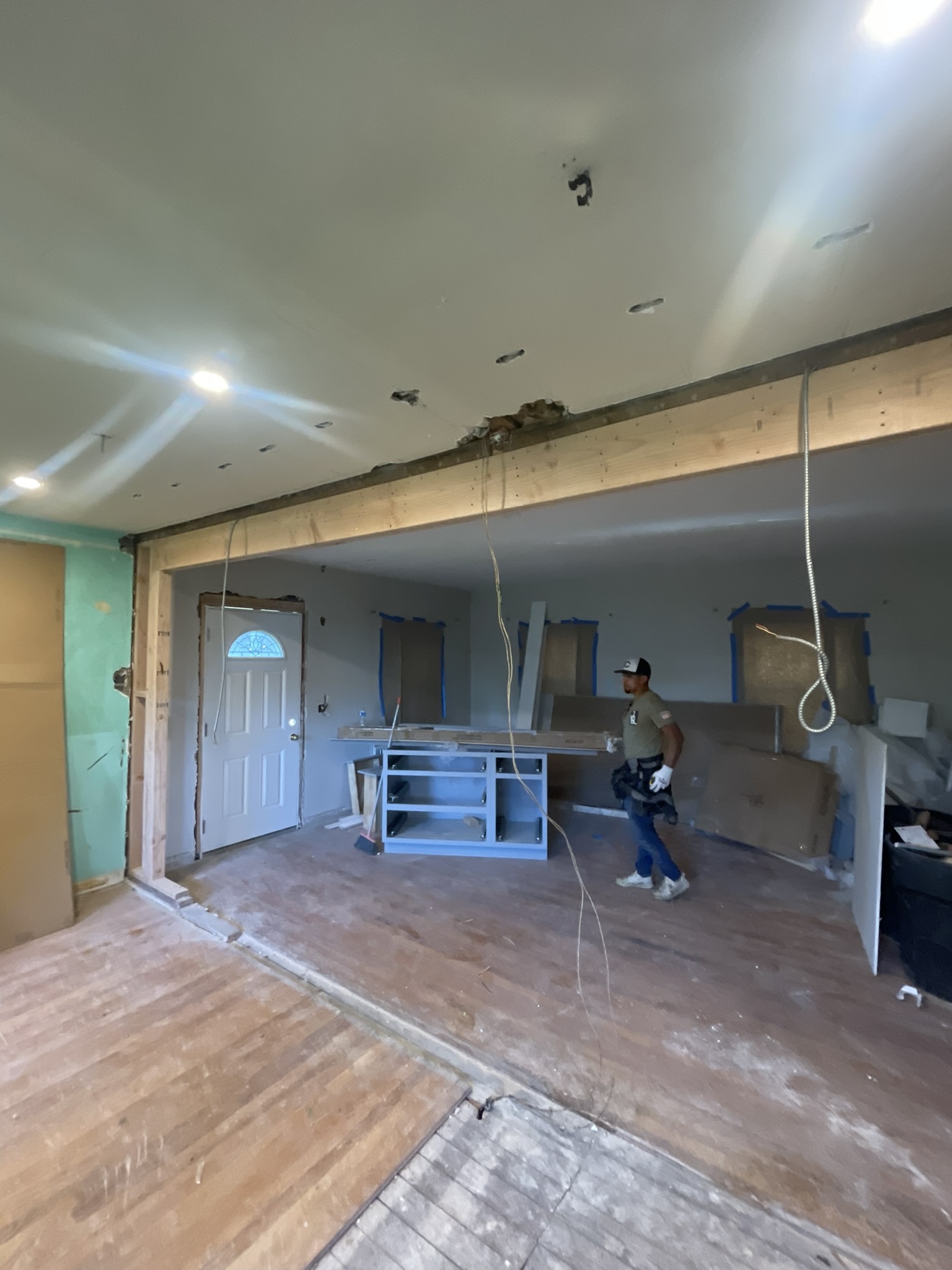
The same two tracks apply, and a kitchen lands harder on the electrical one. A modern kitchen adds circuits: small-appliance branch circuits, a dishwasher circuit, under-cabinet and recessed lighting, sometimes a range circuit. All of that is “electrical wiring for light, heat or power,” and in Smithtown it needs a Building Department permit before it goes in. Relocating a sink or running a new dishwasher supply and drain puts you inside § 112-10E(1). Taking out a wall between a kitchen and a dining room is not an ordinary repair that is non-structural, so it is permit work priced as a residential alteration.
| Scope |
Room |
What Smithtown's Published Record Says |
| Cabinets, countertops, tile, flooring or paint replaced with no change to structure, plumbing or wiring |
Kitchen and bathroom |
Chapter 112 exempts “the performance of ordinary repairs which are not structural in nature.” Smithtown publishes no itemised cosmetic list. Whether a specific refit sits inside that phrase is a determination for the Building Department. Call before you assume. |
| Adding or relocating a plumbing fixture — sink, dishwasher line, toilet, tub, shower, second vanity |
Kitchen and bathroom |
§ 112-10E(1): detailed drawing showing the exact number and location of each plumbing fixture and heating unit, plus a separate permit from the Chief Building Inspector. Residential plumbing $55 for the first two fixtures, $29 each additional. |
| New or altered electrical wiring — a 20-amp bathroom receptacle circuit, kitchen small-appliance circuits, recessed or under-cabinet lighting, a range circuit |
Kitchen and bathroom |
Chapter 145: a violation to install or alter electrical wiring for light, heat or power “until a Building Department permit has been issued and an application for inspection has been filed.” Electrical work only $100, plus electrical agency fees. |
| Removing or altering a wall, header, beam or other structural element |
Kitchen and bathroom |
Outside the “ordinary repairs which are not structural in nature” exemption. Priced as a residential alteration: $305 base plus $0.45 per square foot. |
| Heating units, air-conditioning units, stoves, fireplaces, or a gas pressure test |
Kitchen and bathroom |
The schedule prices fireplaces, stoves, air-conditioning and heating units at $115 per unit, and a gas pressure test at $115 per meter per test. Confirm with the Building Department which of these your scope triggers. |
| Work already performed before the application is filed |
Kitchen and bathroom |
Built-prior work is charged at three times the regular permit fee, plus $150 per item for a listed set of items. |
Why Smithtown's Electrical Permit Is Its Real Distinguishing Feature
In most towns electrical work is handled by an inspection agency: the electrician works, an approved agency inspects, and the certificate lands in the department's file. Smithtown adds a step in front of that. Town Code Chapter 145 states that “It shall be a violation of this chapter for any person to install or cause to be installed or to alter electrical wiring for light, heat or power in or on properties in the Town of Smithtown until a Building Department permit has been issued and an application for inspection has been filed.”
The fee schedule confirms it with a line item of its own: “Electrical work only — $100 (plus electrical agency fees).” Islip and Babylon publish no equivalent standalone electrical building permit. Islip's Town Code § 68-25D(2) requires a certificate from an inspection agency, which is a different instrument arriving at a different point in the job.
Any real kitchen or bathroom adds a circuit, which is why this matters here. New York's 2025 Uniform Code references the 2023 National Electrical Code, effective December 31, 2025. NEC 210.11(C)(3) requires at least one 120-volt 20-amp branch circuit for bathroom receptacles, 210.52(D) a receptacle within three feet of each basin, and 210.8(A)(1) GFCI protection; kitchens sit on the 210.12(B) AFCI list. Each of those is new or altered wiring, and in Smithtown that means a permit before the work, not a certificate after it.
Chapter 112 requires “A duly executed certificate issued by a duly recognized electrical inspection agency,” and Chapter 145 authorises inspectors of qualifying organizations designated by Town Board resolution — ten years of experience, IAEI certification, familiarity with the National Electrical Code. We are not naming agencies for Smithtown. The approved roster is a Town Board resolution we could not retrieve, and no agency is named in the code. Ask the Building Department which agencies it currently recognises.
What Does a Smithtown Building Permit Cost?
Below is Smithtown's published schedule as it stands at § 112-11, amended February 3, 2026 by Res. No. 2026-137. Fee schedules change by resolution, so confirm the current figures with the Smithtown Building Department before you commit a budget.
| Item |
Published Fee |
| Residential additions, alterations, fire repair, garage conversions, decks, accessory structures | $305 base + $0.45 per sq ft |
| Residential new construction | $305 base + $0.55 per sq ft |
| Residential plumbing | $55 for the first two fixtures + $29 each additional fixture |
| Electrical work only | $100 (plus electrical agency fees) |
| Certificate issuance, residential — § 112-11A(4) | $100 (commercial $200) |
| Temporary certificate of occupancy | $500, valid 12 months |
| Document charges under § 112-11C — a separate subsection | Certificate of occupancy $50 per document; duplicate $50; property history letter $500 |
| Fireplaces, stoves, air-conditioning units, heating units | $115 per unit |
| Gas pressure test | $115 per meter, per test |
| Rooftop solar | $175 |
| Fences | $200 |
| Amendment permit, residential | $200 |
| Resubmission | $200 |
| Preliminary plan review | 20% of the permit fee |
| Inspections | Two included per required category; $50 for each additional inspection |
| Built-prior work (performed before filing) | Three times the regular permit fee, plus $150 per item for a listed set of items |
| Refund | 50% if withdrawn before construction; no refund once construction has begun |
Two certificate fees, and they are not the same thing. The $100 residential certificate issuance fee sits at § 112-11A(4) and relates to issuance of the certificate for your project. The $50 per document figure sits in a different subsection, § 112-11C, listed among document charges alongside a $50 duplicate and a $500 property history letter. Do not read the $50 as the price of getting your certificate issued at the end of the job. If your situation could be either, ask the Building Department which subsection applies before you pay.
A worked example makes the formula concrete. A 60-square-foot bathroom taken back to studs is a residential alteration: $305 plus 60 × $0.45, which is $27, for $332. Four fixtures add $55 for the first two plus $29 twice, for $113. New wiring adds the $100 electrical line plus the inspection agency's own charge, which is the agency's number and not the Town's. Certificate issuance at the end is $100. We carry Smithtown permit fees as a visible line item rather than an allowance, because here we can.
Who Is Allowed to Do the Work in Smithtown?
Here the divergence runs in an unexpected direction. Smithtown regulates the inspection agencies rather than the tradespeople. No Town of Smithtown plumber licence and no Town of Smithtown electrician licence appear in the code. Chapter 145's qualification language is aimed at the organizations whose inspectors the Town Board designates, not at the electrician holding the wire.
The code does not impose a Town of Smithtown plumber licence requirement. That is a statement about the text, and it is as far as the text takes us. It is not a statement that anyone may file or perform the work, because practice can differ from the bare code. Islip, Babylon and Huntington each require a Town-licensed plumber; Smithtown's code imposes no such licence. Ask the Building Department directly who it will accept a plumbing application from before anyone prepares one. On our jobs, our own carpenters and project managers run your job start to finish. Electrical and plumbing are performed by licensed Nassau and Suffolk trade contractors we've worked with for years — we schedule them, we coordinate the inspections, and we're accountable for the result. Greene Group Construction holds Suffolk County HIC #HI-72958 and Nassau County HIC #EF-65498; under Suffolk County Code Chapter 563 that Suffolk number is legally required to appear in a contractor's advertising, which makes an ad without one a warning sign.
How Long Does a Smithtown Permit Last? The Code Contradicts Itself
This one requires reading the chapter closely enough to notice that it disagrees with itself. Chapter 112 states that a permit runs six months from issuance, with up to two extensions of three months each, and that “A permit may be renewed once… The renewal fee shall be 1/2 of the original fee.” Separately, § 112-11E states that permits expire one year from issuance, with one renewal at half fee.
Both provisions sit in the same chapter of the same code. We publish the six-month figure and the extension mechanism because it is the shorter and more conservative reading, and because six months plus two three-month extensions is a schedule you can plan against. But a homeowner should know plainly that another section of the same chapter says one year. Ask the Smithtown Building Department which period governs your permit, get the answer in writing, and diary the expiry date.
The related number punishes bad sequencing. Smithtown charges three times the regular permit fee plus $150 per item for built-prior work, refunds half a fee if an application is withdrawn before construction, and refunds nothing once construction has begun. File first, and do not pull a permit for a job you are not ready to start.
What Smithtown Publishes That Its Neighbours Do Not
| What a homeowner wants to know |
What Smithtown publishes |
What the neighbouring towns publish |
| A current, itemised permit fee schedule |
Yes — in the Town Code at § 112-11, amended February 3, 2026 by Res. No. 2026-137 |
Islip publishes a fee list effective May 1, 2024. Babylon's code fixes no amounts and leaves them to Town Board determination. Huntington's two official fee pages publish different numbers. Brookhaven publishes no Building Division fee schedule online. |
| A standalone electrical permit from the building department |
Yes — Chapter 145 requires one before wiring is installed or altered; the schedule prices it at $100 plus electrical agency fees |
Islip and Babylon publish no equivalent standalone electrical building permit. Islip requires an inspection agency certificate under § 68-25D(2). |
| The price of an extra inspection |
Yes — two inspections included per required category, $50 for each additional |
No comparable per-inspection figure appears in the Islip, Babylon, Huntington or Brookhaven material reviewed for this page. |
| The penalty for building first and filing later |
Three times the regular permit fee, plus $150 per item |
Babylon doubles residential fees and triples commercial fees where the application is filed after work has commenced. Islip charges 3× the current fee for work under four years old and 1.5× at four years or more, $100 minimum. Huntington charges three times the amount established. |
| An itemised list of cosmetic work that needs no permit |
No. Chapter 112 exempts only “ordinary repairs which are not structural in nature” |
Islip publishes the clearest list on Long Island: no permit for paint, wallpaper, tile, carpet or cabinets. Babylon, Huntington and Brookhaven publish no cosmetic list either. |
| A town plumber or electrician licence requirement |
The code does not impose one — Smithtown regulates the inspection agencies instead |
Islip requires a Town-licensed master plumber to file and perform the work. Babylon requires a Town-licensed master or restricted master plumber. Huntington requires a Town-licensed master or limited plumber. |
| How long review takes |
Not published. |
Not published by any Long Island jurisdiction. Verified across all twelve. |
Certificates, Turnaround and the Things Smithtown Does Not Publish
Read the close-out rule before you plan a move-in date. Smithtown Town Code provides that “No building or structure shall be maintained, used or occupied in whole or in part until a certificate of occupancy shall have been issued by the Chief Building Inspector.” Residential certificate issuance is $100 under § 112-11A(4); a temporary certificate of occupancy is $500, valid twelve months. Pass the inspections included in your fee, get the electrical inspection agency's certificate into the file, then close out.
Smithtown does not publish a permit turnaround time. Neither does any other Long Island jurisdiction — that was checked across all twelve building departments in this cluster. A contractor quoting a guaranteed number of days for a Smithtown permit is inventing it. Call the department, ask what the queue looks like this month, and build float into the schedule instead of a promise.
Two more gaps we are not going to fill. We are not publishing a Smithtown Building Department street address or phone number here, because the Town's site blocked automated access and neither could be verified from a primary source. Reach the department through the Town of Smithtown's own website rather than a number copied off a directory. And we could not confirm whether Smithtown has adopted the RPTL § 421-f Home Improvement Exemption, which shields up to $80,000 of increased market value on an eight-year declining scale where a town opts in. Smithtown did not appear in the sources confirming adoption for Islip, Huntington, Brookhaven and Babylon, and that absence is not proof either way. Ask the Smithtown Assessor.
One jurisdictional check before you file. Suffolk County has ten town building departments and 32 incorporated villages, and an incorporated village permits separately from the town it sits inside. If your address falls within an incorporated village you file with that village, and its fee schedule governs rather than Smithtown's § 112-11.
What This Costs to Build, Not Just to Permit
Permit fees are a small line inside a much larger number. Across our two silos the published planning ranges run from $12,000 for a surface bathroom refresh to $250,000 and up for high-end custom kitchen work; the tier tables and sourcing sit in the bathroom remodel cost guide and the kitchen remodel cost guide. For the room itself, see bathroom remodeling and kitchen remodeling; for the other nine Suffolk departments, see bathroom remodeling in Suffolk County and kitchen remodeling in Suffolk County.
One scenario changes the conversation entirely. If the bathroom is coming out because of a failed shower pan or a slow leak that reached the joists, the scope is a rebuild rather than a remodel, and it is usually being documented for a carrier while it is being permitted. Greene Group Construction runs water damage restoration and insurance claims support on this same domain, so the team that documents the damage is the team that pulls the permit and rebuilds the room.
Town of Smithtown Remodeling Permit FAQ
What are the Town of Smithtown building permit fees for a remodel?
Smithtown publishes its fees inside the Town Code at § 112-11, amended February 3, 2026 by Res. No. 2026-137. Residential additions, alterations, fire repair, garage conversions, decks and accessory structures are $305 base plus $0.45 per square foot. Residential new construction is $305 plus $0.55 per square foot. Residential plumbing is $55 for the first two fixtures plus $29 for each additional fixture. Electrical work only is $100 plus electrical agency fees. Residential certificate issuance is $100. Two inspections are included per required category and additional inspections are $50 each. Confirm the current schedule with the Smithtown Building Department before you budget.
Do I need a permit to remodel a bathroom in Smithtown?
Almost any bathroom remodel that touches plumbing or wiring does. Smithtown Town Code § 112-10E(1) requires a detailed drawing showing the exact number and location of each plumbing fixture and a separate permit from the Chief Building Inspector, and Chapter 145 requires a Building Department permit before electrical wiring for light, heat or power is installed or altered. Chapter 112 exempts only the performance of ordinary repairs which are not structural in nature, and Smithtown publishes no itemised list of cosmetic work. Whether a given refit falls inside that exemption is a determination for the Building Department, so call before you assume.
Do I need a permit to remodel a kitchen in Smithtown?
A kitchen remodel that moves a sink or dishwasher line, adds circuits, or removes any structural element needs permits in Smithtown. Plumbing needs a separate permit from the Chief Building Inspector under § 112-10E(1), with a drawing showing the exact number and location of each fixture. New or altered wiring needs a Building Department permit under Chapter 145. Chapter 112 exempts only ordinary repairs which are not structural in nature and Smithtown publishes no cosmetic itemisation, so confirm your specific scope with the Building Department.
Does Smithtown require a permit for electrical work?
Yes. Smithtown Town Code Chapter 145 states that it shall be a violation of this chapter for any person to install or cause to be installed or to alter electrical wiring for light, heat or power in or on properties in the Town of Smithtown until a Building Department permit has been issued and an application for inspection has been filed. The fee schedule prices electrical work only at $100 plus electrical agency fees. This is Smithtown's clearest difference from its neighbours: Islip and Babylon publish no equivalent standalone electrical building permit.
Who has to file the plumbing permit in Smithtown?
Smithtown Town Code § 112-10E(1) requires the applicant to submit, in writing, a detailed drawing showing the exact number and location of each plumbing fixture and heating unit to be installed, and to obtain a separate permit from the Chief Building Inspector. The code does not impose a Town of Smithtown plumber licence requirement, unlike the Town of Islip and the Town of Babylon, which both require a Town-licensed master plumber. Departmental practice can differ from the text of the code, so confirm with the Smithtown Building Department who it will accept an application from before anyone files.
How long is a Smithtown building permit valid?
The chapter conflicts with itself and a homeowner should know that before scheduling. Chapter 112 states that a permit runs six months from issuance, with up to two extensions of three months each, and that a permit may be renewed once with a renewal fee of one half of the original fee. Separately, § 112-11E states that permits expire one year from issuance with one renewal at half fee. Plan against the six-month figure and the extension mechanism, and confirm the operative period in writing with the Smithtown Building Department before you rely on either.
What does it cost in Smithtown if the work is already built before you file?
Smithtown's published schedule sets built-prior work, meaning work performed before the permit application is filed, at three times the regular permit fee plus $150 per item for a listed set of items. That is on top of the regular fee structure, so a $305 base plus $0.45 per square foot alteration becomes a materially larger number. Smithtown also refunds 50% of a fee if an application is withdrawn before construction and nothing once construction has begun.
How long does it take to get a building permit in Smithtown?
Smithtown does not publish a permit turnaround time, and neither does any other Long Island jurisdiction. A contractor who quotes you a guaranteed number of days is inventing it. Review time moves with season, with how complete the application is, and with whether the scope pulls in plan review. Call the Smithtown Building Department, ask about the current queue, and build float into the schedule rather than a promise.
Town codes and fee schedules change by resolution — Smithtown's own schedule was amended February 3, 2026. Confirm the current requirements, fees and permit period with the Town of Smithtown Building Department before you rely on anything here. This page is general information as of July 2026, not legal, code or tax advice.
 Kitchen Lighting — New Circuits
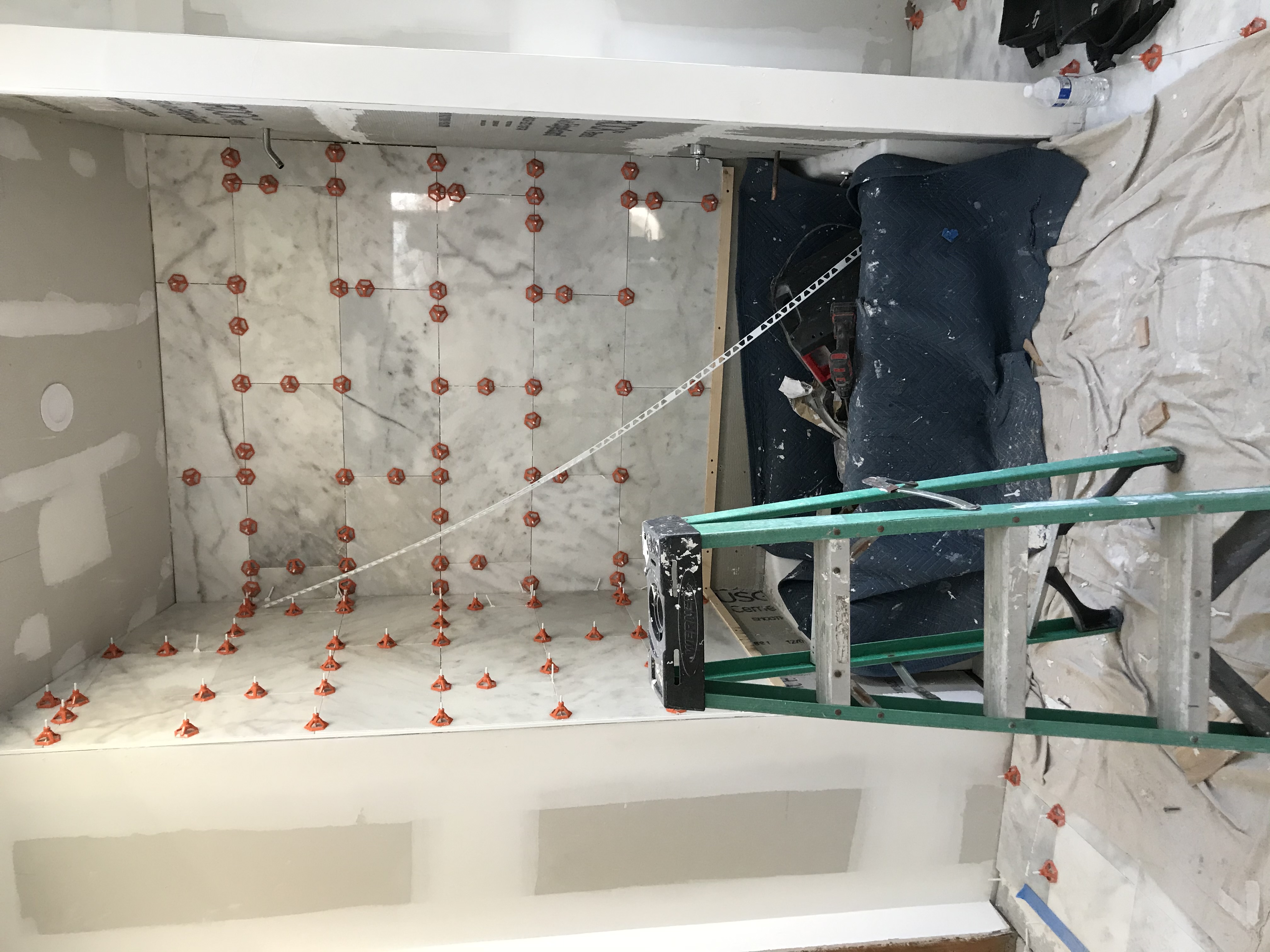
 Rough-In — Inspection Stage
 Bathroom Tile Going In
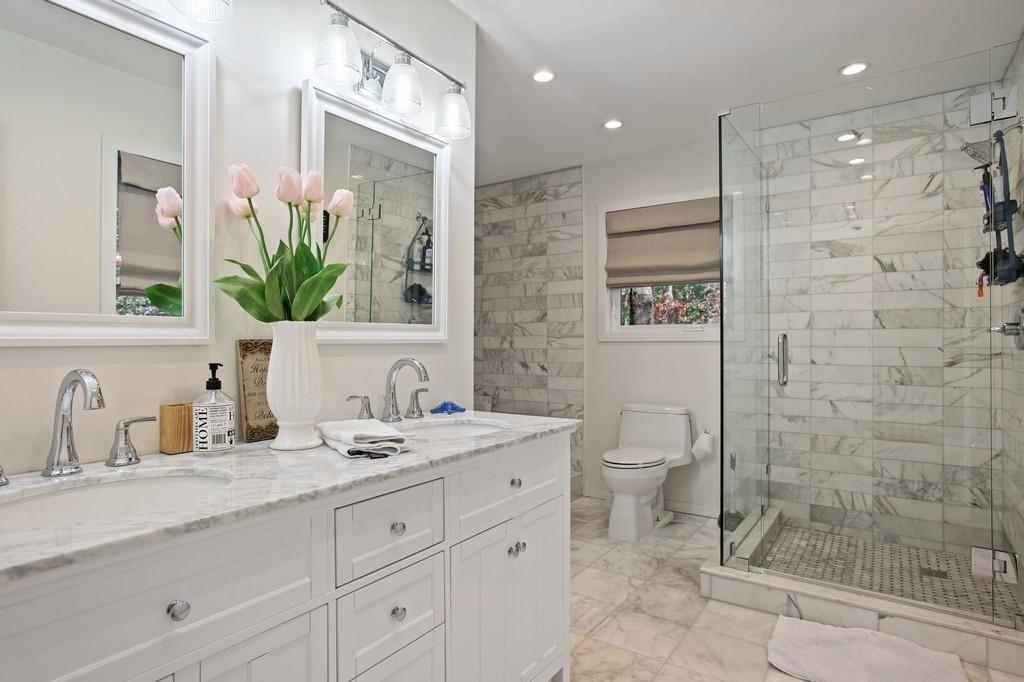 Marble Master — Finished