Bathroom Remodeling in Suffolk County
Quick Answer
Suffolk County bathroom projects answer to two authorities. Ten independent town building departments decide the permit, and the Town of Islip publishes the clearest rule on Long Island. Suffolk County Sanitary Code Article 6 governs wastewater, and its expansion trigger is bedrooms, not bathroom count. Greene Group Construction is licensed in Suffolk, HIC #HI-72958, with an office in Quogue.
Key Takeaways
- Suffolk's wastewater trigger is bedrooms. Per Sanitary Code §760-603(28), the expansion definition turns on adding bedrooms beyond the count previously approved by the Office of Wastewater Management.
- A second path exists in the same definition: an addition “requiring the addition or modification of Sewage disposal facilities” is captured regardless of bedroom count.
- §760-603(25) Major Reconstruction is reconstruction cost above 50% of the market value of the existing structure — the threshold that catches whole-house gut renovations.
- Islip: no permit for paint, wallpaper, tile, carpet or cabinets; new fixtures or gas piping do require one, and where roughing or new piping is involved the licensed plumber must file it.
- Smithtown is the only Long Island town publishing real fees: $305 + $0.45/sq ft, $55 for the first two plumbing fixtures, $100 for a residential CO.
- No Suffolk town publishes a permit turnaround time. We will not invent one, and neither should anyone quoting you a schedule.
Do You Need a Permit to Remodel a Bathroom in Suffolk County?
There is no single Suffolk County bathroom permit. Suffolk is divided into ten towns — Babylon, Brookhaven, East Hampton, Huntington, Islip, Riverhead, Shelter Island, Smithtown, Southampton and Southold — each running its own building department with its own forms, fees and interpretations, and incorporated villages can add a second layer of review. New York State sets the floor: 19 NYCRR 1203.3(a)(1) requires every authority having jurisdiction to require building permits for work that must conform to the Codes, while allowing localities to exempt a short list of categories that includes “painting, wallpapering, tiling, carpeting, or other similar finish work.” The state mandates permits for regulated work and merely allows towns to exempt cosmetic work. That is the real reason the answer varies town to town.
The Town of Islip Building Division publishes the most useful guidance on Long Island, and for a bathroom it is the single most relevant permit rule anywhere on the Island. Islip states that a building permit is not required for painting, wallpaper, tile, carpet or cabinets. A permit is required for new fixtures or gas piping, and for fixture replacement “if roughing or new piping is involved” — and in that case the licensed plumber must file the permit and perform the work. Electrical work requires a certificate from the New York Board of Fire Underwriters or an approved third-party inspection agency.
Applied to a bathroom, that draws a clean practical line. Retiling a shower in place, replacing a vanity top, painting and swapping a mirror are finish work. Moving a toilet three feet, adding a second sink, converting a tub to a curbless shower or running new supply and waste lines is permit work, and the plumbing permit is the plumber's to file. As of July 2026, confirm the current rule with your own building department before ordering materials. Our Long Island remodeling permits hub sets out what each Suffolk town publishes about permit triggers, fees and trade licensing, department by department. Towns update their handouts independently, and this page is general information, not legal or code advice.
How Do Suffolk's Ten Town Building Departments Actually Differ?
Below are the five Suffolk towns where most of our bathroom work happens, and what genuinely changes from one to the next. Read it as a scheduling document rather than trivia.
| Town |
Hamlets Covered |
What's Different There |
| Islip |
Bay Shore, Bayport, Bohemia, Brentwood, Central Islip, East Islip, Islip, Islip Terrace, Oakdale, Sayville, West Islip, parts of Hauppauge, Holbrook & Ronkonkoma. The Village of Brightwaters reviews its own permits. |
The clearest “do I need a permit” guidance on Long Island. No permit for painting, wallpaper, tile, carpet or cabinets. Permit required for new fixtures or gas piping, and for fixture replacement if roughing or new piping is involved — the licensed plumber must file it and perform the work. Electrical needs a New York Board of Fire Underwriters certificate or an approved third-party inspection agency. Has adopted RPTL §421-f. |
| Smithtown |
Kings Park, Nesconset, Saint James, Smithtown, parts of Commack & Hauppauge |
The only Long Island jurisdiction publishing real fees. Residential alterations $305 + $0.45/sq ft. Plumbing $55 for the first two fixtures. Residential certificate of occupancy $100. Electrical is the inspection agency's fee plus a $100 Town fee. The plumbing application must show the exact number and location of every fixture — so the bathroom layout has to be final before you file. |
| Babylon |
Copiague, Deer Park, North Babylon, West Babylon, Wyandanch and other unincorporated hamlets. The Villages of Amityville, Babylon and Lindenhurst review their own permits. |
Fees double if you file after work has started — the most expensive scheduling mistake a Suffolk homeowner can make. Permits expire in 180 days, and extensions run 180 days each. The code does not cap how many extensions may be granted, which matters on a bathroom that stalls waiting on tile or glass. |
| Huntington |
Dix Hills, East Northport, Greenlawn, Huntington, Huntington Station, Melville, part of Commack. The Village of Northport reviews its own permits. |
The heaviest paperwork package in the county: 2 notarized applications, 3 recent surveys by a licensed surveyor, 3 plot plans, 3 sets of drawings at ¼″ = 1′, workers' compensation form C-105.2 or U-26.3, and a copy of the Suffolk County Home Improvement Contractor photo ID. Has also adopted RPTL §421-f. |
| Brookhaven |
Coram, Farmingville, Holtsville, Mastic, Medford, Middle Island, Miller Place, Mount Sinai, Ridge, Rocky Point, Setauket, Shirley, Stony Brook, Yaphank and more. The Villages of Bellport, Patchogue and Port Jefferson review their own permits. |
The largest town in Suffolk, with the most varied housing stock. “Minor plumbing repairs to existing systems” are exempt — a full bathroom rebuild is a different animal. |
Smithtown is also the honest answer to what a bathroom permit costs, because Smithtown is the only Long Island town publishing a schedule you can budget against. As of July 2026 a residential alteration permit is $305 plus $0.45 per square foot, plumbing is $55 for the first two fixtures, a residential certificate of occupancy is $100, and electrical is billed by the inspection agency plus a $100 Town fee. For a 60-square-foot bathroom that is roughly $332 in building permit fees before plumbing, electrical and the CO. The other nine towns publish nothing comparable, so we carry permit fees as a visible line item in every Suffolk proposal rather than burying an estimate.
What nobody publishes: not one Suffolk County town publishes a permit turnaround time. Not Islip, not Smithtown, not Babylon, not Huntington, not Brookhaven. A contractor promising you “permits in two weeks” for a Suffolk bathroom is inventing that number. Call the department, ask about the current queue, and schedule with float.
Does a Bathroom Project in Suffolk County Trigger a Septic Review?
This is the question that separates a Suffolk bathroom from a bathroom anywhere else, and it is the question the remodeling industry on Long Island does not answer. Here is the operative fact, from Suffolk County Sanitary Code Article 6 as amended December 1, 2020.
In Suffolk County the trigger for wastewater review is bedrooms, not bathroom count. Under §760-603(28), a “New or Expanded Single-Family Residence” includes “the addition of one or more bedrooms to an existing Single-Family Residence that exceeds the number of bedrooms previously approved by the Department's Office of Wastewater Management.” Suffolk sizes residential systems off bedrooms. A second or third bathroom by itself does not increase the design flow the Suffolk County Department of Health Services assigns to the house. If you are adding a powder room off the hallway and the bedroom count is unchanged, the bedroom test is not what pulls you in. Cost, where a new bathroom can realistically go, and the drain and vent runs it depends on are covered in our Long Island bathroom addition guide.
The same definition contains a second path, and it is the one that catches real bathroom projects. An addition “requiring the addition or modification of Sewage disposal facilities” is included regardless of bedroom count. If the new bathroom forces the septic tank or a leaching pool to be relocated or modified, or if the new construction encroaches on the separation distances the system has to hold, the project is captured on that basis alone. This is why the sanitary system belongs on the site plan at design stage, not after demolition. We locate the tank and pools before we draw anything, because the cheapest version of this problem is the one you find on paper.
The third trigger is scale rather than plumbing. §760-603(25) defines Major Reconstruction as reconstruction where the cost exceeds 50% of the market value of the existing structure — structure only, excluding land, determined using FEMA P-758 methodology. A single bathroom rarely approaches that. A whole-house gut renovation with a new bathroom inside it frequently does, and that is what the threshold is built to catch.
Which Article 6 Outcomes Apply to Which Bathroom Scenarios?
| Scenario |
Outcome Under Article 6 |
Code Basis |
| Fixtures, tile and vanity replaced in an existing bathroom; bedroom count unchanged; sanitary system untouched |
Bedroom count governs, and it has not moved. The bedroom test is not met. |
§760-603(28) |
| Second or third bathroom added inside the existing footprint; bedroom count unchanged; tank and pools stay where they are |
Bathroom count is not the measure of design flow. The bedroom test is not met. |
§760-603(28), §760-614.D |
| Den, attic or basement room converted to a bedroom, taking the house above its previously approved bedroom count |
Meets the definition of a New or Expanded Single-Family Residence. |
§760-603(28) |
| New bathroom requires the tank or a leaching pool to be added, relocated or modified, or encroaches on required separation distances |
Captured regardless of bedroom count. |
§760-603(28) |
| Whole-house renovation where reconstruction cost exceeds 50% of the market value of the structure, excluding land |
Meets the definition of Major Reconstruction. |
§760-603(25) |
| Interior work that is not a Major Reconstruction, with no change in square footage or building footprint, in a house of five bedrooms or fewer |
Article 6 permits an exemption on these facts. |
§760-614.E |
| Project that is not a Major Reconstruction and adds no bedroom beyond the previously approved count |
Article 6 permits an exemption on these facts. |
§760-614.D |
| Sale of a house with an existing conventional system |
Article 6 contains no point-of-sale requirement. |
Article 6 |
Two exemptions do the practical work here, and both are worth reading as permissions rather than loopholes. §760-614.E allows an exemption where the project is not a Major Reconstruction, there is no change in square footage or building footprint, and total bedrooms do not exceed five. §760-614.D allows an exemption where the project is not a Major Reconstruction and no bedroom is added beyond the previously approved count. A gut bathroom renovation inside an existing four-bedroom house, with no footprint change, sits squarely inside both descriptions. Where Article 6 is triggered, §760-614.A requires a New York State Department of Health-approved innovative/alternative onsite wastewater treatment system (I/A OWTS) for applications submitted on or after July 1, 2021. We do not publish an I/A OWTS installation price, because we do not have a sourced figure and a made-up one would be worse than none.
Is There a Point-of-Sale Septic Requirement in Suffolk County?
There is no point-of-sale septic trigger in Suffolk County Sanitary Code Article 6. Article 6 attaches to construction activity and to applications made to the Health Department. It does not attach to the transfer of a deed. Lenders, title insurers and buyers can and do make an inspection or a system replacement a condition of their own deal, and those are private contract terms. Knowing the difference is worth money on both sides of a closing, and it is worth knowing before you plan a pre-sale bathroom renovation.
Scale explains why this matters across so much of the county. Roughly 74% of Suffolk County is unsewered, with approximately 380,000 individual onsite systems, about 209,000 of them in priority areas. Those figures come from the Suffolk County Countywide Wastewater Management District Feasibility Study, May 15, 2020. Where county sewage works are available and accessible, the direction runs the other way: Suffolk County Code §740-44 makes connection mandatory within one year of notification from the Administrator. So a Suffolk homeowner is usually in one of two situations — on a system the county wants improved, or on a street where a connection obligation can arrive by mail.
Two funding programs exist and they are published separately. The Suffolk County Septic Improvement Program offers a $20,000 county grant. The New York State Septic System Replacement Program offers up to $25,000. We quote them separately because the county publishes them separately. Eligibility conditions apply to both: the property must be unsewered with a recorded deed, taxes current, a valid certificate of occupancy and no liens; the existing system must be abandoned and replaced; new construction on a vacant lot is not eligible. Program contact is SepticGrants@SuffolkCountyNY.gov and (631) 852-5811.
Article 6 is amended periodically. Confirm the current requirements with the Suffolk County Department of Health Services Office of Wastewater Management before you rely on any of this for your project. This page is general information, not legal, code or health-department advice.
How Is Nassau County Different on Septic?
Structurally, not just in degree. The Nassau County Department of Health has jurisdiction over septic systems for realty subdivisions of five lots or more, and over commercial systems with a design flow of 1,000 gallons per day or more. For an individual single-family home, Nassau directs homeowners to the local building department. There is no Nassau county-level equivalent of SCDHS review for a single-family bathroom addition — in Nassau that question is a town or village matter. If your project is on the other side of the county line, we cover the village-by-village reality in bathroom remodeling in Nassau County. Out east, where almost nothing is sewered, the wastewater question is at its sharpest: see bathroom renovation in the Hamptons and East End.
What Does a Bathroom Remodel Cost in Suffolk County?
These ranges are triangulated from Zonda's 2025 Cost vs. Value data for the New York metro market and the published tiers of Long Island bathroom contractors. They are planning ranges, not a quote. We publish no Nassau-versus-Suffolk price delta, because no credible dataset splits Long Island bathroom cost by county. The real county difference is jurisdictional.
| Tier |
Range |
What It Is |
Timeline |
| Surface refresh | $12,000 – $25,000 | Fixtures, vanity, paint, re-tile in place. Nothing moves. | 1–2 weeks |
| Midrange full remodel | $25,000 – $50,000 | Everything replaced, layout essentially unchanged. Zonda's NY metro midrange figure of $30,376 sits inside this band. | 3–5 weeks |
| Major / gut renovation | $50,000 – $85,000 | Down to studs and subfloor. Layout changes, plumbing moves, hidden conditions surface. | 5–8 weeks |
| Upscale | $85,000 – $140,000 | Stone, custom glass, radiant floor, high-end fixtures. Zonda's NY metro upscale figure of $90,686 sits inside this band. | 8–12 weeks |
| High-end custom / East End | $140,000+ | Fully bespoke. | 12+ weeks |
Planning ranges as of July 2026, triangulated from Zonda's 2025 Cost vs. Value data for the New York metro market and published Long Island contractor tiers. Not a quote.
Adding a bathroom is a different exercise. A half bath inside the existing footprint runs $25,000 to $45,000 over 4 to 6 weeks. A full bath inside the existing footprint — a basement, closet or spare-room conversion — runs $40,000 to $75,000 over 6 to 10 weeks. A full bath that adds square footage runs $70,000 to $130,000 and up over 10 to 16 weeks. Zonda's New York metro reference points for additions are $70,419 midrange and $126,509 upscale. In Suffolk County an addition may trigger New York State Department of Health-approved I/A OWTS requirements. That is a separate scope with its own SCDHS review, and we do not fold a placeholder for it into a bathroom number. Suffolk's Septic Improvement Program offers a $20,000 county grant, and the New York State Septic System Replacement Program offers up to $25,000. For line-item allowances, the labor split and where homeowners overspend, see our Long Island bathroom remodel cost guide.
Can a Bathroom Remodel Raise Your Property Taxes in Suffolk County?
An improvement can raise an assessment, and New York's Home Improvement Exemption is built to soften that. Under RPTL §421-f, up to $80,000 of increased market value is shielded on an eight-year declining scale: 100%, 87.5%, 75%, 62.5%, 50%, 37.5%, 25%, then 12.5%. The improvement must exceed $3,000, and the greater portion of the improved building by square footage must be at least five years old. Ordinary maintenance and repairs do not qualify, and the exemption is opt-in by locality. Islip and Huntington have both adopted it at the $80,000 cap. A gut bathroom in an older Islip or Huntington house clears the $3,000 floor without effort. Confirm eligibility and the current filing window with your own town assessor — this is general information, not tax or legal advice.
What If Water Damage Is Why Your Suffolk Bathroom Needs Work?
A bathroom packs more plumbing into less floor area than any other room in a house. A failed shower pan, a supply line behind the vanity or a wax ring that has been weeping for two years does not stop at the tile — the subfloor, the joists and the ceiling below all need assessing before anyone talks about finishes. Greene Group Construction runs restoration and insurance-claims work as real service lines on this same domain, which means water damage restoration and the finished bathroom rebuild sit under one contract. When a carrier is paying, the team that documents the damage is the team that scopes and performs the repair, and nothing gets lost in a handoff between a mitigation vendor and a separate remodeling contractor. Our insurance claims support page covers how we document and scope those jobs.
This is also where the one-day bath franchises reach their limit, honestly stated. A liner over an existing tub is a real service for a sound bathroom. It is a real limitation the moment there is water in the subfloor, a wall to move, or a claim to run. Structural work runs through our general contracting division, and demolition debris goes out with our own junk removal and cleanout crews rather than a rented dumpster you coordinate yourself.
How Do You Verify a Bathroom Contractor Is Licensed in Suffolk County?
Start with the number. Greene Group Construction holds Suffolk County HIC #HI-72958 and Nassau County HIC #EF-65498. Under Suffolk County Code Chapter 563, a home improvement contractor's license number is legally required to appear in advertising — which makes it a free screening tool. An ad, truck or website with no visible Suffolk license number is itself a warning sign, and the number you are given is worth verifying with the Suffolk County Department of Labor, Licensing and Consumer Affairs. Huntington goes a step further and requires a copy of the Suffolk County HIC photo ID in the permit package.
One more thing to ask about, because honest answers here are rare. Our own carpenters and project managers run your job start to finish. Electrical and plumbing are performed by licensed Nassau and Suffolk trade contractors we've worked with for years — we schedule them, we coordinate the inspections, and we're accountable for the result.
Suffolk County Bathroom Remodeling FAQ
Do I need a permit to remodel a bathroom in Suffolk County?
It depends on your town and on your scope. The Town of Islip publishes the clearest rule on Long Island: no building permit for painting, wallpaper, tile, carpet or cabinets. A permit is required for new fixtures or gas piping, and for fixture replacement if roughing or new piping is involved, in which case the licensed plumber must file the permit and perform the work. Retiling a shower in place is usually finish work. Moving a toilet or adding a fixture is not.
Does adding a bathroom in Suffolk County trigger a Health Department wastewater review?
The trigger in Suffolk County is bedrooms, not bathroom count. Under Suffolk County Sanitary Code §760-603(28), a New or Expanded Single-Family Residence includes the addition of one or more bedrooms beyond the number previously approved by the Department's Office of Wastewater Management. Suffolk sizes residential systems off bedrooms, so a second or third bathroom by itself does not increase the design flow SCDHS assigns to the house. The same definition also captures any addition requiring the addition or modification of sewage disposal facilities, so a bathroom that forces the tank or leaching pool to move is included regardless of bedroom count.
What triggers an I/A OWTS requirement on a Suffolk County home?
Suffolk County Sanitary Code §760-614.A requires a New York State Department of Health-approved innovative/alternative onsite wastewater treatment system where Article 6 is triggered, for applications submitted on or after July 1, 2021. The two common triggers are a bedroom count above the previously approved number under §760-603(28) and Major Reconstruction under §760-603(25), meaning reconstruction cost exceeding 50% of the market value of the existing structure, structure only, excluding land, using FEMA P-758 methodology.
Does Suffolk County require a septic upgrade when you sell a house?
There is no point-of-sale septic trigger in Suffolk County Sanitary Code Article 6. Article 6 attaches to construction activity and to Health Department applications, not to the transfer of a deed. Lenders, title companies and buyers can still make an inspection or an upgrade a condition of their own transaction, and those are private terms rather than a county requirement. Article 6 is amended periodically, so confirm the current requirements with the Suffolk County Department of Health Services Office of Wastewater Management.
Which Suffolk County town publishes its bathroom permit fees?
The Town of Smithtown is the only Long Island jurisdiction publishing a usable schedule. As of July 2026 a residential alteration permit is $305 plus $0.45 per square foot, plumbing is $55 for the first two fixtures, a residential certificate of occupancy is $100, and electrical is the inspection agency fee plus a $100 Town fee. Smithtown also requires the plumbing application to show the exact number and location of every fixture.
How long does a bathroom permit take to get approved in Suffolk County?
No Suffolk County town publishes a permit turnaround time. That is the honest answer, and a contractor quoting you a guaranteed number is inventing it. Review time varies by town, by season, by how complete the application is, and by whether the scope pulls in plan review or a Health Department application. Call the department, ask about the current queue, and schedule with float.
What does a bathroom remodel cost in Suffolk County?
Plan on $12,000 to $25,000 for a surface refresh, $25,000 to $50,000 for a midrange full remodel, $50,000 to $85,000 for a major or gut renovation, $85,000 to $140,000 for upscale work, and $140,000 and up for high-end custom. Adding a bathroom runs $25,000 to $45,000 for a half bath inside the existing footprint, $40,000 to $75,000 for a full bath inside the footprint, and $70,000 to $130,000 and up when you add square footage. These ranges are triangulated from Zonda's 2025 Cost vs. Value data for the New York metro market and the published tiers of Long Island bathroom contractors. They are planning ranges, not a quote.
How do I check that a Suffolk County bathroom contractor is licensed?
Ask for the Suffolk County Home Improvement Contractor license number and verify it with the Suffolk County Department of Labor, Licensing and Consumer Affairs. Under Suffolk County Code Chapter 563 that number is legally required to appear in a contractor's advertising, so an ad without one is itself a warning sign. Greene Group Construction holds Suffolk County HIC #HI-72958 and Nassau County HIC #EF-65498.
Ready to talk about your Suffolk County bathroom? Call (631) 532-7346 and we will tell you which town department your address falls under, whether Article 6 has anything to say about your scope, and what the work costs. Our office is in Quogue — inside Suffolk County, in the Town of Southampton. For the Island-wide picture, start at our bathroom remodeling hub, or request a free estimate.
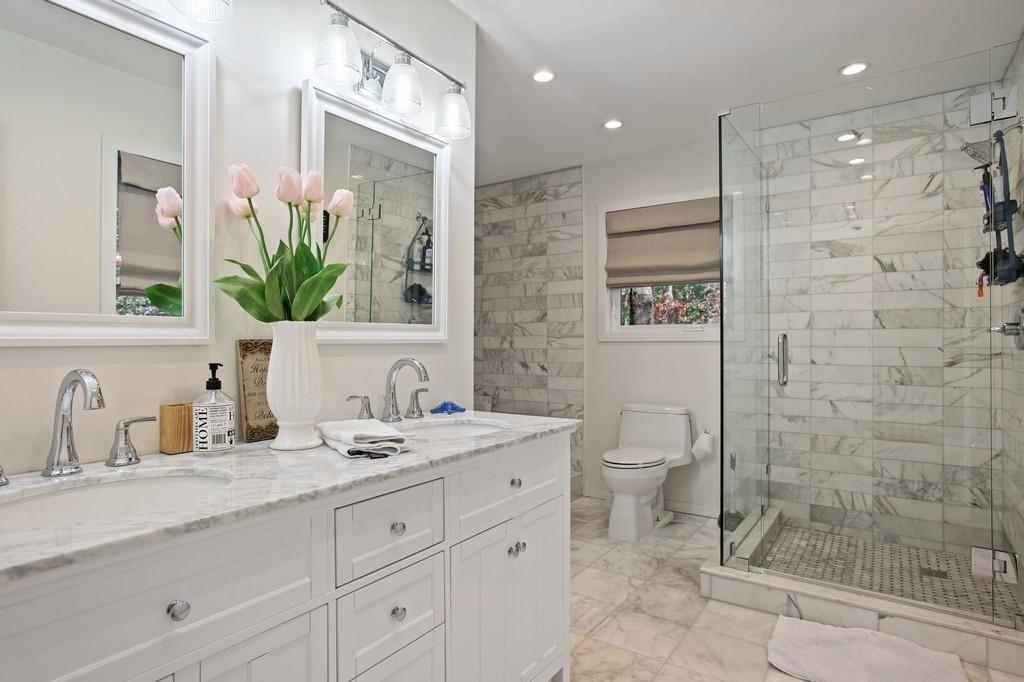 Marble Master — Walk-In Glass Shower
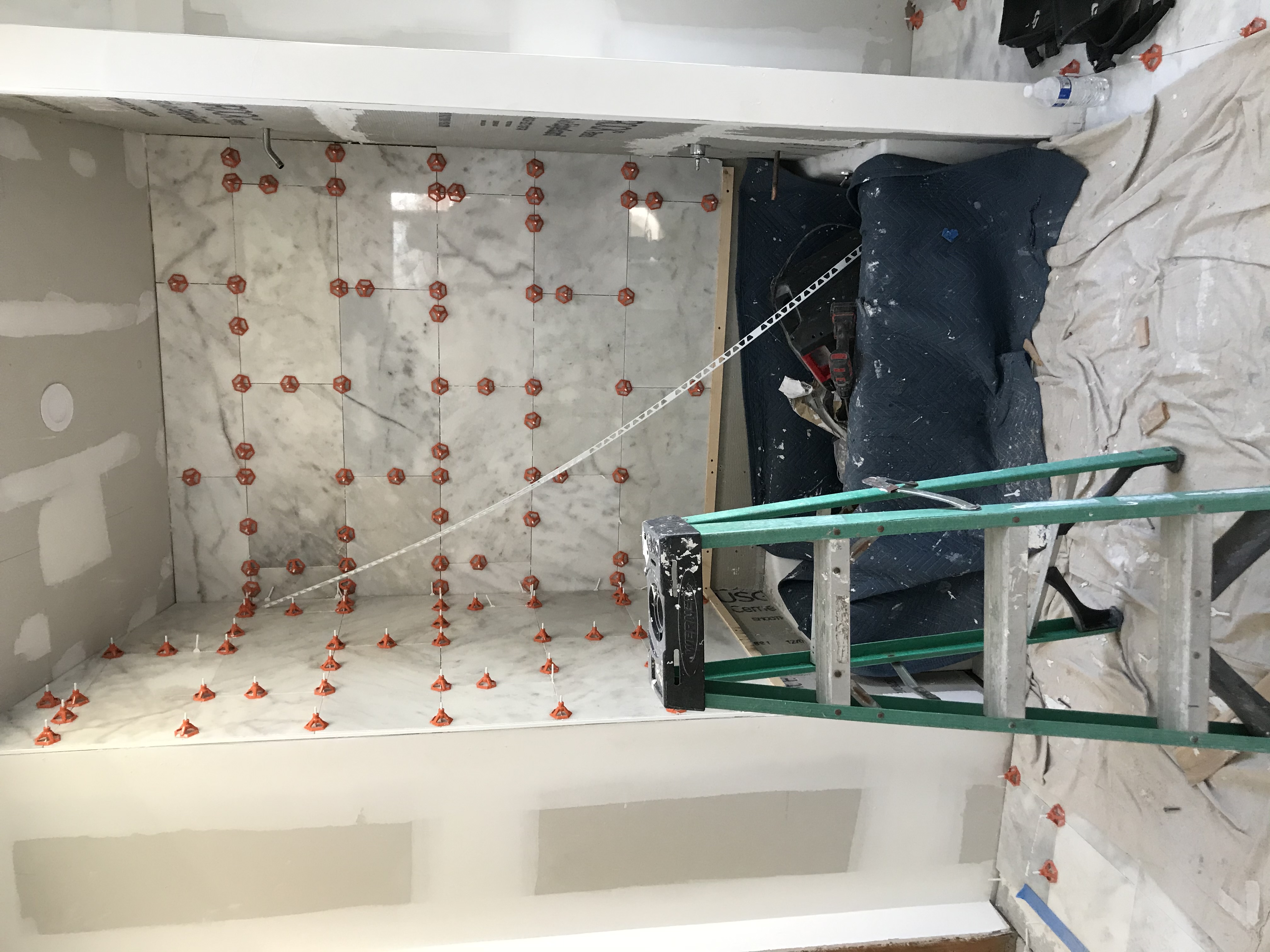 Shower Tile Going In
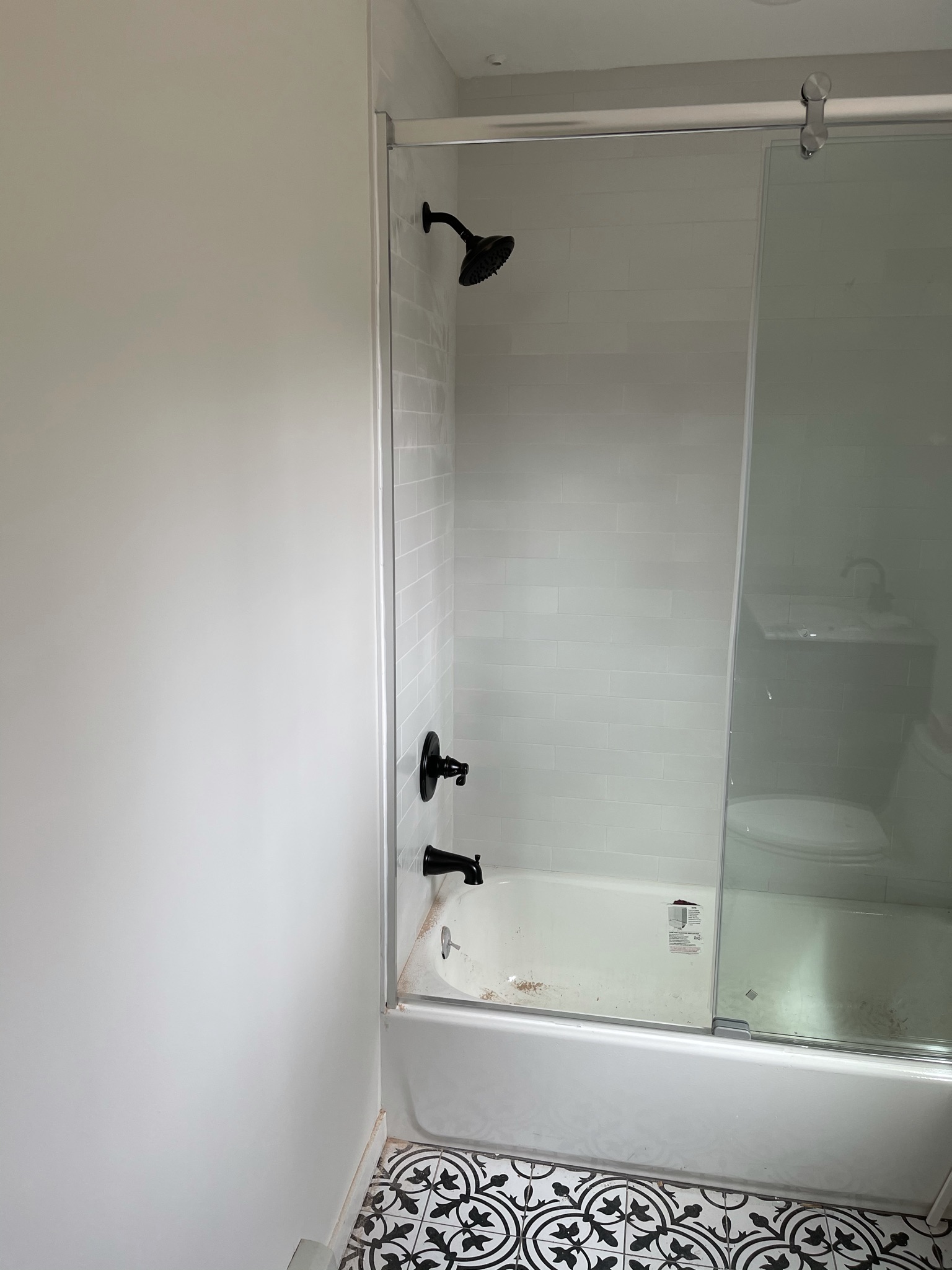
 Tub/Shower — Frameless Glass
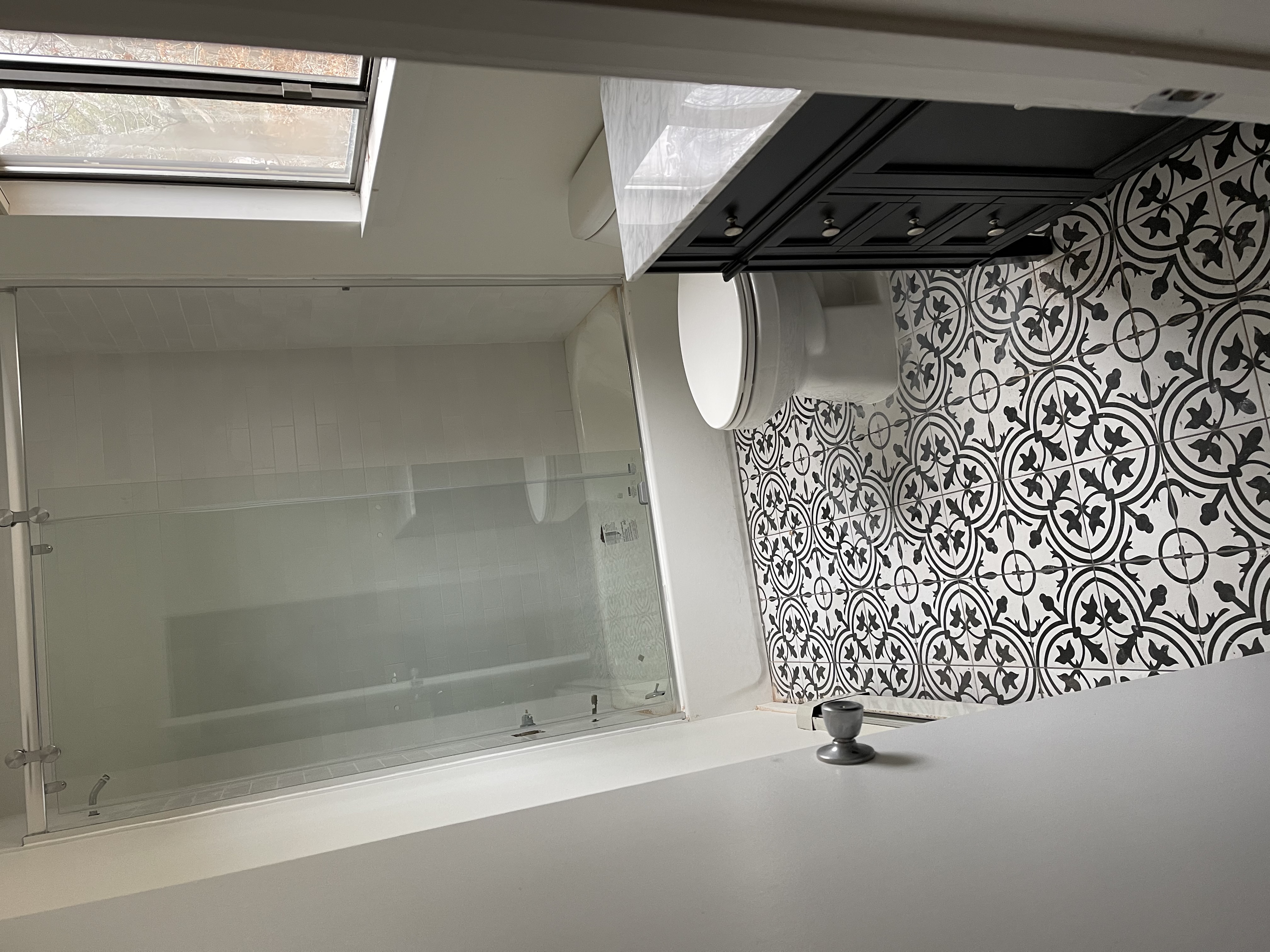
 Marble Top & Hex Mosaic Floor