Kitchen Remodeling in Suffolk County
Quick Answer
Kitchen remodeling in Suffolk County is governed by ten independent town building departments, not one county code. The Town of Islip publishes the clearest rule on Long Island: no permit for paint, wallpaper, tile, carpet or cabinets, but a permit is required for new fixtures or gas piping. Smithtown is the only Long Island town publishing real fees — $305 plus $0.45 per square foot for residential alterations. Babylon doubles fees if you file late. Huntington demands notarized applications and three surveys. No Suffolk town publishes a permit turnaround time. Greene Group Construction is licensed in Suffolk (HIC #HI-72958) and based in Quogue.
Key Takeaways
- Suffolk has ten independent town building departments — your town decides the rules, not the county.
- Islip: no permit for cabinets, tile, paint or carpet; new fixtures or gas piping do require one, filed by the licensed plumber.
- Smithtown is the only Long Island town publishing real fees: $305 + $0.45/sq ft, $55 for the first two plumbing fixtures, $100 for a residential CO.
- Babylon fees double if you file after work has started. Permits expire in 180 days; extensions run 180 days each and the code does not cap how many may be granted.
- RPTL §421-f shields up to $80,000 of added value over eight declining years. Islip and Huntington adopted it.
- No town publishes permit turnaround times and no dataset splits kitchen cost by county — we will not invent either.
Do You Need a Permit to Remodel a Kitchen in Suffolk County?
There is no single Suffolk County kitchen permit. Suffolk is divided into ten towns — Islip, Smithtown, Babylon, Huntington, Brookhaven, Southampton, Southold, Riverhead, Shelter Island and East Hampton — each running its own building department with its own forms, fees and interpretations, and incorporated villages can add a second layer of review. A homeowner in Sayville and one in Northport are doing the same kitchen under genuinely different rulebooks, which is why generic Long Island advice fails here.
The Town of Islip Building Division publishes the most useful guidance on the Island, and it is worth quoting because it settles the question most homeowners actually ask. Islip states that a building permit is not required for finish work: painting, wallpaper, tile, carpet and cabinets. A permit is required for new fixtures or gas piping, and for fixture replacement “if roughing or new piping is involved” — and in that case the licensed plumber must file the permit and perform the work. Electrical work requires a certificate from the New York Board of Fire Underwriters or an approved third-party inspection agency.
That distinction is the practical test across Suffolk. Swapping cabinets and countertops in place is usually finish work. The moment you move a sink, run gas to a new range location, add circuits for an induction cooktop or take down a wall, you are in permit territory. Our Long Island remodeling permits hub covers each Suffolk town building department in turn, with the code language each one publishes on permit triggers and trade licensing. As of July 2026, confirm the current rule with your own building department before ordering materials — towns update their handouts independently, and this page is general information, not legal or code advice.
How Do Suffolk's Town Building Departments Actually Differ?
The table below is the part no Long Island competitor publishes: the five Suffolk towns where most of our kitchen work happens, and what genuinely changes from one to the next.
| Town |
Towns / Hamlets Covered |
What's Different There |
| Islip |
Bay Shore, Bayport, Bohemia, Brentwood, Central Islip, East Islip, Islip, Islip Terrace, Oakdale, Sayville, West Islip, Brightwaters, parts of Hauppauge, Holbrook & Ronkonkoma |
Best-documented “do I need a permit” guidance on Long Island. No permit for paint, wallpaper, tile, carpet or cabinets. Permit required for new fixtures or gas piping, and for fixture replacement if roughing or new piping is involved — the licensed plumber must file it and do the work. Electrical needs a New York Board of Fire Underwriters or approved third-party certificate. Has adopted RPTL §421-f. |
| Smithtown |
Kings Park, Nesconset, Saint James, Smithtown, parts of Commack & Hauppauge |
The only Long Island jurisdiction publishing real fees. Residential alterations $305 + $0.45/sq ft. Plumbing $55 for the first two fixtures. Residential certificate of occupancy $100. Electrical is the inspection agency's fee plus a $100 Town fee. The plumbing application must show the exact number and location of every fixture. Online residential permit portal. |
| Babylon |
Amityville, Babylon, Copiague, Deer Park, Lindenhurst, North Babylon, West Babylon, Wyandanch |
Fees double if you file after work has started — the most expensive scheduling mistake a Suffolk homeowner can make. Permits expire in 180 days, and extensions run 180 days each with no cap in the code on how many may be granted. A certificate of occupancy is required after alteration. |
| Huntington |
Dix Hills, East Northport, Greenlawn, Huntington, Huntington Station, Melville, Northport, part of Commack |
The heaviest paperwork package in the county: 2 notarized applications, 3 recent surveys by a licensed surveyor, 3 plot plans, 3 sets of drawings at ¼″ = 1′, workers' comp form C-105.2 or U-26.3, and a copy of the Suffolk County Home Improvement Contractor photo ID. Has also adopted RPTL §421-f. |
| Brookhaven |
Bellport, Coram, Farmingville, Holtsville, Lake Grove, Mastic, Medford, Middle Island, Miller Place, Mount Sinai, Patchogue, Port Jefferson, Ridge, Rocky Point, Setauket, Shirley, Stony Brook, Yaphank and more |
The largest town in Suffolk, with the most varied housing stock. “Minor plumbing repairs to existing systems” are exempt — virtually nothing else in a kitchen is. Permit status lookup is online; full online filing is not. |
Read that table as a scheduling document, not trivia. Babylon's doubling rule means demolition cannot start before the paperwork lands. Huntington's survey requirement means a licensed surveyor lined up weeks ahead. Smithtown's plumbing drawing means the fixture layout must be final before filing. These details turn a six-week kitchen into a four-month one.
What Do Kitchen Permits Cost in Suffolk County?
Smithtown is the honest answer to this question, because Smithtown is the only Long Island town that publishes a schedule you can actually budget against. As of July 2026: a residential alteration permit is $305 plus $0.45 per square foot. Plumbing is $55 for the first two fixtures. A residential certificate of occupancy is $100. Electrical is billed by the inspection agency, plus a $100 Town fee. For a 200-square-foot kitchen that is roughly $395 in building permit fees before plumbing, electrical and the CO.
The other nine Suffolk towns publish nothing comparable. Brookhaven publishes no Building Division fee schedule at all; Babylon publishes the doubling penalty rather than a base table. Beyond that you are calling the department. We would rather say so than print invented numbers, and we build permit fees into every Suffolk proposal as a visible line item.
What nobody publishes: not one Suffolk County town publishes a permit turnaround time. Not Islip, not Smithtown, not Babylon, not Huntington, not Brookhaven. Every contractor who promises you “permits in two weeks” for a Suffolk kitchen is guessing. Call the department, ask about the current queue, and schedule with float. If you want the full picture across both counties, our
kitchen remodeling hub lays out the Island-wide process.
Can a Kitchen Remodel Lower Your Property Taxes in Suffolk County?
It cannot lower them, but New York's Home Improvement Exemption can stop a remodel from raising them all at once. Under RPTL §421-f, up to $80,000 of increased market value is shielded on an eight-year declining scale: 100%, 87.5%, 75%, 62.5%, 50%, 37.5%, 25%, then 12.5%. The improvement must exceed $3,000, and the greater portion of the improved building by square footage must be at least five years old. Ordinary maintenance and repairs do not qualify.
The exemption is opt-in by locality, which is why it matters that we can name the towns. Islip adopted it by Local Law 1 on July 13, 1994, and Huntington adopted it by Local Law 1 on January 25, 1994 — both at the $80,000 cap. If you are in Islip or Huntington and your kitchen project clears $3,000 in a house older than five years, this is a real reason to remodel rather than move, and it is essentially uncontested in search because almost nobody explains it.
Two cautions. We deliberately publish no Nassau County 421-f figure here: Nassau's special provision was repealed effective January 1, 2026, and stale numbers still circulate. And this is general information, not tax or legal advice — adoption, caps and filing deadlines change, so confirm eligibility and the current filing window with your own town assessor.
What Do Suffolk County Kitchens Actually Look Like?
Suffolk is not one housing market. On the South Shore, in Babylon and Islip, the volume mid-market is postwar ranches and capes — compact galley or L-shaped kitchens, often walled off from a small dining room, with the single biggest gain coming from opening one wall. Brookhaven holds the largest and most varied stock on the Island: 1960s through 1980s colonials and splits, where the kitchen usually already borders a family room and the work is about widening an opening and rebalancing the layout around an island.
The Huntington corridor — Huntington proper, Dix Hills, Melville — is the affluent end: larger footprints, higher finish budgets, genuinely structural open-concept work. On the North Shore, Northport, Port Jefferson and Stony Brook bring older village and waterfront housing, with tighter village rules, older framing and more surprises behind the plaster.
One pattern cuts across all of it. Suffolk's 1950s and 1960s stock routinely surfaces $3,000 to $15,000 of code-update work once the walls open — undersized electrical panels, no dedicated circuits for modern appliances, and cast-iron waste lines at the end of their service life. This is not upselling; it is what an inspector will require. We price a contingency for it up front rather than presenting it as a change order in week three.
What Does a Kitchen Remodel Cost in Suffolk County?
The honest framing first: no credible dataset splits Long Island kitchen remodeling cost by county. Anyone showing you a precise county percentage invented it. The real difference between the counties is not price — it is jurisdiction. Nassau kitchens run through three towns, two cities and roughly 64 incorporated villages; Suffolk kitchens run through ten independent town departments with different forms, fees and requirements. That is a schedule difference, and schedule is where budgets break. What we can give you is Greene Group Construction's own observed Long Island range, labelled as exactly that.
| Tier |
Typical Scope |
Greene Group Observed Range |
| Cosmetic refresh | Cabinet refacing or replacement in place, countertops, backsplash, flooring, paint. No layout change. | $20,000 – $40,000 |
| Midrange full remodel | Full tear-out, new cabinetry and counters, updated electrical and plumbing in existing footprint, minor layout change. | $45,000 – $85,000 |
| Major / gut renovation | Down to studs, wall removal with engineered beam, relocated plumbing and gas, panel upgrade, new flooring throughout. | $85,000 – $150,000 |
| Upscale | Custom cabinetry, premium appliance package, structural open-concept work, integrated lighting design. | $150,000 – $250,000 |
| High-end custom | Bespoke millwork, architectural involvement, additions or bump-outs, high-end stone and specialty finishes. | $250,000+ |
Greene Group Construction's observed Long Island project ranges as of July 2026. Not a published index, not a quote. Suffolk permit fees, code-update work and appliance selections move these numbers.
For the full cost breakdown — line-item allowances, what drives each tier, and where homeowners overspend — see our dedicated kitchen remodel cost guide for Long Island. If your project sits in the other county or out east, we cover those separately at kitchen remodeling in Nassau County and kitchen remodeling in the Hamptons and East End.
Can You Remove a Wall in a Suffolk Ranch, Cape or Colonial?
Usually yes — but the answer is structural, not stylistic. In a South Shore ranch or cape the wall between the kitchen and the dining or living room is frequently load-bearing, carrying ceiling joists and sometimes a second-floor knee wall. Removing it means an engineered LVL or steel beam, properly sized, with the load carried down through new posts to adequate bearing at the foundation. That is permit work in every Suffolk town, and it typically requires stamped drawings.
In Brookhaven's colonials and splits the wall is often already partly open, and the work is widening it and building a header that spans the gap. In Huntington and Dix Hills the spans get longer and the beams heavier, which is where steel beats laminated lumber. In older North Shore village housing the framing is less predictable, so we open an inspection hole before quoting a beam. Because we are a general contractor rather than a showroom, the structural work, demolition and debris hauling are ours — broader structural work runs through our general contracting division, and debris goes out with our own junk removal and cleanout crews rather than a rented dumpster you coordinate yourself.
What If Fire or Water Destroyed Your Suffolk Kitchen?
Kitchens are where most residential fires start and where a surprising share of water losses show up — supply lines under the sink, dishwasher connections, refrigerator ice-maker lines, and failures in the ceiling above from a second-floor bath. A destroyed kitchen is a different project from a chosen remodel: it starts with mitigation and an insurance carrier, not with a cabinet showroom.
Greene Group Construction runs restoration and insurance-claims work as real service lines alongside kitchen remodeling. That means one company handles emergency water damage mitigation or fire damage cleanup, the demolition, the debris hauling, the structural repair and the finished kitchen rebuild. On a claim that matters, because the team documenting the damage is the team scoping and performing the repair — there is no handoff where scope gets lost between a mitigation vendor and a separate remodeling contractor. See our restoration services and how we handle insurance claims.
How Do You Verify a Kitchen Contractor Is Licensed in Suffolk County?
Start with the number. Greene Group Construction holds Suffolk County HIC #HI-72958 and Nassau County HIC #EF-65498. Under Suffolk County Code Chapter 563, a home improvement contractor's license number is legally required to appear in advertising — a free screening tool. An ad, truck or website with no visible Suffolk license number is telling you something, and the number you are given is worth verifying with the Suffolk County Department of Labor, Licensing and Consumer Affairs.
New York backs this up with real consequences. CPLR 3015(e) requires a contractor suing a consumer to plead its license name, number and issuing agency — and it covers licenses from Suffolk, Nassau, Westchester, Rockland and Putnam counties plus the New York City Department of Consumer Affairs. Note that this is a Long Island and downstate rule, not a blanket statewide one. Case law goes further: in Holistic Homes, LLC v. Greenfield (2d Dep't 2016), the court held that an unlicensed contractor may neither enforce a home improvement contract nor recover in quantum meruit. This is general information, not legal advice.
One more thing to ask about, because honest answers here are rare. Our own carpenters and project managers run your job start to finish. Electrical and plumbing are performed by licensed Nassau and Suffolk trade contractors we've worked with for years — we schedule them, we coordinate the inspections, and we're accountable for the result.
Suffolk County Kitchen Remodeling FAQ
Do I need a permit to replace kitchen cabinets in Suffolk County?
In the Town of Islip, no. Islip states plainly that a building permit is not required for painting, wallpaper, tile, carpet or cabinets. A permit is required once you add new fixtures or gas piping, or replace a fixture where roughing or new piping is involved. Other Suffolk towns follow similar logic without publishing it as clearly, so confirm with your own building department.
Which Suffolk County town publishes its kitchen permit fees?
The Town of Smithtown is the only Long Island jurisdiction publishing a usable schedule. As of July 2026 a residential alteration permit is $305 plus $0.45 per square foot, plumbing is $55 for the first two fixtures, a residential certificate of occupancy is $100, and electrical is the inspection agency fee plus a $100 Town fee. The other nine towns do not.
How long does a kitchen permit take to get approved in Suffolk County?
No Suffolk County town publishes a permit turnaround time. That is the honest answer, and any contractor quoting you a guaranteed number is inventing it. Review time varies by town, by season, by how complete your application is, and by whether a structural change triggers plan review. Call the department, ask about the current queue, and schedule with float.
Will a kitchen remodel raise my property taxes in Suffolk County?
It can, but New York RPTL §421-f softens it. The Home Improvement Exemption shields up to $80,000 of increased market value on an eight-year declining scale beginning at 100%. The improvement must exceed $3,000 and the greater portion of the building by square footage must be at least five years old. Islip and Huntington have both adopted it.
What does a kitchen remodel cost in Suffolk County?
Based on Greene Group Construction's own Long Island project history, cosmetic refreshes run $20,000–$40,000, a midrange full remodel $45,000–$85,000, a major or gut renovation $85,000–$150,000, upscale work $150,000–$250,000, and high-end custom above $250,000. Those are our observed ranges, not a published index. Postwar houses frequently add $3,000–$15,000 of code-update work once the walls open.
Is a kitchen remodel cheaper in Suffolk County than in Nassau County?
We will not publish a price delta, because no credible dataset splits Long Island kitchen cost by county. Anyone quoting a precise Nassau versus Suffolk percentage made it up. The real county difference is jurisdictional: Nassau kitchens are permitted through three towns, two cities and roughly 64 incorporated villages, while Suffolk kitchens run through ten independent town building departments with materially different rules and fees.
How do I check that a Suffolk County kitchen contractor is licensed?
Ask for the Suffolk County Home Improvement Contractor license number and verify it with the Suffolk County Department of Labor, Licensing and Consumer Affairs. Under Suffolk County Code Chapter 563 that number is legally required in a contractor's advertising, so an ad without one is itself a warning sign. Greene Group holds Suffolk County HIC #HI-72958 and Nassau County HIC #EF-65498.
Can you rebuild a Suffolk County kitchen damaged by fire or water?
Yes. Greene Group Construction runs restoration and insurance-claims work alongside kitchen remodeling, so a fire or water loss moves from emergency mitigation through demolition, debris hauling, structural repair and full kitchen rebuild under one company. On a claim that matters, because the same team documents the damage, scopes the repair and finishes the work.
 Open Concept — Island & Pendants
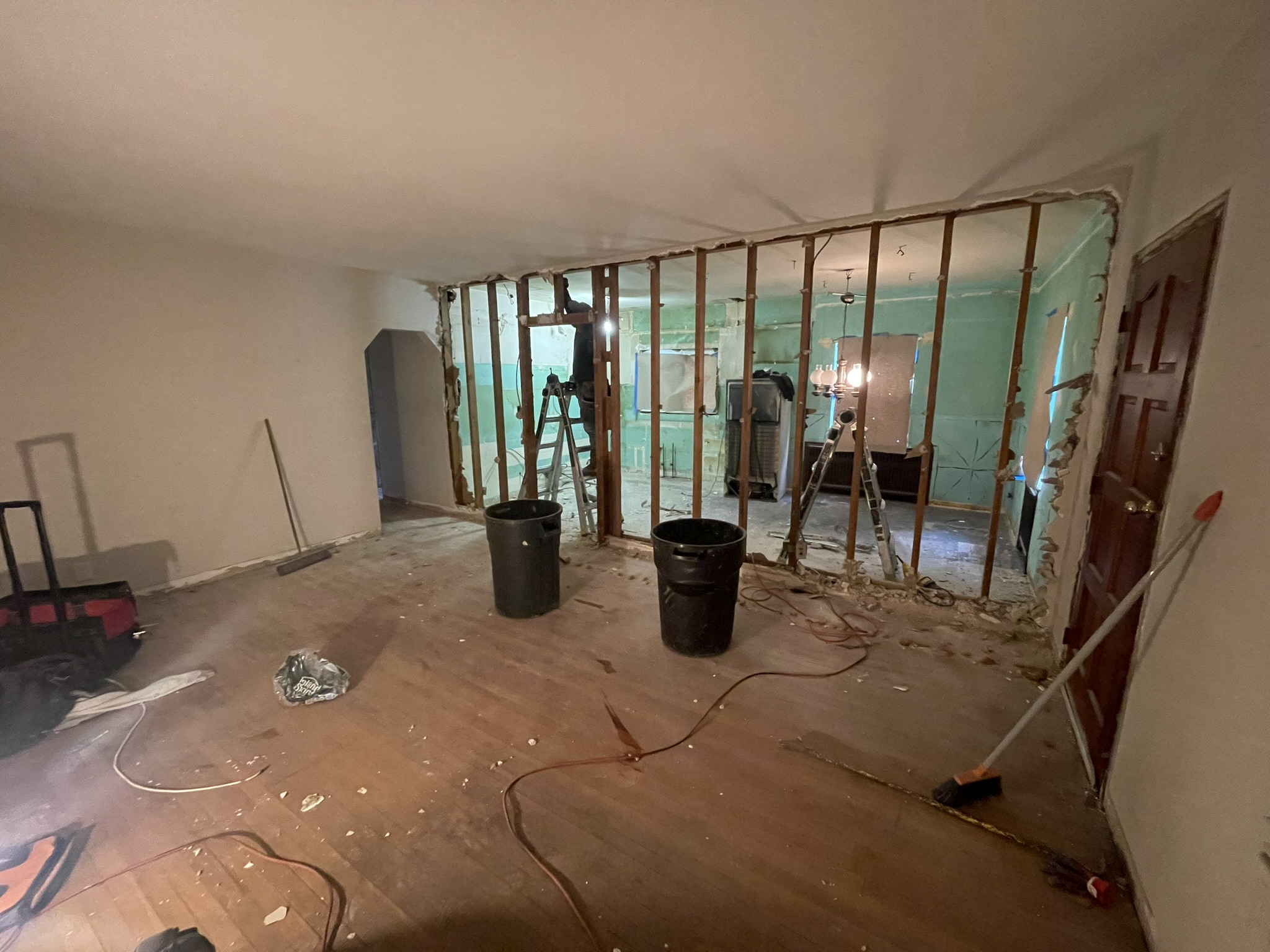 Demolition Day
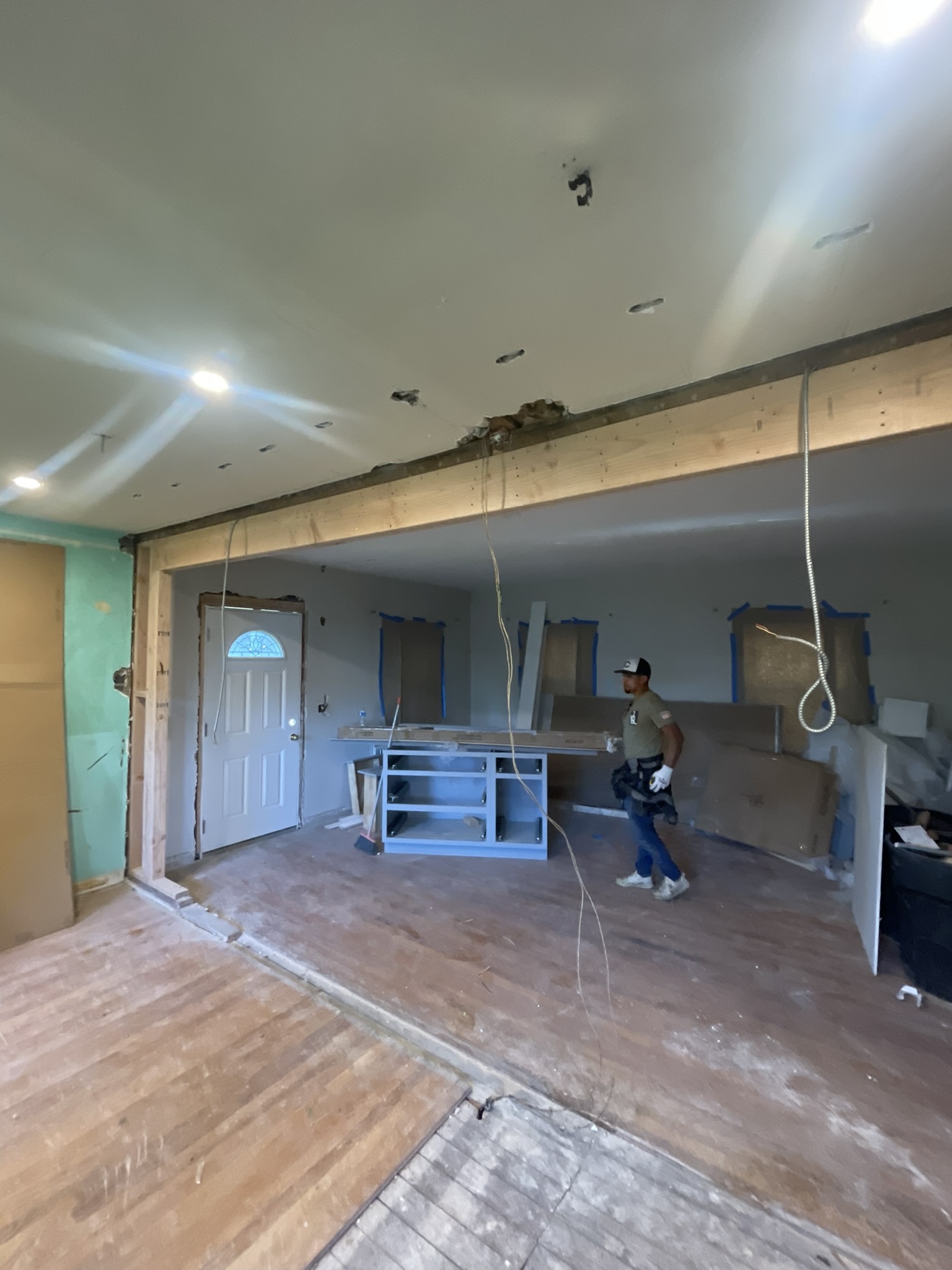 Structural Beam After Wall Removal
 Quartz Waterfall Island