Kitchen & Bathroom Permits in the Town of Southampton
Quick Answer
Town Code § 123-8 says a building permit is not required where there is no change in the perimeter or structural elements of a structure being repaired, improved or remodeled. A like-for-like kitchen or bathroom refit can read as exempt from the building permit. Southampton's separate electrical and plumbing applications under § 123-9A(3) and (4) still stand on their own.
Key Takeaways
- Southampton publishes the clearest permit-trigger sentence on the East End. § 123-8: “An application for a building permit or a demolition permit is not required where there is no change in the perimeter or structural elements of an existing structure which is being repaired, improved or remodeled.”
- Two more applications sit behind it. § 123-9A(3) and (4) require separate electrical and plumbing or drainage applications filed with the Building Division. They are not conditioned on a building permit having been issued.
- Construction hours, stated correctly: § 235-4A(2) covers 7:00 a.m. through 7:00 p.m. Monday through Friday and § 235-4A(3) covers 8:00 a.m. through 6:00 p.m. Saturday and Sunday. There is no seasonal restriction in the Town Code.
- The villages are where the summer rules live. Westhampton Beach bars Sunday work in July and August under Chapter 110 § 110-3(E), and bars pile driving and pneumatic hammering on July and August weekends under § 110-3(F).
- Fees, certificate of occupancy requirements and § 421-f adoption are not published or not retrievable here. We publish no Southampton fee figure and no portal name. Confirm the current filing method with the Land Management, Building and Zoning Division.
- Our office is in Quogue, inside this town. Greene Group Construction holds Suffolk County HIC #HI-72958 and Nassau County HIC #EF-65498.
Why Does the Permit Answer Change From Town to Town?
Because New York State wrote it that way. 19 NYCRR 1203.3(a)(1) requires every authority having jurisdiction to require building permits for work that must conform to the Codes. It then lets localities exempt eight categories, two of which matter to a kitchen or a bathroom: “painting, wallpapering, tiling, carpeting, or other similar finish work,” and “repairs, provided that the work does not have an impact on fire and life safety.” The State mandates the permit for regulated work and merely permits the exemption. Each of Suffolk's ten town departments decides whether to take that option, and each of the county's 32 incorporated villages decides for itself as well. That is why the answer genuinely varies.
Southampton took the option and wrote its choice into the code in a single sentence. That sentence is the reason this page exists.
What Section 123-8 Actually Says
Here it is, verbatim from the Town Code: “An application for a building permit or a demolition permit is not required where there is no change in the perimeter or structural elements of an existing structure which is being repaired, improved or remodeled.” Two nouns carry the whole rule. Perimeter is the outline of the structure. Structural elements are the parts that carry load. If your project changes neither, § 123-8 says the building permit application is not required.
The companion provision is § 123-9A(1): “No person, firm or corporation shall commence the erection, construction, enlargement, alteration, improvement, conversion or change in the use or nature of the occupancy of any building or structure… without first obtaining a building permit.” Read the two together and the shape of the rule appears. Section 123-9A(1) casts a wide net — alteration and improvement are broad words. Section 123-8 then carves out the case where the perimeter and the structural elements are untouched.
Two cautions, and they matter. First, the determination is the division's to make, not ours and not yours. A scope that looks like an in-place refit on paper can turn out to move a bearing partition once the walls are open. Second, § 123-8 addresses the building permit and the demolition permit. It does not speak to the other two applications in the same chapter, which is where most of the confusion on the East End comes from.
The Two Filings Most Homeowners Miss
§ 123-9A(3) and § 123-9A(4) require separate electrical and plumbing or drainage applications, filed with the Building Division. They are their own applications. Nothing in § 123-8 turns them off, because § 123-8 is about the building permit and the demolition permit.
That is the distinction that decides most Southampton kitchen and bathroom jobs. A homeowner hears “no permit needed,” understands it to mean no paperwork at all, and finds out otherwise when the house goes on the market. What the code actually describes is a job that can be exempt from one application while still requiring one or both of the others. A bathroom is the clearest example: retile the shower and repaint and you have touched neither the perimeter nor a structural element nor a system; add a dedicated GFCI circuit, put in an exhaust fan, or move the toilet three feet, and you are working on the electrical and plumbing systems that § 123-9A(3) and (4) address in their own right.
The honest instruction is short. Describe your actual scope to the Land Management, Building and Zoning Division and ask which of the three applications it wants. Ask before demolition, not after.
Southampton Permit Triggers, Kitchen and Bathroom Side by Side
The table below splits a normal kitchen and a normal bathroom against the two halves of the rule. The middle column is how the scope reads against § 123-8 and § 123-9A(1). The right column is the separate trade filings, which move independently.
| Scope |
Building permit — § 123-8 / § 123-9A(1) |
Separate filings — § 123-9A(3) and (4) |
| Kitchen: cabinets, countertops, backsplash, flooring and paint in the existing layout | Reads as not required — no change in perimeter or structural elements | None if the electrical and plumbing systems are not altered |
| Kitchen: same refit plus new island receptacles, new circuits or relocated lighting | Reads as not required if the perimeter and structural elements are unchanged | Electrical application, § 123-9A(3) |
| Kitchen: sink or dishwasher relocated, new supply, waste or vent piping | Determination for the division — the work is an alteration or improvement under § 123-9A(1) | Plumbing and drainage application, § 123-9A(4) |
| Kitchen: wall between kitchen and dining room removed | Required — a change in structural elements | Both, as the scope touches them |
| Bathroom: shower and floor retiled, walls painted, vanity top replaced | Reads as not required — no change in perimeter or structural elements | None if nothing is added to or altered in either system |
| Bathroom: fixtures replaced in place, plus a new GFCI circuit and an exhaust fan | Reads as not required if the perimeter and structural elements are unchanged | Electrical application, § 123-9A(3); ask about the plumbing filing |
| Bathroom: toilet moved, second sink added, tub converted to a curbless shower | Determination for the division — new soil, waste or vent piping is an alteration | Plumbing and drainage application, § 123-9A(4) |
| Bathroom: new bathroom created by extending the footprint or altering structure | Required — a change in perimeter or structural elements | Both |
Every row that says “reads as” is a reading of published code language against a described scope. It is not a determination. The Land Management, Building and Zoning Division at 116 Hampton Road, Southampton, NY 11968 makes the determination. Confirm the current filing method with the division — we do not publish a portal name for Southampton, because we could not verify which system the Town uses, and the internet is full of confident answers that belong to Southampton, Massachusetts.
What Are the Construction Hours in the Town of Southampton?
This is the second question every East End homeowner asks, and it is answered badly almost everywhere. The Town of Southampton's noise chapter is specific. § 235-4A(2) covers “Construction activities between 7:00 a.m. through 7:00 p.m., Monday through Friday.” § 235-4A(3) covers “between 8:00 a.m. through 6:00 p.m. Saturday and/or Sunday.” Weekend work is contemplated by the Town Code, on both days, inside a narrower window than the weekday one.
There is no seasonal restriction in the Town Code. No July shutdown, no August moratorium, no Memorial Day to Labor Day rule. Those exist on the East End, but they live in village codes, and a village code only reaches the addresses inside that village.
The noise standards sit alongside the hours. § 235-3A(1)(a) sets a 65 dBA residential daytime standard and § 235-3A(2)(a) sets 50 dBA at night. § 235-6A provides penalties up to $1,000, rising to $2,500 to $10,000 for a third or subsequent violation within 18 months. On a summer job with close neighbors, the escalation clause is the number that matters, because complaints repeat.
Construction Hours Across the Town and Its Villages
Here is the comparison that catches people. A homeowner with a Southampton or Westhampton Beach mailing address often assumes one rule applies to the whole area. It does not.
| Jurisdiction |
Published construction hours |
Citation |
| Town of Southampton (areas the Town permits) | Mon–Fri 7:00 a.m. through 7:00 p.m.; Saturday and/or Sunday 8:00 a.m. through 6:00 p.m. No seasonal restriction in the Town Code. | § 235-4A(2), § 235-4A(3) |
| Village of Westhampton Beach | Mon–Fri 7:00 a.m. to 6:00 p.m.; Sat and Sun 8:00 a.m. to 5:00 p.m., “except during the months of July and August, when none of the activities… shall be permitted on Sunday.” No pile driving or pneumatic hammering on Saturdays or Sundays in July and August. | Ch. 110 § 110-3(E), § 110-3(F) |
| Village of Southampton | Not stated here. Confirm with the Village; a change may be pending — as of July 2026 there is reporting that the Village is weighing new restrictions on summer construction and landscaping. | Confirm with the Village |
| Village of Quogue | Not stated here. Ask Building, Code Enforcement and Fire Marshal at 121 Jessup Avenue, (631) 653-4555. | Confirm with the Village |
| Village of Sag Harbor | Not stated here. The Village noise chapter was not retrievable for this page. Confirm with the Village Building Department. | Confirm with the Village |
| Village of East Hampton (Town of East Hampton — shown for contrast) | May 15 to September 15: Mon–Fri 8:00 a.m. to 6:00 p.m., Saturdays noon to 4:00 p.m. only. Sundays and federal holidays prohibited year-round. | Ch. 196 § 196-1A(9) |
The last row is a different town and it is here on purpose. The Village of East Hampton allows four hours of Saturday work in high season and no Sunday work at all, which is a different world from the Town of Southampton's 8:00 a.m. to 6:00 p.m. weekend window. We cover that rule and the Town of East Hampton's very different one on our East Hampton permits page. Where hours are marked “not stated here,” that means we could not verify the village's provision from a primary source, and we would rather tell you that than print a plausible number.
Which Villages Sit Inside the Town of Southampton?
Suffolk County is ten independent town building departments and 32 incorporated villages. A village permits separately, with its own application, its own fee schedule and sometimes its own trade licences. The Town of Southampton contains villages including Southampton, Sagaponack, North Haven, Quogue, Westhampton Beach and West Hampton Dunes, plus part of Sag Harbor. We have written “including” deliberately: we were not able to primary-verify a complete list, so treat this as a starting point and confirm which jurisdiction your address sits in before you file anything. The practical test is your property tax bill, where a village tax appears as a separate line.
Village of Quogue is verified. Building, Code Enforcement and Fire Marshal is at 121 Jessup Avenue, (631) 653-4555, in person 9:00 a.m. to 1:00 p.m. Monday to Friday, with appointments after 1:00 p.m. Our own office is in Quogue, so this is a counter we know.
Village of Southampton runs its own rule under Chapter A119: a permit is required for an alteration, “except that no building permit shall be required for the performance of ordinary repairs which are not structural in nature.” That is close in spirit to the Town's § 123-8 but it is not the same sentence, and it is administered by a different office. On construction hours, confirm with the Village; a change may be pending.
Village of Sag Harbor is the geographic oddity worth knowing about: Sag Harbor straddles both the Town of Southampton and the Town of East Hampton. The Village Building Department is at 55 Main St., P.O. Box 660, Sag Harbor, NY 11963, and it issues building permits, electric work applications, demolition permits and certificates of occupancy or compliance. Its own guidance flags the paperwork that most often delays an application: missing workers' compensation certificates, missing construction costs, and missing energy or wind-resistance details. It also states that “ACORD forms are neither accepted nor required in any instance” — and an ACORD certificate is exactly what most carriers issue by default, which is why that line costs people a week.
What the Town of Southampton Does Not Publish
This is the part competitors fill in with guesses. We are not going to. The table below is the honest inventory as of July 2026.
| Item |
Status for the Town of Southampton |
| Permit-trigger language | Published and quotable — § 123-8 and § 123-9A(1) |
| Separate electrical application | Published — § 123-9A(3) |
| Separate plumbing and drainage application | Published — § 123-9A(4) |
| Construction hours | Published — § 235-4A(2) and § 235-4A(3) |
| Noise standards and penalties | Published — § 235-3A(1)(a), § 235-3A(2)(a), § 235-6A |
| Building permit fee schedule | Not published or not retrievable here. We publish no Southampton fee figure. Ask the division. |
| Certificate of occupancy requirements | Not retrievable here. Ask the division which certificate your scope requires. |
| Permit turnaround time | Not published — and no Long Island jurisdiction publishes one. |
| Online filing portal | Not confirmed. We name no portal for Southampton. Confirm the current filing method with the division. |
| RPTL § 421-f Home Improvement Exemption adoption | Not confirmed either way. Ask the Southampton Town Assessor. |
| Town home improvement licence on top of the county HIC | Reported but not confirmed. Confirm with the Town before you sign a contract. |
| Department telephone number | We could not verify one. The address is 116 Hampton Road, Southampton, NY 11968. |
Two of those lines deserve a sentence each. On turnaround: no Long Island jurisdiction we examined publishes a permit processing time, so a contractor promising “permits in three weeks” for a Southampton job is inventing that number. On the portal: a well-indexed permitting system named for a town called Southampton belongs to Southampton, Massachusetts, a different state with a different building code. Homeowners and content writers land on it constantly. Confirm the filing method with the Land Management, Building and Zoning Division rather than with a search result.
Who Does the Work, and What Does It Cost?
Our own carpenters and project managers run your job start to finish. Electrical and plumbing are performed by licensed Nassau and Suffolk trade contractors we've worked with for years — we schedule them, we coordinate the inspections, and we're accountable for the result. Greene Group Construction holds Suffolk County HIC #HI-72958 and Nassau County HIC #EF-65498. We hold no town-level trade licence, and Suffolk County Code Chapter 563 requires that Suffolk number in all advertising, which is why it appears at the top of this page.
Permit fees are a small line inside a larger number, and on the East End the larger number runs high. Our published planning ranges start around $12,000 for a surface bathroom refresh and reach $250,000 and above for high-end custom kitchen work; the detail is in our kitchen remodel cost guide and our bathroom remodel cost guide. For the service picture, start at kitchen remodeling or bathroom remodeling, and for how the East End differs from the rest of Long Island see Hamptons kitchen renovation and Hamptons bathroom renovation.
One more Southampton-specific gate. If you are adding a bathroom rather than renovating one, the county wastewater question can open. Suffolk County Sanitary Code Article 6 sizes residential systems off bedrooms, not bathroom count, per § 760-603(28), and the East End is very largely unsewered. That makes it a separate scope with its own review rather than a line item in a bathroom number. We cover it on our bathroom addition and Suffolk County bathroom remodeling pages. Article 6 is amended periodically. Confirm the current requirements with the Suffolk County Department of Health Services Office of Wastewater Management before you rely on any of this for your project.
Permit questions get urgent in one scenario in particular. When a kitchen or a bathroom is rebuilt after a failed supply line or a leaking shower pan, the damage rarely stops at the finishes, and the subfloor, joists and the ceiling below need assessing before anyone talks about tile. Greene Group Construction runs water damage restoration and insurance claims support as real service lines, so documentation, mitigation and the rebuild sit under one contract. Structural work runs through our general contracting division, and debris leaves with our own junk removal and cleanout crews.
This page is general information about the Town of Southampton's published code language, not legal, code or tax advice. Codes, fee schedules and department procedures change. Confirm current requirements — including the current filing method, the fee schedule and the certificate your scope requires — with the Land Management, Building and Zoning Division, 116 Hampton Road, Southampton, NY 11968, before you rely on any of this.
Town of Southampton Remodeling Permit FAQ
Do I need a Town of Southampton building permit for a renovation?
Southampton Town Code § 123-8 states that an application for a building permit or a demolition permit is not required where there is no change in the perimeter or structural elements of an existing structure which is being repaired, improved or remodeled. § 123-9A(1) requires a permit for erection, construction, enlargement, alteration, improvement, conversion or change of use. A renovation that leaves the perimeter and the structural elements alone reads as exempt from the building permit under § 123-8, and that reading is a determination for the Land Management, Building and Zoning Division to make on your actual scope, not a promise this page can give you.
Do I need a permit to remodel a bathroom in Southampton?
It depends on what the job touches, and the answer has two halves. A like-for-like bathroom refit inside the existing walls, with no change in the perimeter or structural elements, reads as exempt from the building permit under § 123-8. The separate filings do not go away. § 123-9A(3) requires an electrical application and § 123-9A(4) requires a plumbing and drainage application, filed with the Building Division in their own right. A new GFCI circuit, a new exhaust fan, a relocated toilet or a tub converted to a curbless shower is work on those systems. Confirm the current filing method and your specific scope with the Land Management, Building and Zoning Division at 116 Hampton Road, Southampton.
Do I need a permit to remodel a kitchen in Southampton?
The same two-part test applies. Cabinets, countertops, a backsplash, flooring and paint in the existing layout change neither the perimeter nor the structural elements, so they read as exempt from the building permit under § 123-8. Taking down the wall between the kitchen and the dining room changes structural elements and is an alteration under § 123-9A(1). New circuits for an induction range or island receptacles pull in the electrical application under § 123-9A(3), and moving the sink or the dishwasher pulls in the plumbing and drainage application under § 123-9A(4).
If no building permit is required, do I still need electrical and plumbing applications in Southampton?
The electrical and plumbing filings stand on their own. § 123-9A(3) and § 123-9A(4) require separate electrical and plumbing or drainage applications filed with the Building Division. They are not conditioned on a building permit having been issued. Most homeowners hear no permit needed and assume no filings at all, and that is not what the Southampton Town Code says. Ask the division directly whether your scope triggers either application before work starts.
What are the construction hours in the Town of Southampton?
Town Code § 235-4A(2) covers construction activities between 7:00 a.m. through 7:00 p.m., Monday through Friday, and § 235-4A(3) covers construction activities between 8:00 a.m. through 6:00 p.m. Saturday and/or Sunday. There is no seasonal or summer restriction in the Town Code. § 235-3A(1)(a) sets a 65 dBA residential daytime standard and § 235-3A(2)(a) sets 50 dBA at night. § 235-6A provides penalties up to $1,000, rising to $2,500 to $10,000 for a third or subsequent violation within 18 months. These are the Town rules and they apply where the Town has jurisdiction.
Are construction hours different in the Southampton villages?
Yes, and that is where people get caught. The Village of Westhampton Beach, Chapter 110 § 110-3(E), permits the listed activities between 7:00 a.m. and 6:00 p.m. Monday through Friday and between 8:00 a.m. and 5:00 p.m. Saturday and Sunday, except during the months of July and August, when none of the activities shall be permitted on Sunday. § 110-3(F) bars pile driving and pneumatic hammering on Saturdays and Sundays in July and August. § 110-10 sets 60 dBA residential daytime and 50 dBA at other times, and § 110-12 provides a fine of up to $500 or up to 15 days. For the Village of Southampton, the Village of Quogue and the Village of Sag Harbor, confirm hours with the village directly.
What does a Town of Southampton building permit cost, and how long does it take?
We could not retrieve a published Town of Southampton fee schedule, so this page publishes no Southampton fee figure. Ask the Land Management, Building and Zoning Division at 116 Hampton Road, Southampton, NY 11968 for the current schedule and the current filing method. Turnaround is not published either. No Long Island jurisdiction publishes a permit turnaround time, and a contractor quoting you a guaranteed number of days is inventing it.
Which building department covers my address on the East End?
Suffolk County is made up of ten independent town building departments and 32 incorporated villages, and a village permits separately from the town around it. The Town of Southampton contains villages including Southampton, Sagaponack, North Haven, Quogue, Westhampton Beach and West Hampton Dunes, plus part of Sag Harbor, which straddles the Town of Southampton and the Town of East Hampton. Confirm which jurisdiction your address sits in before you file. The practical test is your property tax bill: village residents are billed a village tax as a separate line and residents of unincorporated town areas are not.
 Kitchen — Quartz Waterfall Island
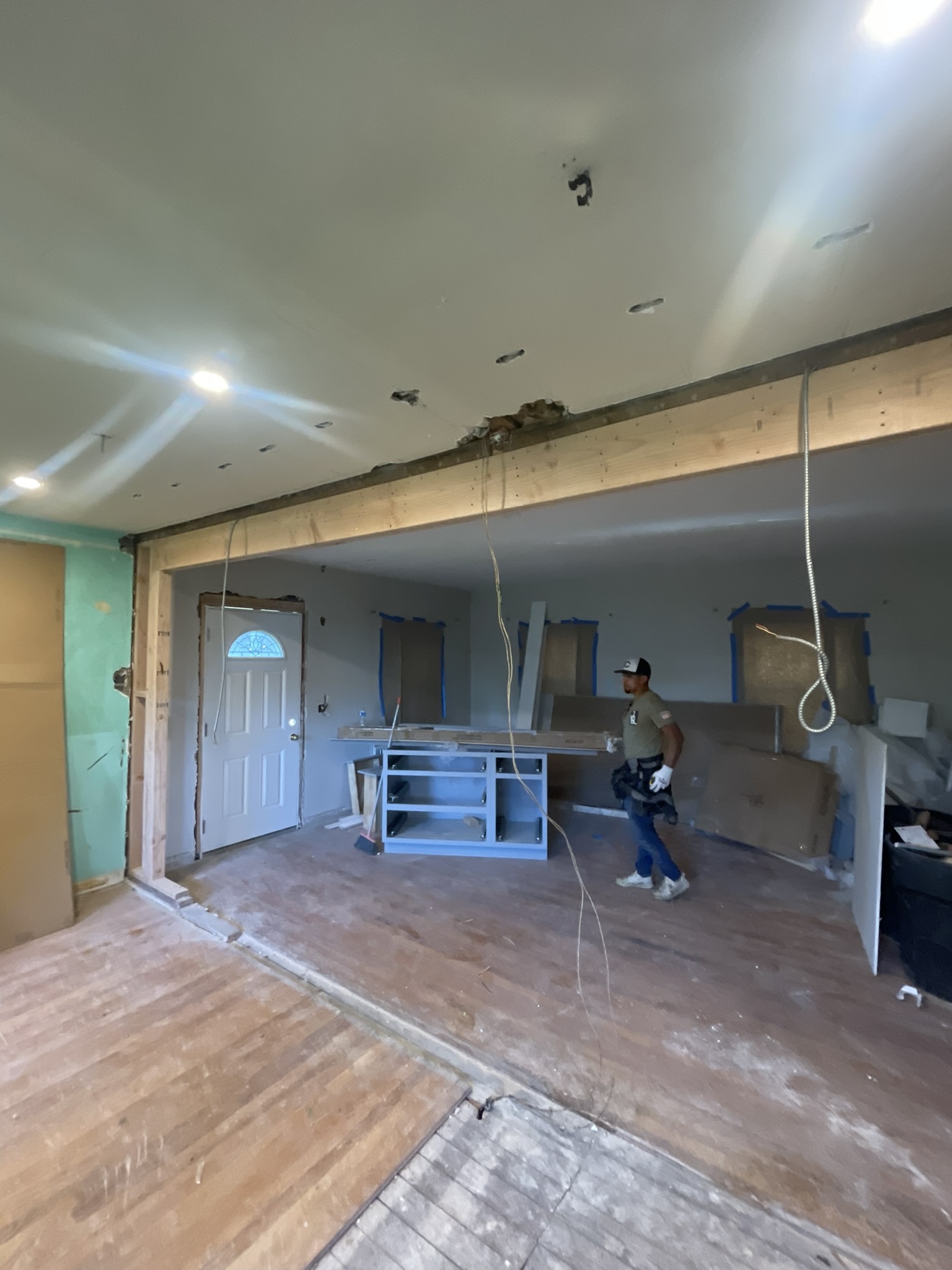 Kitchen In Progress
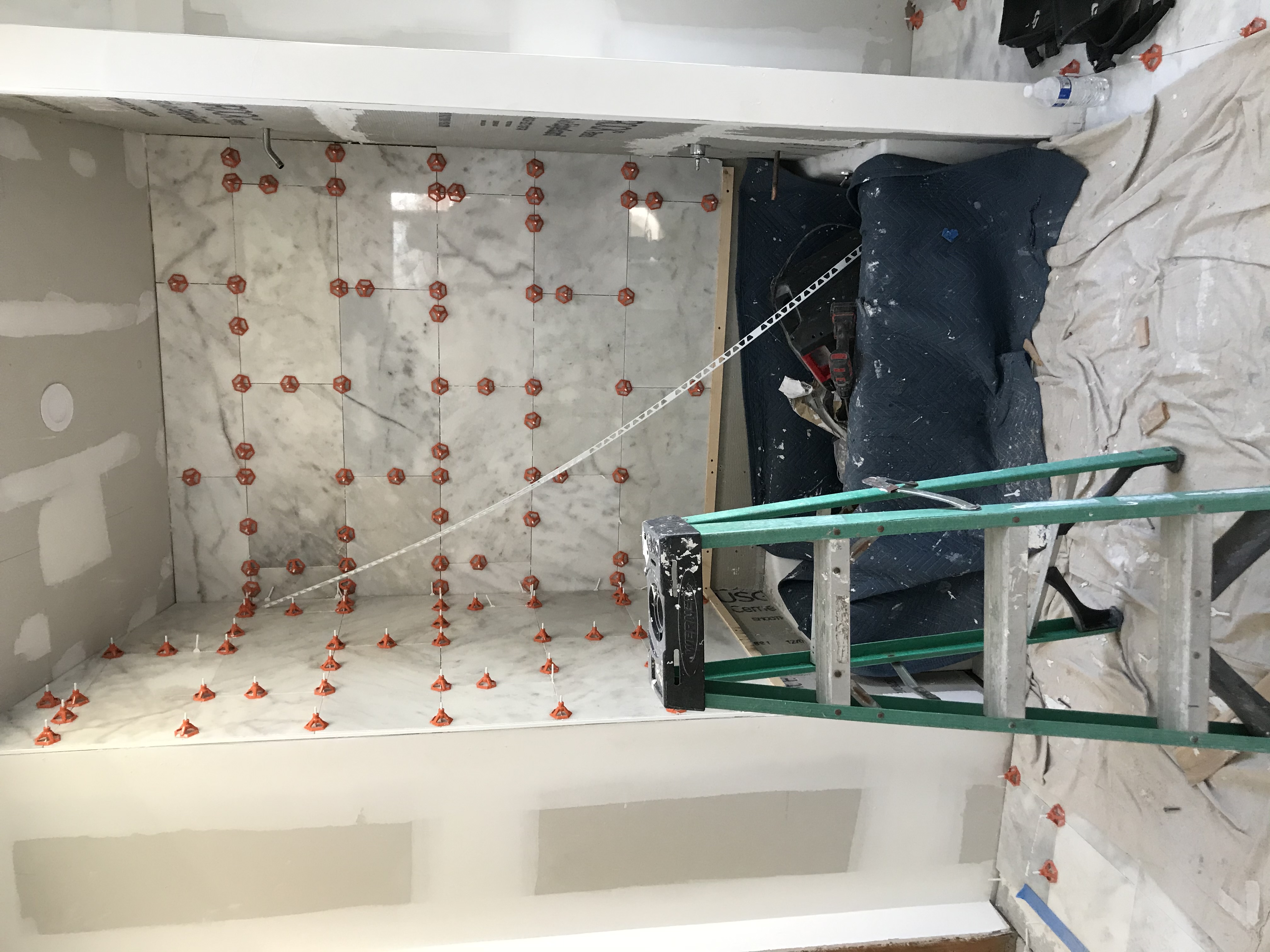 Shower Tile Going In
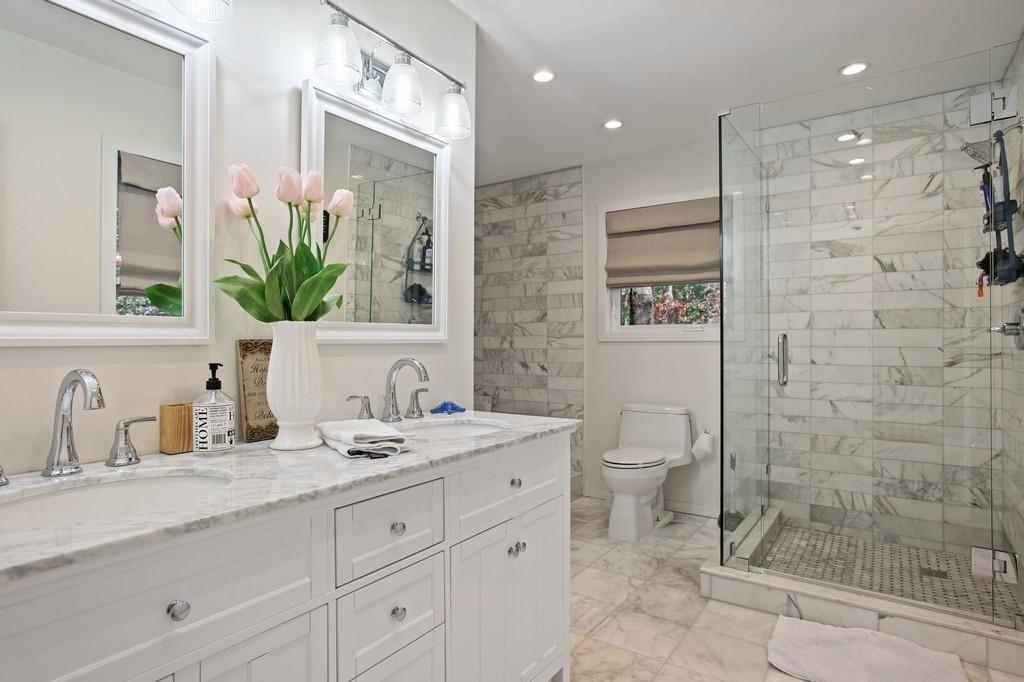 Finished Bath — Marble Master