Bathroom Renovation in the Hamptons & the East End
Quick Answer
Hamptons bathroom renovation runs through five town building departments — Southampton, East Hampton, Riverhead, Southold and Shelter Island — plus incorporated villages with separate, stricter codes. The Town of Southampton files through its Land Management, Building and Zoning Division; the Town of East Hampton takes all Building Department applications through its OpenGov Digital Portal. The Town of East Hampton has no summer construction moratorium, but the Village of East Hampton permits Saturday construction only from noon to 4:00 p.m. between May 15 and September 15. Most East End primary bathrooms price between $85,000 and $140,000. Greene Group Construction's office is in Quogue, inside the Town of Southampton.
Key Takeaways
- The East End is five towns plus incorporated villages. Village codes are separate from the Town's and stricter. Your address decides the rulebook.
- The Town of East Hampton has no summer construction moratorium — but the Village of East Hampton restricts summer Saturdays. Village Code § 196-1A(9) permits Saturday construction only from noon to 4:00 p.m. between May 15 and September 15, and prohibits Sunday and federal holiday work year-round.
- Town of East Hampton Chapter 185 sets a general residential daytime standard of 65 dBA and exempts construction carried on between 7:00 a.m. and 8:30 p.m. from that standard. The hours are the exemption, not a decibel cap imposed on your crew.
- Suffolk's wastewater trigger is bedrooms, not bathroom count — with a separate trigger for work that requires modifying the sewage disposal facilities.
- Upscale East End bathrooms run $85,000–$140,000; fully bespoke work runs $140,000+. Zonda's New York metro upscale figure is $90,686 at 40.1% recouped.
- Carry more schedule float out here. The work is the same; deliveries, in-season trade availability and inspections are what stretch.
- A seasonally-closed house punishes a badly ventilated bathroom faster than a year-round one. Ventilation and waterproofing detail matter more here.
Where Is the East End, and Who Reviews Your Bathroom?
“The Hamptons” is a market description. The East End is a jurisdictional one, and for a renovation the jurisdiction is what you actually deal with. The East End means the Towns of Southampton, East Hampton, Riverhead, Southold and Shelter Island — five of Suffolk County's ten independent town building departments — sitting underneath a second layer of incorporated villages that write and enforce their own codes.
That village layer is the part homeowners underestimate. Southampton Village, East Hampton Village, Sag Harbor, Westhampton Beach and Quogue are separately incorporated, and their codes are separate from the Town's and stricter than the Town's. A house in Bridgehampton files with the Town of Southampton. A house four miles away inside Sag Harbor Village files with the Village, and Sag Harbor itself straddles the Southampton and East Hampton town lines. Historic district and architectural review can sit on top of the building permit in several of these villages, which is a schedule question before it is a design question.
Our office is in Quogue. Quogue is an incorporated village inside the Town of Southampton, which means the jurisdictional maze described above is the one we file in every week rather than one we read about before driving east. That is the plain reason to hire locally out here: not sentiment, proximity to the counter.
| Jurisdiction |
Covers |
What's Different There |
| Town of Southampton |
Bridgehampton, Water Mill, Hampton Bays, Noyac, Flanders, Remsenburg, Eastport and surrounding hamlets |
Bathroom work is filed with the Town's Land Management, Building and Zoning Division at 116 Hampton Road, Southampton NY 11968; confirm the current filing method with the division. The largest East End town by population and the one holding the most incorporated villages. Greene Group Construction's office in Quogue sits inside this town. |
| Town of East Hampton |
Amagansett, Montauk, Springs, Wainscott, Napeague |
All Building Department applications must be submitted digitally through the Town's OpenGov Digital Portal, a requirement that began May 19, 2025, and no payments are accepted at the counter. Work hours and noise are governed by Chapter 185 of the Town Code, described in detail below. |
| Town of Riverhead |
Riverhead, Aquebogue, Jamesport, Wading River, Calverton |
The North Fork gateway and the most year-round of the East End towns. Housing stock is a wider mix, and so is the range of bathroom work. |
| Town of Southold |
Mattituck, Cutchogue, Southold, Orient, Fishers Island, plus the Village of Greenport |
North Fork. Older village and waterfront housing with less predictable framing behind the plaster, and the Village of Greenport adds its own review inside the town. |
| Town of Shelter Island |
The entire island, reachable only by ferry |
Every delivery, dumpster and trade visit crosses on a ferry. That is a real line item and a real schedule constraint, not a rounding error. |
| Incorporated villages |
Southampton Village, East Hampton Village, Sag Harbor, Westhampton Beach, Quogue and others |
Separate codes, stricter than the Town's, reviewed by the village rather than the town. Historic and architectural review can add a layer above the building permit. |
Filing, verified July 2026: The Town of East Hampton states that all Building Department applications must be submitted digitally through its OpenGov Digital Portal, a requirement that began May 19, 2025, and that no payments are accepted at the counter. Since late 2025 the department's counter and phone access has been reduced to 8:30 to 10:30 a.m., which the Town describes as temporary until two new office assistants are hired. For the Town of Southampton, the Building and Zoning Division sits under Land Management at 116 Hampton Road, Southampton NY 11968; we file with the Town directly and confirm the current filing method with the division before each submission.
One Southampton provision is worth knowing before you assume a building permit is required. Town Code § 123-8 states that an application is not required “where there is no change in the perimeter or structural elements of an existing structure which is being repaired, improved or remodeled.” A like-for-like bathroom refit inside the existing walls can fall under that language. It does not escape the trade filings: § 123-9A(3) and (4) require separate electrical and plumbing and drainage applications. Whether a given scope qualifies is a determination for the Building and Zoning Division rather than for a contractor, so get it confirmed in writing before demolition starts.
As of July 2026, confirm the current filing requirements with the department that covers your address before ordering materials. Departments update their forms and portals independently, and this page is general information rather than legal or code advice.
Is There a Summer Construction Moratorium in East Hampton?
“East Hampton” is two separate governments with two different rules, and that is where a summer schedule goes wrong. The Town of East Hampton has no summer construction moratorium. The Village of East Hampton restricts construction hours seasonally, and that restriction is real. Which one applies to you depends on which side of the village line your parcel sits.
Town of East Hampton and Village of East Hampton are not the same rule.
Town of East Hampton: construction activity carried on between 7:00 a.m. and 8:30 p.m. is exempt from the Town's noise standards, seven days a week, with no seasonal restriction.
Village of East Hampton: between May 15 and September 15, construction is permitted on Saturdays only from noon to 4:00 p.m., and Sundays and all federal holidays are prohibited year-round.
Two houses a block apart can share the same postal town and fall under different rules. Confirm which government covers your parcel before a summer schedule is built on it. Both codes are quoted in full on our East Hampton remodeling permits page.
In the Town of East Hampton, Chapter 185 works by exemption rather than by a decibel cap on your crew. The Town's general residential daytime standard of 65 dBA sits at § 185-3A(1)(a). § 185-4 is titled “Exceptions,” and § 185-4B exempts “Construction activities between 7:00 a.m. and 8:30 p.m. and the associated use of construction devices and to the noise generated thereby” from those standards. Construction carried on inside that window is carved out of the 65 dBA standard rather than measured against it. Construction outside that window is not exempt.
The penalties are what make the chapter serious rather than symbolic. Under § 185-6A, a first violation carries up to $1,000 or 15 days; a second within 18 months carries $1,000 to $2,500; a third or subsequent within 18 months carries $2,500 to $10,000. And § 185-6B provides that “if the violation is of a continuing nature, each hour during which any of these offenses occurs shall constitute an additional, separate and distinct offense.” A crew running a tile saw and a demolition hammer outside the exempt window on a summer morning can accrue several countable offenses before lunch.
What Are the Village of East Hampton Construction Hours?
The Village of East Hampton is where the genuine seasonal restriction lives. Village Code Chapter 196, § 196-1A(9) sets construction hours by calendar period.
| Period |
Monday–Friday |
Saturday |
Sunday & federal holidays |
| January 1 – May 14 |
8:00 a.m. – 6:00 p.m. |
10:00 a.m. – 6:00 p.m. |
Prohibited |
| May 15 – September 15 |
8:00 a.m. – 6:00 p.m. |
Noon – 4:00 p.m. |
Prohibited |
| September 16 – December 31 |
8:00 a.m. – 6:00 p.m. |
10:00 a.m. – 6:00 p.m. |
Prohibited |
Sundays and all federal holidays are prohibited year-round. § 196-1A(10) allows a hardship variance to be obtained from the Village Building Inspector. Penalties under § 196-3A run $250 to $1,000 for a first offense, $500 to $2,500 for a second within two years, and $2,500 to $5,000 for a third or subsequent within two years.
The practical consequence is a four-hour Saturday. A Village of East Hampton bathroom running between May 15 and September 15 gets Monday through Friday plus a noon-to-four Saturday window, and nothing on Sunday. That is a material change to how a 12-week project lands on a calendar, and it is the detail an out-of-area contractor is most likely to get wrong out here.
What Are the Construction Hours Elsewhere on the East End?
Hours are set parcel by parcel, so the answer depends on the government that covers your address. These are the provisions we have verified as of July 2026.
- Town of Southampton: § 235-4A(2) permits construction 7:00 a.m. to 7:00 p.m. Monday through Friday, and § 235-4A(3) permits 8:00 a.m. to 6:00 p.m. Saturday and Sunday. No seasonal restriction.
- Village of Westhampton Beach: Chapter 110, § 110-3(E) permits 7:00 a.m. to 6:00 p.m. Monday through Friday and 8:00 a.m. to 5:00 p.m. Saturday and Sunday, “except during the months of July and August, when none of the activities… shall be permitted on Sunday.” § 110-3(F) additionally bars pile driving and pneumatic hammering on Saturdays and Sundays during July and August.
- Town of Riverhead: § 251-5K(1)(a) prohibits construction between 8:00 p.m. and 7:00 a.m. on weekdays and at any time on Sundays or legal holidays — a year-round Sunday ban.
- Town of Shelter Island: the Town's noise chapter contains no construction-hours provision. Separately, § 43-6A exempts nonstructural work under $10,000 from needing a building permit.
- Southampton Village, Sag Harbor Village and the Town of Southold: we could not verify the current noise chapters for these three, so confirm the hours with the Village or the Town before you schedule. There is reporting as of July 2026 that Southampton Village is weighing new restrictions on summer construction and landscaping, which is a further reason to confirm rather than assume.
The useful version of this for a homeowner: on the East End the constraint is a working-hours constraint rather than a calendar ban, but the working hours are set by whichever town or village covers your parcel, and in the Village of East Hampton and the Village of Westhampton Beach those hours narrow in summer. Loud phases — demolition, cutting stone, coring for a new drain line — get sequenced deliberately inside the window that applies, and a 12-week project takes 12 weeks of working days rather than being compressed by starting at dawn. In a village with an active summer population, the courtesy standard neighbors expect can also be tighter than the code requires.
Does a New Bathroom on the East End Trigger a Septic Upgrade?
The East End is almost entirely unsewered, which makes this the most consequential question on the page. Suffolk County's requirements sit in Suffolk County Sanitary Code Article 6, administered by the Suffolk County Department of Health Services Office of Wastewater Management, and the mechanics are widely misdescribed online.
Per §760-603(28), the expansion trigger is bedrooms. A “New or Expanded Single-Family Residence” includes “the addition of one or more bedrooms to an existing Single-Family Residence that exceeds the number of bedrooms previously approved by the Department's Office of Wastewater Management.” Suffolk sizes residential systems off bedroom count, so a second or third bathroom by itself does not increase the design flow the county assigns to the house.
Two other doors matter as much. The same definition catches an addition “requiring the addition or modification of Sewage disposal facilities” regardless of bedroom count — so if a new primary bathroom forces the tank or a leaching pool to move, or encroaches on setbacks, it is pulled in. And §760-603(25) defines Major Reconstruction as reconstruction cost exceeding 50% of the market value of the existing structure, excluding land, using FEMA P-758 methodology. That threshold is what catches whole-house gut renovations, and on the East End a whole-house gut is a common way a bathroom project starts.
There is no point-of-sale septic trigger in Article 6. Suffolk is frequently described online as having one; the code sets the triggers described above.
On funding: the Suffolk County Septic Improvement Program offers a $20,000 county grant, and the New York State Septic System Replacement Program offers up to $25,000. The county publishes those two amounts separately and we present them separately. The Towns of East Hampton, Shelter Island and Southampton also administer their own additional wastewater funding, which is one of the genuine advantages of being on the East End rather than elsewhere in the county.
Confirm before you rely on it: Article 6 is amended periodically. Confirm the current requirements with the Suffolk County Department of Health Services Office of Wastewater Management before you rely on any of this for your project. For the full treatment — every exemption, the Major Reconstruction math, the grant eligibility conditions and how the ten town departments interact with county review — see our detailed page on
bathroom remodeling in Suffolk County.
If your project adds square footage rather than reworking what exists, expect $70,000 to $130,000+ and 10 to 16 weeks for a full bathroom that extends the footprint. One caveat belongs with that number. In Suffolk County an addition may trigger New York State Department of Health-approved I/A OWTS requirements. That is a separate scope with its own SCDHS review, and we do not fold a placeholder for it into a bathroom number.
What Does a Hamptons Bathroom Renovation Cost?
The East End is the highest price tier on Long Island, and the honest way to present it is with the resale math attached rather than hidden.
Most East End primary bathrooms we are asked to price sit in the upscale band: stone, custom glass, radiant floor, high-end fixtures, at $85,000 to $140,000. Fully bespoke work — architect involvement, specialty stone, custom millwork, fixtures specified rather than selected — runs $140,000 and up. These ranges are triangulated from Zonda's 2025 Cost vs. Value data for the New York metro market and the published tiers of Long Island bathroom contractors. They are planning ranges, not a quote.
| Tier |
What It Is |
Planning Range |
Construction Timeline |
Days Without That Bathroom |
| Upscale |
Stone, custom glass, radiant floor, high-end fixtures. Layout may change; plumbing may move. |
$85,000 – $140,000 |
8–12 weeks |
25–35 working days |
| High-end custom / East End |
Fully bespoke. Architectural involvement, specialty stone, custom millwork and glass, specified fixtures. |
$140,000+ |
12+ weeks |
Varies with scope |
Planning ranges as of July 2026, triangulated from Zonda's 2025 Cost vs. Value data for the New York metro market and published Long Island contractor tiers. Not a quote. The “days without that bathroom” column is our own derivation from Angi's published phase durations, May 2026, plus Long Island inspection wait times — no industry source publishes that figure, and we would rather show the arithmetic than borrow a number that does not exist.
Now the part most contractors skip. Zonda's 2025 Cost vs. Value Report puts an upscale bathroom remodel in the New York metro market at $90,686, recouping $36,380 — 40.1%. That figure is for the New York metro market, which is how Zonda defines it; Nassau and Suffolk are not separate Cost vs. Value markets and we will not relabel it “Long Island.” At the top of this market the resale recapture is poor and it gets worse as the budget rises.
We say that plainly because it is what a buyer at this level already suspects. People build a bathroom at this tier because they want the room — the light, the stone, the shower they will use every morning of every summer for twenty years — not because a spreadsheet says it pays back. A contractor promising a strong return here is quoting a national midrange statistic at you. For the full picture across every tier, see our Long Island bathroom remodel cost guide.
How Does the Season Change an East End Bathroom Schedule?
This is the part that is genuinely different out here, and it has nothing to do with the construction itself. A bathroom in Quogue and a bathroom in Commack are built the same way. What differs is everything around the build.
Trade availability compresses in season. Between Memorial Day and Labor Day the licensed electricians, plumbers and tile setters who do this level of work are booked further out than they are in February. Deliveries take longer, because lead times on stone, custom glass and made-to-order vanities are long to begin with and because summer traffic on Route 27 turns a delivery window into a delivery day. Inspections are scheduled against a queue that no East End town publishes a turnaround time for — that is the honest answer, and any contractor giving you a guaranteed inspection date is guessing.
Then there is the house itself. A year-round primary residence can absorb a bathroom under construction for eight weeks. A house used on weekends between Memorial Day and Labor Day has a narrower window for disruptive work, and the calendar tends to be set by when the family is not there rather than by when the crew is free. Most of our East End bathroom work therefore runs in the shoulder and off seasons — September through May — with selections and permits handled during the summer so the work can start the week the season ends.
The guidance is simple: carry more float on an East End project than the construction timeline alone suggests. Not because the work is different, but because scheduling, inspections and deliveries are.
What Do Salt Air and a Closed House Do to a Bathroom?
Two coastal realities drive detailing out here, and both are about specification rather than craft.
The first is salt air on fixtures and hardware. Living finishes and unlacquered brass will patina fast within a mile of the ocean, which some clients want and some do not. That is a selection conversation to have before ordering, not after installation, because the same faucet behaves differently in Montauk than it does in Melville.
The second is humidity in a house that sits closed. Code requires bathroom ventilation of 50 cfm intermittent or 20 cfm continuous, and the exhaust must discharge directly outdoors — never into an attic, a crawl space or any other area inside the building. Terminations must sit at least three feet from property lines and three feet from gravity air intakes, operable windows and doors. In a year-round house, a marginal fan is forgiving because somebody opens a window. In a house closed from October to May, moisture from a weekend of four people showering has nowhere to go, and a badly vented bathroom shows it in the paint, the grout and eventually the framing. A seasonally-closed house punishes a badly ventilated bathroom faster than a year-round one does.
One more thing about the exhaust path, phrased carefully because the code does not say it in a single line: the requirement to discharge directly outdoors, combined with the required clearance from air intakes, is why terminating a bathroom fan into a soffit is a detail we avoid. That is reasoning from two requirements, not a quotable code sentence, and we would rather be accurate about the distinction than repeat what the internet says.
Waterproofing is where the same logic applies to the wall. Water-resistant gypsum — “greenboard” — is not a compliant backer where there is direct exposure to water. Tile in a tub or shower area goes over cement board, fiber-cement or glass-mat gypsum. That is a code requirement everywhere in New York, and it is the single most common thing we find behind failed tile in a house that has been quietly leaking for years. Anti-scald protection is the other detail worth naming: IRC P2708.4 requires balanced-pressure, thermostatic or combination valves limited to a maximum of 120°F, with the limit field-adjusted per the manufacturer's instructions rather than assumed from the box, and in-line thermostatic valves do not satisfy that section.
What Happens When a Supply Line Fails in an Empty House?
A bathroom packs more plumbing into less floor area than any other room in a house, and a seasonally-occupied house changes the arithmetic completely. A braided supply line that fails in March in an occupied house is a bad afternoon. The same failure in a house closed until Memorial Day runs for weeks, through the subfloor, down the joists and into the ceiling below. By the time anyone opens the door, the question is no longer whether the bathroom needs replacing. What a homeowners policy generally covers on that kind of rebuild, the New York claim deadlines that apply, and what to photograph before anything is torn out are set out in our guide to rebuilding a bathroom after a leak or flood.
That is exactly the project Greene Group Construction is built for. Anyone can put a new shower where the old one was. We are who you call when the problem is what is behind it. We run water damage restoration and insurance claims as real service lines on this same site, alongside bathroom renovation, which means a loss in a closed house moves from emergency mitigation through drying, demolition, debris hauling, structural repair and the finished bathroom under one company. On a claim that matters, because the team documenting the damage is the team scoping and performing the repair — there is no handoff where scope quietly disappears between a mitigation vendor and a separate remodeling contractor.
For East End clients this is also a monitoring conversation. If your house sits unoccupied for stretches, the single highest-value thing you can do for it is a main shutoff or leak-detection valve and somebody physically walking the house on a schedule. We would rather tell you that than sell you a rebuild.
Do Tariffs Change What a Custom Vanity Costs?
At this price tier, yes, and it is worth planning around because custom and imported vanities are the norm rather than the exception.
Section 232 covers imported bathroom vanities at 25%, with the increase to 50% deferred to January 1, 2027 under Proclamation 11000, published at 91 FR 1039 on January 9, 2026. Vanities are named in the operative clause of the underlying proclamation, not read into it. Verified current as of July 2026. That deferral is the one real deadline in this build: a made-to-order imported vanity specified now and delivered in 2026 carries a different duty exposure than the same vanity ordered late next year.
On countertops, the situation is different and the distinction is worth money. Engineered quartz is the subject of a Section 201 safeguard proceeding that has been recommended, not imposed. The USITC found injury on April 1, 2026 and on May 5, 2026 recommended a four-year tariff-rate quota; the report was transmitted May 18, 2026. As of July 29, 2026, no presidential proclamation has issued. Separately, natural stone — granite, marble, soapstone, quartzite — is expressly outside the scope of that proceeding. For an East End vanity top, where natural stone is usually the preference anyway, that is a genuine hedge rather than a talking point.
Who Actually Does the Work?
Greene Group Construction holds Suffolk County HIC #HI-72958 and Nassau County HIC #EF-65498. Under Suffolk County Code Chapter 563, a home improvement contractor's license number is legally required to appear in advertising — which makes it a free screening tool. An East End contractor advertising without a visible Suffolk number is telling you something, and the number you are given is worth verifying with the Suffolk County Department of Labor, Licensing and Consumer Affairs.
On staffing, the honest answer, because vague answers here are common. Our own carpenters and project managers run your job start to finish. Electrical and plumbing are performed by licensed Nassau and Suffolk trade contractors we've worked with for years — we schedule them, we coordinate the inspections, and we're accountable for the result. Demolition, debris hauling and restoration work are handled by our own crews, which is why a gut bathroom does not require you to coordinate a separate dumpster or a separate cleanout vendor.
One more distinction that matters at this tier. The one-day bath franchises sell a surface installed fast — a real service for a sound bathroom, and a real limitation the moment there is water in the subfloor, a wall to move, a septic question to answer or a claim to run. An East End primary bathroom at $85,000 and up is a construction project: framing, structure, plumbing rough-in, waterproofing, licensed trades and inspections. Broader structural work runs through our general contracting division, and debris leaves with our own junk removal and cleanout crews.
Hamptons & East End Bathroom Renovation FAQ
Is there a summer construction moratorium in the Town of East Hampton?
The Town of East Hampton has no summer construction moratorium, but the Village of East Hampton has a genuine seasonal restriction on working hours. In the Town, Chapter 185 sets a general residential daytime standard of 65 dBA and exempts construction activity carried on between 7:00 a.m. and 8:30 p.m. from that standard, seven days a week. In the Village, Chapter 196 § 196-1A(9) permits construction Monday through Friday from 8:00 a.m. to 6:00 p.m. year-round, and between May 15 and September 15 permits Saturday work only from noon to 4:00 p.m.; Sundays and all federal holidays are prohibited year-round. Same name, two different governments — confirm which one covers your parcel before you build a summer schedule.
Can a crew work on a Saturday in July in the Village of East Hampton?
Between May 15 and September 15, Village of East Hampton Code § 196-1A(9) permits construction on Saturdays only from noon to 4:00 p.m. Monday through Friday hours are 8:00 a.m. to 6:00 p.m., and Sundays and all federal holidays are prohibited year-round. § 196-1A(10) allows a hardship variance to be obtained from the Village Building Inspector. Penalties under § 196-3A run $250 to $1,000 for a first offense, $500 to $2,500 for a second within two years, and $2,500 to $5,000 for a third or subsequent within two years. The Town of East Hampton has no equivalent Saturday restriction.
Does adding a bathroom on the East End trigger a septic upgrade?
Under Suffolk County Sanitary Code Article 6, the expansion trigger is bedrooms, not bathroom count. §760-603(28) defines a New or Expanded Single-Family Residence to include adding bedrooms beyond the number previously approved by the Office of Wastewater Management. Separately, an addition requiring the addition or modification of sewage disposal facilities is caught regardless of bedroom count, and Major Reconstruction exceeding 50% of the structure's market value catches whole-house guts. Confirm current requirements with SCDHS.
What does a Hamptons bathroom renovation cost?
Most East End primary bathrooms we are asked to price land in the upscale band of $85,000 to $140,000, and fully bespoke work runs $140,000 and up. Zonda's 2025 Cost vs. Value Report puts an upscale bathroom remodel in the New York metro market at $90,686, recouping 40.1% at resale. These are planning ranges triangulated from Zonda's New York metro data and published Long Island contractor tiers, not a quote.
Which building department reviews a bathroom renovation in the Hamptons?
It depends on your address. The East End covers the Towns of Southampton, East Hampton, Riverhead, Southold and Shelter Island, each with its own building department. The Town of Southampton's Building and Zoning Division sits under Land Management at 116 Hampton Road, Southampton NY 11968; file with the Town directly and confirm the current filing method with the division. The Town of East Hampton requires all Building Department applications to be submitted digitally through its OpenGov Digital Portal, a requirement that began May 19, 2025, and accepts no payments at the counter. If your house sits inside an incorporated village, that village reviews the work under its own code.
How long does a Hamptons bathroom renovation take?
An upscale primary bathroom runs roughly 8 to 12 weeks of construction, and fully custom work runs 12 weeks and up. On the East End we ask clients to carry more schedule float than a western Suffolk project would need. The work itself is the same; deliveries, trade availability in season and inspection scheduling are what stretch. No East End town publishes a permit turnaround time.
Do East End villages have their own bathroom permit rules?
Yes. Southampton Village, East Hampton Village, Sag Harbor, Westhampton Beach and Quogue are incorporated villages with codes separate from the Town's, and those codes are stricter. A house inside village lines is reviewed by the village, and historic district or architectural review can add a layer on top of the building permit. A Bridgehampton address and a Sag Harbor address are not the same filing.
Why do seasonally-closed Hamptons houses have bathroom moisture problems?
A house that sits closed for weeks has no one opening a window or running a fan, so moisture from a weekend of heavy use stays in the room. Code requires bathroom exhaust of 50 cfm intermittent or 20 cfm continuous, discharged directly outdoors and never into an attic or crawl space. Salt air also attacks unprotected hardware finishes. Ventilation and waterproofing detail matter more here, not less.
Can you rebuild an East End bathroom after a water leak on an insurance claim?
Yes. Greene Group Construction runs water damage restoration and insurance claims work alongside bathroom renovation, so a failed supply line in a closed house moves from mitigation through demolition, structural repair and the finished bathroom under one company. Seasonal houses discover leaks late, which makes the loss larger and the documentation more important. The team documenting the damage is the team performing the repair.
Ready to talk about your East End bathroom? Call (631) 532-7346 and we will tell you which department covers your address, whether a village adds a layer, what the wastewater question looks like for your house, and what the work costs. Our office is in Quogue — inside the Town of Southampton. Start with the full overview at our bathroom remodeling hub, or request a free estimate.
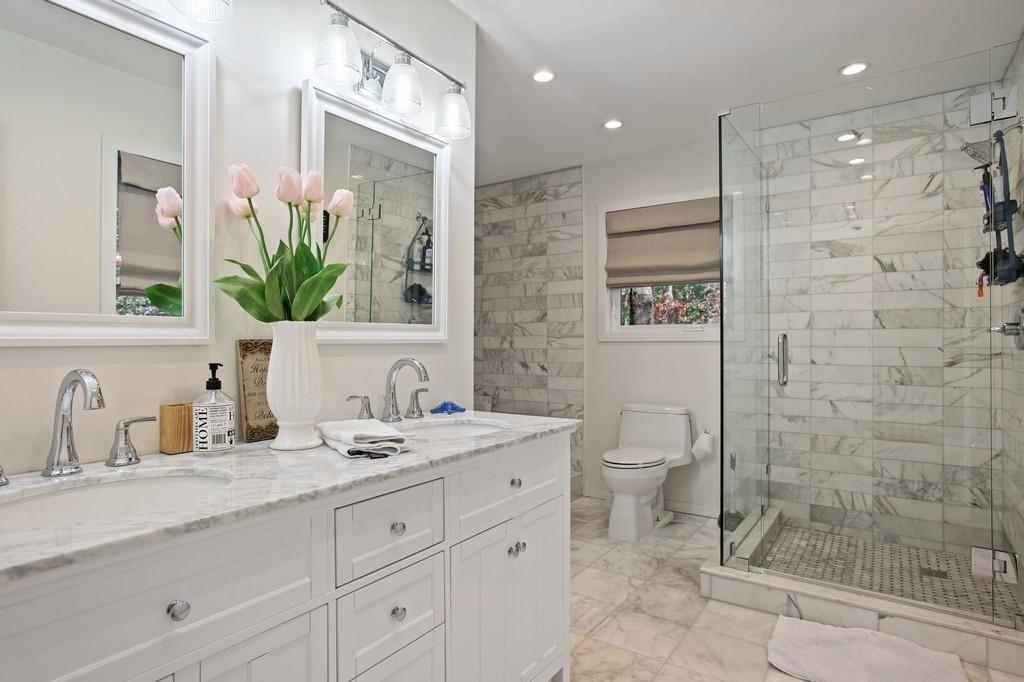 Marble Primary — Walk-In Glass Shower
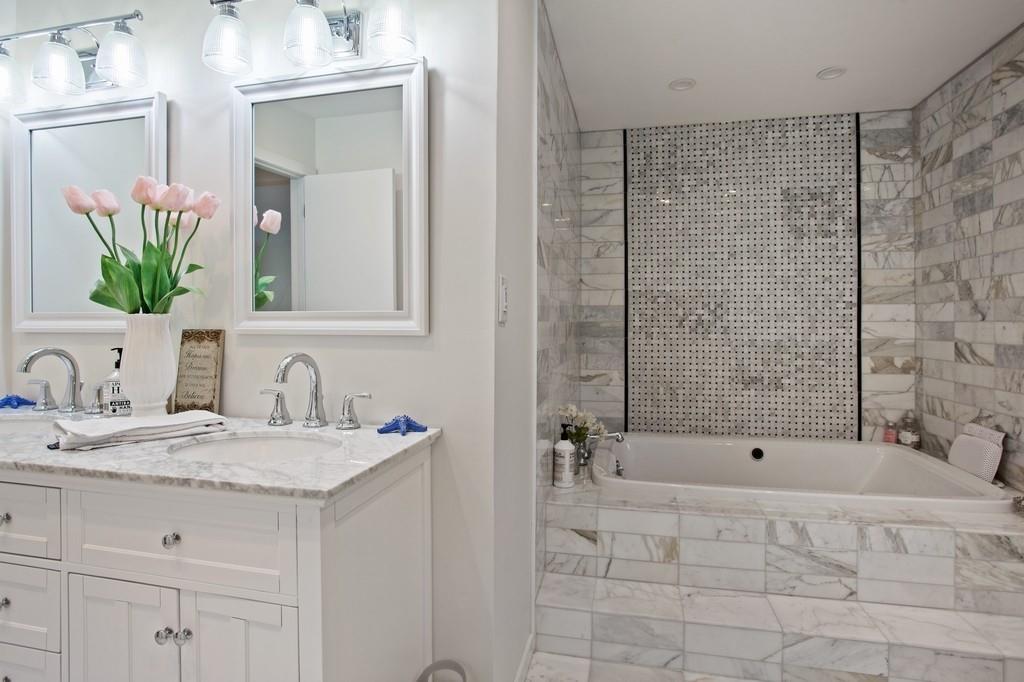 Soaking Tub & Marble Surround
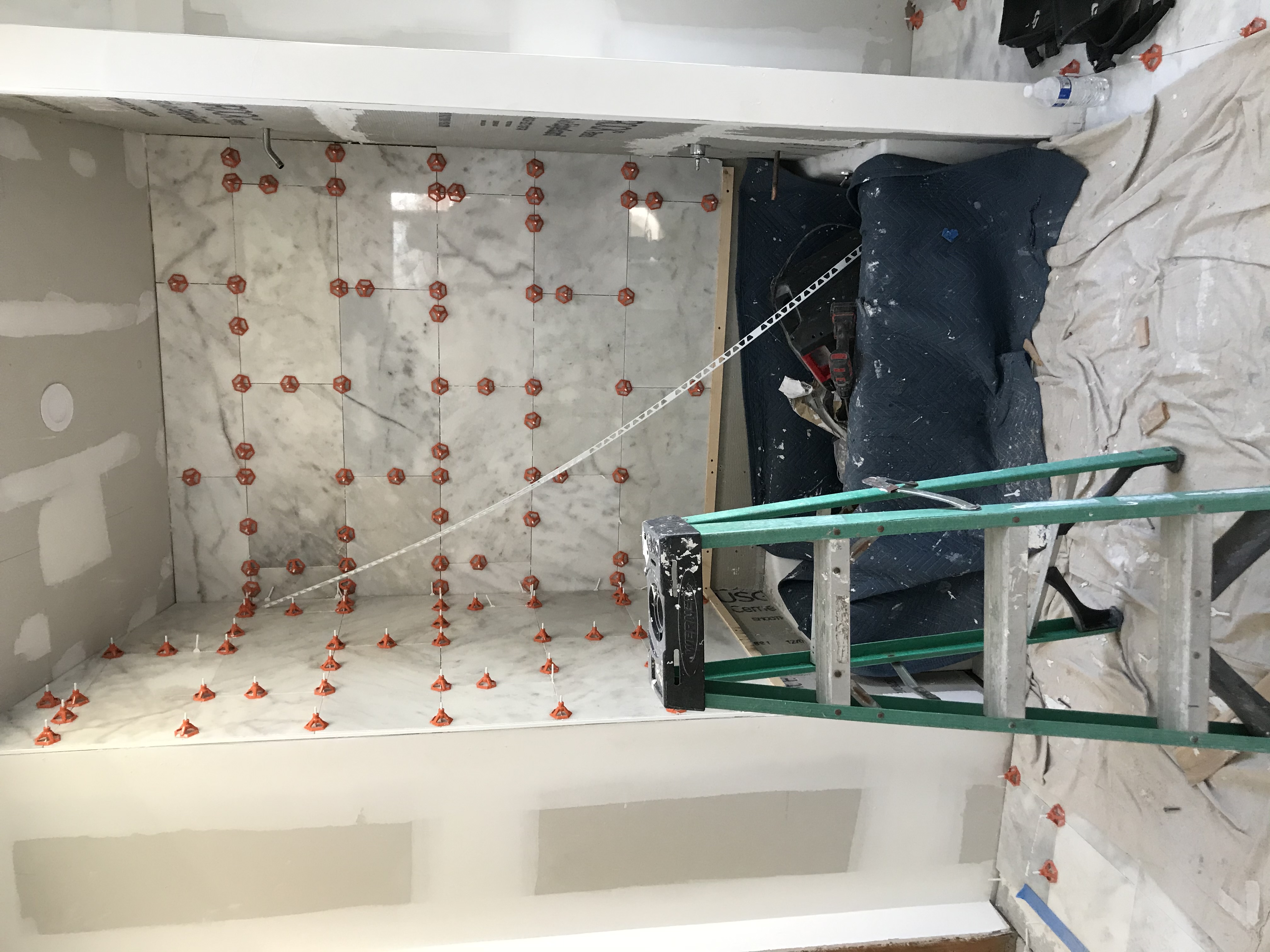 Shower Tile Set With Leveling Clips
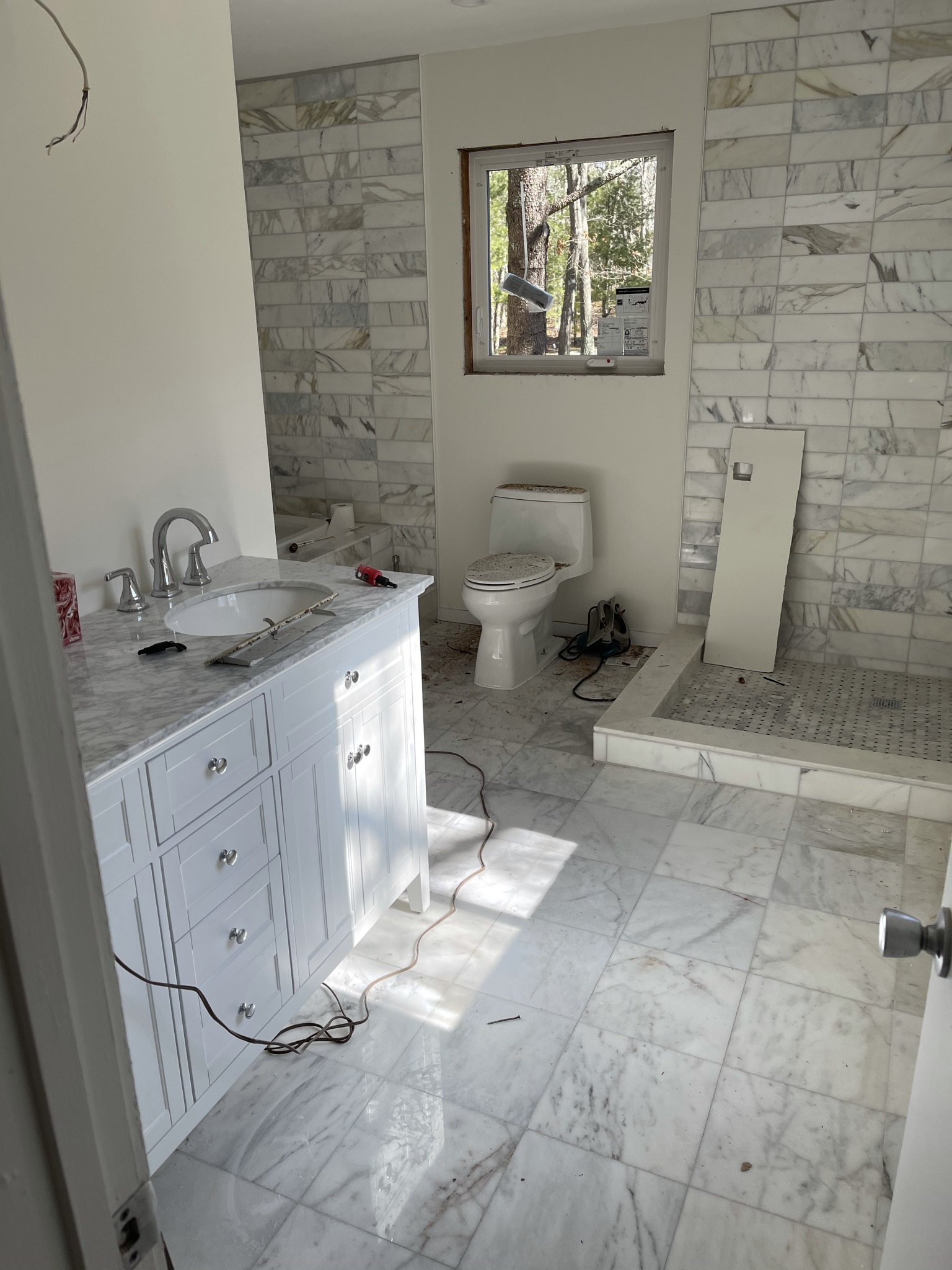 Marble Floor & Wall Tile Complete