Bathroom Rebuild After a Leak or Flood
Quick Answer
A bathroom rebuild after a leak or flood runs in sequence: stop the water, document everything before demolition, notice your carrier, mitigate, scope, dry, then rebuild. New York gives your insurer 15 business days to acknowledge a claim under 11 NYCRR §216.4(a). Whether the loss is covered depends on your specific policy form and the facts.
Key Takeaways
- Document before demolition. Once the wet material is in a dumpster the evidence is gone, and almost every contested question in a water claim is a question about facts that lived in that material.
- ISO HO 00 03 Peril 12 covers accidental discharge or overflow of water or steam from a plumbing, heating, air conditioning or automatic fire protective sprinkler system or a household appliance — and expressly does not include loss “To the system or appliance from which the water or steam escaped.”
- Tear-out is addressed directly. The Exception To c.(6) includes “the cost to tear out and replace any part of a building… but only when necessary to repair the system or appliance.”
- Sudden versus slow is drawn differently form to form. The ISO homeowners form gets there through wear and tear and deterioration; many carriers use an explicit seepage clause instead.
- §216.6(e): where only part of a claim is disputed, the insurer must pay the undisputed portion without waiting for the dispute to resolve.
- Two years, not six. Insurance Law §3404(e) sets twenty-four months, and the Court of Appeals upheld a two-year suit-limitation clause in Farage v. Associated Ins. Mgmt. Corp. on November 26, 2024.
This page is for the homeowner standing in a wet bathroom right now, and for the one who just found a stain on a ceiling. It is general information about how homeowners policies and New York's claim rules are structured — not legal or insurance advice, and not a coverage opinion on your loss. Every coverage statement below depends on your actual policy form and the specific facts. The wording of your form decides most of the close cases.
The Insurance Information Institute, citing ISO, reports that “water damage and freezing” accounted for 23.4% of homeowners insurance losses from 2018 through 2022, at an average claim severity of $13,954. That category bundles frozen-pipe losses and includes covered mold, so read it as a category rather than a bathroom number. A bathroom packs more plumbing into less floor area than any other room in a house.
What Do You Do In The First Hour After a Bathroom Leak?
Stop the water. Every toilet and vanity has a stop valve underneath it; a tub or shower valve usually does not, which is why the main shut-off matters. If the ceiling below is sagging it is holding water and can come down in one piece, so stay out from under it. Where water has reached recessed lights, a fan or a receptacle, shut the circuit off at the panel first. Then stop for twenty minutes, because the instinct to start pulling wet material out is right in every way except one: the moment you remove it, you have destroyed the physical record of what happened.
Why Does Documenting Before Demolition Matter More Than Anything Else?
Because the questions a carrier will argue about are questions of fact, and the facts live in the wet material. How long did the leak run? Was the damage hidden inside the assembly or visible on the surface? What failed — the hose, the pan, the liner, the wax ring, the grout? Once the debris is hauled away, that can only be answered from your record, or from the other side's expert.
Do it in this order and it takes less time than making coffee. Shoot continuous wide video of every affected room first, narrating the date. Then close photographs: the failed component, the wet ceiling from below, the cabinet interior, the baseboards, and every damaged item of contents. Then bag the failed part and keep it — the burst braided hose, the section of pan liner, the corroded valve, the compressed wax ring. Do not let a plumber leave with it. Write down when you first noticed anything, and keep every receipt from that day forward.
None of this conflicts with your duty to protect the property from further damage. Documentation takes minutes; mitigation follows immediately. Our water damage restoration crews document a loss before opening anything, because the same photographs that support a claim also show where the water traveled inside the assembly.
When Do You Notify the Carrier, and What Clock Starts?
Notice starts New York's claim-handling clocks. They live in Regulation 64, 11 NYCRR Part 216, and they bind the insurer's conduct.
| Deadline |
What Has To Happen |
Citation |
| 15 business days | Acknowledge receipt of the claim | §216.4(a) |
| 15 business days | Reply to other pertinent communications | §216.4(b) |
| 15 business days from notice | Commence investigation | §216.5(a) |
| 15 business days after a properly executed proof of loss and all requested items | Accept or reject the claim in writing. Extends to 30 business days where arson is suspected. | §216.6(c) |
| Every 90 days | Send an explanatory letter where more investigation time is needed | §216.6(c) |
| No waiting | Where only part of a claim is disputed, pay the undisputed portion without waiting for the disputed portion to resolve | §216.6(e) |
| 5 business days | Pay any amount finally agreed | §216.6(f) |
| 10 business days | Respond to a Department of Financial Services inquiry | §216.4(d) |
§216.6(e) is the one to remember. A bathroom claim frequently splits: the carrier agrees the supply line burst and the ceiling below is a covered loss, and disagrees about the mold. Disagreement about one part does not license the insurer to sit on the rest. Ask for the undisputed portion in writing, cite the section, and keep the dated request. And §216.4(d) puts a ten-business-day clock on a Department of Financial Services inquiry, which is why a DFS complaint is a real tool.
What Does a Homeowners Policy Actually Cover When a Bathroom Leaks?
Start with the peril, because if the peril is not triggered nothing else matters. The industry-standard ISO HO 00 03 form lists as Peril 12, Accidental Discharge Or Overflow Of Water Or Steam: “a. This peril means accidental discharge or overflow of water or steam from within a plumbing, heating, air conditioning or automatic fire protective sprinkler system or from within a household appliance. b. This peril does not include loss: (1) To the system or appliance from which the water or steam escaped…”
Read that second sentence twice. The peril reaches the water and what the water ruined. It does not reach the thing that failed. The burst hose is not covered; what it did to your subfloor, joists and the ceiling below is a separate question.
Then there is tear-out, the part of the form almost nobody reads and the part that decides who pays to open the assembly and close it again. The Exception To c.(6) provides: “Unless the loss is otherwise excluded, we cover loss to property covered under Coverage A or B resulting from an accidental discharge or overflow of water or steam from within a… Plumbing, heating, air conditioning or automatic fire protective sprinkler system or household appliance on the ‘residence premises’. This includes the cost to tear out and replace any part of a building, or other structure, on the ‘residence premises’, but only when necessary to repair the system or appliance.… We do not cover loss to the system or appliance from which this water or steam escaped.” Alongside it sits the general ensuing-loss clause: “any ensuing loss to property described in Coverages A and B not precluded by any other provision in this policy is covered.”
The plain translation: the policy generally pays to open the wall, floor or ceiling to get to the leak, and to close it back up. It does not pay for the pipe, valve, hose, pan or fixture that failed. Those eight words — “not precluded by any other provision in this policy” — are where a carrier's own seepage clause bites, if the carrier's form has one. That is why the specific form governs.
| The Item |
How the ISO HO-3 Form Addresses It |
Where |
| Water escaping from within a plumbing system or household appliance | This is the named peril: accidental discharge or overflow of water or steam. | Peril 12.a |
| The pipe, valve, hose, pan or fixture that failed | “This peril does not include loss: (1) To the system or appliance from which the water or steam escaped” | Peril 12.b.(1) |
| Opening the wall, floor or ceiling to reach the leak and closing it back up | “This includes the cost to tear out and replace any part of a building… but only when necessary to repair the system or appliance.” | Exception To c.(6) |
| Wear and tear, marring, deterioration | Excluded | 2.c.(6)(a) |
| Mechanical breakdown, latent defect, inherent vice, or any quality in property that causes it to damage or destroy itself | Excluded | 2.c.(6)(b) |
| Smog, rust or other corrosion, or dry rot | Excluded | 2.c.(6)(c) |
| Mold, fungus or wet rot, generally | Excluded, subject to the carve-back below | 2.c.(5) |
| Mold, fungus or wet rot hidden within the walls or ceilings or beneath the floors or above the ceilings, resulting from accidental discharge or overflow from a plumbing system or household appliance on the residence premises | Insured, per the express carve-back — and separately subject to any fungi sublimit your policy schedules | 2.c.(5) |
| Ensuing loss | “any ensuing loss to property described in Coverages A and B not precluded by any other provision in this policy is covered” | Ensuing loss clause |
That carve-back describes a Long Island bathroom exactly. Mold, fungus or wet rot hidden within the walls or ceilings or beneath the floors or above the ceilings of a structure is insured, under the ISO HO-3 form, where the loss results from accidental discharge or overflow from within a plumbing system or a household appliance on the residence premises. A second-floor bathroom leaking into a first-floor ceiling is the textbook fact pattern, and the one a homeowner sees nothing of for months.
Sudden Failure or Slow Leak: Where Is the Line Actually Drawn?
The phrase “constant or repeated seepage or leakage over a period of weeks, months or years” is widely quoted as though it were standard homeowners language. It is not in ISO's standard homeowners form. It appears in ISO's commercial property form CP 10 30, which carries a 14-day trigger, and in many carrier-proprietary and state-specific homeowners forms. Chris Boggs, writing for Independent Agent on February 24, 2017: “although some state-specific forms use the same or similar wording, no such exclusion exists in ISO's standard homeowners forms.”
So the honest framing is this. Most homeowners policies draw a line between a sudden failure and a slow one, but how that line is drawn depends on your specific form. The ISO form gets there through “wear and tear” and “deterioration” in paragraph 2.c.(6). Many individual carriers use an explicit seepage clause instead. Read yours. One New Jersey carrier form excludes loss caused by “constant or repeated seepage or leakage of water… over a period of weeks, months or years” — a New Jersey form, quoted as an example of the wording family, not New York law and not universal language.
How Are the Six Common Bathroom Failures Usually Treated?
These are typical treatments under the industry-standard form, not predictions about your claim. Where the honest answer is “it depends,” the table says so, because a clean yes on a contested scenario is worse than useless mid-claim.
| Failure |
Typical Treatment |
| Supply line or braided hose bursts |
The cleanest covered case in the category. This is accidental discharge from within a plumbing system, squarely inside Peril 12. Resulting damage is generally covered; the hose itself is not, under Peril 12.b.(1). |
| Shower pan or liner fails slowly |
The most contested scenario in the category, and genuinely fact-dependent. The pan itself is excluded as deterioration or latent defect. Whether the resulting rot and ceiling damage is covered turns on the carrier's form, on whether the damage was hidden and unknown, and on how long an expert says the leak ran. There is no clean answer here, and anyone giving you one is guessing. |
| Grout and tile fail over time |
The weakest position of the six. Grout and tile are maintenance items and are not a plumbing system, so the peril is not triggered in the first place. Frequently denied. |
| Toilet supply line versus wax ring |
These are two different answers and should never be lumped together. A toilet supply line burst is usually covered as accidental discharge. A wax ring typically fails gradually, weeping into the subfloor over a long period, which pushes it toward the deterioration side of the form. |
| Drain line leaks inside a wall |
A drain line is part of a plumbing system, so the peril triggers. Drain leaks are also almost always gradual, which puts the wear-and-tear and deterioration language back in play. The hidden-within-walls mold carve-back helps here. Carrier language is decisive. |
| Tub or sink overflow |
Peril 12 expressly names “overflow,” and the form contains no exclusion for the insured's own negligence in a first-party loss. Generally covered. |
One principle sits underneath all six: the specific form governs. Courts elsewhere have decided water-damage disputes on one carrier's proprietary wording rather than on a general rule about sudden versus gradual loss. Pull your own form, find paragraph 2.c and the ensuing-loss clause, and read what your carrier wrote.
Who Has To Prove What?
This cuts both ways. On one side, an exclusion is an affirmative defense and the insurer carries it. The insured proves the loss falls within the grant of coverage; the insurer proves the exclusion applies. Boggs argues that a carrier relying on a seepage clause must define the period the clause requires, prove the leak ran that long, tell the insured how long it says the leak ran, and explain how it reached that conclusion.
On the other side, and this is what consumer content leaves out: policyholder advocates including United Policyholders and the American Association for Justice note that courts tend to focus on when the leak originated rather than when the homeowner discovered it, and that insureds who do not retain their own expert on leak duration usually lose. If the only technical opinion in the file is the carrier's, it tends to become the fact. That is why documentation before demolition matters: it is the cheapest expert evidence you will ever collect.
Who Pays For Mold After a Bathroom Leak?
Frequently both, in different proportions, and the mechanism catches people off guard. The water repair may be covered in full under Coverage A while the mold remediation is often capped at a separate, much smaller sublimit. Homeowners assume a covered water loss means fully funded mold work, then discover a schedule they never read.
That sublimit typically arrives through an endorsement such as ISO HO 04 27, “Limited Fungi, Wet Or Dry Rot, Or Bacteria Coverage.” There is no single number to print for it. Scheduled limits of $5,000, $10,000, $25,000 and $50,000 all exist across different carriers and states, which is why no figure published here could stand in for yours. The limit governing your claim is printed on your own declarations page under a heading like “fungi” or “mold.” Find it on day one. For what the physical scope involves, see our mold remediation page.
What Does New York's Mold Licensing Law Require?
New York Labor Law Article 32, effective July 28, 2015, created three licenses: mold assessment, mold remediation and mold abatement worker. Assessment and remediation licensees must carry at least $50,000 in liability insurance. Penalties under §937(2) run up to $2,000 for a first violation and up to $10,000 for each subsequent one.
The provision worth knowing is §936(2)-(3), the separation rule, and almost no contractor page on Long Island carries it: “No licensee shall perform both mold assessment and mold remediation on the same property.” No person may hold an ownership interest in both licensees on the same property either. In practice an independent licensed assessor scopes the work, then performs post-remediation clearance and issues a written passed-clearance report. The law separates the party who says how much mold there is from the party paid to remove it.
Article 32 exempts several parties under §933, including a residential property owner doing the work on their own property, an owner or employee working on a building of not more than four dwelling units, and government units. What a homeowner should do with this is simple: ask to see the licenses, ask who the independent assessor is, and ask for the written clearance report before drywall closes. Greene Group Construction does not claim to hold a New York mold license. This is general information, not legal advice.
How Long Do You Have To Sue Your Insurer in New York?
Two years. Not six. The ISO HO-3 “Suit Against Us” condition requires that “the action is started within two years after the date of loss.” New York Insurance Law §3404(e), the standard fire policy, requires suit to be “commenced within twenty-four months next after inception of the loss.” The same section sets loss payable 60 days after proof of loss and ascertainment, and provides an appraisal mechanism: 20 days to name appraisers, 15 days to agree an umpire, judicial appointment if the parties cannot.
New York's general limitation period for a contract claim is six years. A contractual shortening is enforceable where it is fair and reasonable, and on November 26, 2024 the New York Court of Appeals upheld exactly that kind of two-year clause in Farage v. Associated Ins. Mgmt. Corp. If your claim is drifting, the two-year date is the one to have written down. Older editions differ; the 1991 ISO edition used one year. Speak to a lawyer well before the deadline.
Do You Need a Public Adjuster in New York?
Sometimes, and it is your decision alone. A public adjuster works for you, not the carrier. Insurance Law §2101(g)(2) defines one as a person who, for compensation, acts on behalf of an insured in negotiating or effecting the settlement of a property claim, and §2102(a)(1) requires a license to do it. Acting as one without a license is a misdemeanor.
The protections are specific. The fee is capped at 12.5% of the recovery under 11 NYCRR §25.7(a); since an amendment effective October 8, 2021 a supplemental claim may carry up to 20%, provided the aggregate stays at or under 12.5% of the full claim payment. Referral compensation from service providers counts toward that cap under §25.7(b). You may cancel the retainer without penalty up to midnight of the third business day, per New York Department of Financial Services homeowner guidance. And §25.3(a) bars soliciting a loss adjustment between 6 p.m. and 8 a.m., including indirectly through a contractor.
What Can a Contractor Do On a New York Claim, and What Should You Be Wary Of?
Read this as what to expect from any contractor and what to be wary of, not as a description of any one company. It is general information, not legal advice, and the line between explaining an estimate and negotiating a claim is not bright.
A contractor may inspect and document the damage; write a detailed scope and estimate; take moisture readings and keep photographs and drying logs; meet the carrier's adjuster on site and walk the physical scope of work; perform emergency mitigation; and discuss its own estimate with the carrier as the party pricing the repair.
A contractor may not negotiate with the insurer or effect a settlement on the homeowner's behalf for compensation — that is unlicensed public adjusting under §2102(a)(1) — and may not act as an indirect solicitation channel for a public adjuster outside the hours permitted by §25.3(a). A 2007 New York State Insurance Department (the predecessor to today's Department of Financial Services) Office of General Counsel opinion notes that undisclosed referral fees may implicate commercial bribery, because a public adjuster owes the insured a duty of undivided loyalty. Three warning signs: an offer to “handle the whole claim for you,” an offer to waive your deductible, and an unsolicited introduction to a public adjuster at nine at night. Our insurance claims support page covers how documentation, scoping and rebuild fit together.
How Does the Drying and Rebuild Actually Work?
Standing water is extracted, saturated material is removed once documented, containment goes up, and drying equipment is set to a plan rather than a guess. Ask for daily moisture readings logged by location, and ask to see the drying log at the end. Closing a wall over wet framing is how a covered water claim becomes an uncovered mold problem eighteen months later.
Then scope it. A line-item scope beats a lump sum, because a lump sum gives an adjuster nothing to agree with: name the failed component, every affected assembly, the condition of subfloor and joists once exposed, the waterproofing method and the finishes. The rebuild runs in order — framing repairs, plumbing and electrical rough-in with inspections, backer, waterproofing, tile, fixtures. Two code points matter. Water-resistant gypsum, “greenboard,” shall not be used where there is direct exposure to water, so tile backers in a tub or shower area are cement board, fiber-cement or glass-mat gypsum. And where the shower or tub valve is replaced, IRC P2708.4 requires a balanced-pressure, thermostatic or combination valve with a means to limit the maximum setting to 120°F, field-adjusted per the manufacturer's instructions, and states that in-line thermostatic valves shall not be used for compliance.
One straight answer on staffing. Our own carpenters and project managers run your job start to finish. Electrical and plumbing are performed by licensed Nassau and Suffolk trade contractors we've worked with for years — we schedule them, we coordinate the inspections, and we're accountable for the result. Demolition, debris hauling, restoration and cleanout are handled by our own crews.
What Does a Bathroom Rebuild Cost After Water Damage?
A water-damage rebuild rarely lands in the cheapest tier, because by definition something behind the tile has failed. As planning ranges: a surface refresh where nothing moves runs $12,000 to $25,000; a midrange full remodel $25,000 to $50,000; a gut renovation down to studs and subfloor — the usual shape of a leak rebuild — $50,000 to $85,000 over 5 to 8 weeks; upscale $85,000 to $140,000; high-end custom $140,000 and up. These ranges are triangulated from Zonda's 2025 Cost vs. Value data for the New York metro market and the published tiers of Long Island bathroom contractors. They are planning ranges, not a quote. For allowances and the labor split, see our Long Island bathroom remodel cost guide. If the loss came out of a fire or the firefighting that followed one, the peril and the scope are different, and that work runs through fire damage restoration. To add a bathroom while the house is open, see our bathroom addition page.
This page describes how homeowners policy forms and New York's claim regulations are generally structured. It is general information, not legal, insurance or code advice, and not a coverage opinion on any particular loss. Coverage depends on your actual policy form and the specific facts. Read your policy and your declarations page, and talk to a licensed professional about your claim.
Bathroom Water Damage & Insurance FAQ
Will insurance pay for my bathroom after a leak?
It depends on your policy form and on the facts of the loss, and any honest answer starts there. Under the industry-standard ISO HO 00 03 form, Peril 12 covers accidental discharge or overflow of water or steam from within a plumbing, heating, air conditioning or automatic fire protective sprinkler system or from within a household appliance. That is the peril a burst supply line falls under. The same peril expressly does not include loss to the system or appliance from which the water or steam escaped, so the damage to the bathroom is treated differently from the part that failed. Read your own policy and your declarations page, because carrier forms vary.
What if the leak was slow?
Slow leaks are the contested end of this category. Most homeowners policies draw a line between a sudden failure and a slow one, but how that line is drawn depends on your specific form. The industry-standard ISO form gets there through wear and tear and deterioration. Many individual carriers use an explicit seepage clause instead. The phrase constant or repeated seepage or leakage over a period of weeks, months or years is not in the ISO standard homeowners form, and where it appears it appears in commercial or carrier-specific or state-specific wording. The ISO homeowners form also insures mold, fungus or wet rot hidden within the walls or ceilings or beneath the floors or above the ceilings of a structure when the loss results from accidental discharge, which is exactly a second-floor bathroom leaking into a ceiling. Whether a particular slow leak is covered turns on your form, on whether the damage was hidden, and on what an expert says about duration.
Who pays for mold after a bathroom leak?
Often the carrier and the homeowner both, in different proportions, and the trap is the sublimit. Water damage repair may be covered in full under Coverage A while mold remediation is often capped by a scheduled sublimit added through an endorsement such as ISO HO 04 27, Limited Fungi, Wet Or Dry Rot, Or Bacteria Coverage. Sublimit amounts vary widely by carrier and by state, so there is no single number worth quoting. Look at your declarations page for the fungi or mold limit before you assume remediation is fully funded.
How long does the insurer have to respond to my claim in New York?
New York's Regulation 64, 11 NYCRR Part 216, sets the clocks. Section 216.4(a) gives the insurer 15 business days to acknowledge receipt of a claim. Section 216.4(b) gives it 15 business days to reply to other pertinent communications. Section 216.5(a) gives it 15 business days from notice to commence investigation. Section 216.6(c) gives it 15 business days to accept or reject the claim in writing after a properly executed proof of loss and all requested items, extended to 30 business days where arson is suspected, with explanatory letters every 90 days where more investigation time is needed. Section 216.6(e) requires the insurer to pay the undisputed portion of a claim without waiting for the disputed portion to be resolved. Section 216.6(f) requires payment of any amount finally agreed within 5 business days.
How long do I have to sue my insurance company in New York?
Assume two years from the date of loss, not six. The ISO HO-3 Suit Against Us condition requires that the action is started within two years after the date of loss, and New York Insurance Law Section 3404(e) requires suit on the standard fire policy to be commenced within twenty-four months next after inception of the loss. New York's general contract limitation period is six years, but a contractual shortening is enforceable where it is fair and reasonable, and the New York Court of Appeals upheld a two-year suit-limitation clause in Farage v. Associated Ins. Mgmt. Corp. on November 26, 2024. Older policy editions can differ, so read your own conditions section and speak to a lawyer well before the deadline.
Do I need a public adjuster?
Not always, and it is your decision to make. A public adjuster is licensed under New York Insurance Law Section 2102(a)(1) to act for an insured in negotiating or effecting settlement of a property claim, and acting as one without a license is a misdemeanor. The fee is capped at 12.5 percent of the recovery under 11 NYCRR Section 25.7(a), with a narrow supplemental-claim allowance that still holds the aggregate at or under 12.5 percent of the full claim payment. Referral compensation from service providers counts toward that cap under Section 25.7(b). The retainer may be cancelled without penalty up to midnight of the third business day. Section 25.3(a) bars soliciting a loss adjustment between 6 p.m. and 8 a.m., including indirectly through a contractor, so a knock on the door the night of the loss is a warning sign.
Should I tear out the wet material before the adjuster sees it?
Document first. Photograph and video everything before anything moves, wide shots and close shots, including the failed component itself, and keep the failed hose, valve, pan section or wax ring in a bag. Then mitigate, because your policy also asks you to protect the property from further damage. The contested questions in a water claim are almost all questions about facts that live in the wet material, and once that material is in a dumpster the evidence is gone. Emergency mitigation and documentation are not in conflict with each other. The documentation takes about twenty minutes.
Can my contractor negotiate with my insurance company for me?
Not for compensation, and this is general information rather than legal advice. Negotiating with or effecting settlement with an insurer on a homeowner's behalf for compensation is public adjusting, which requires a license under New York Insurance Law Section 2102(a)(1). What a contractor may do is inspect and document the damage, write a detailed scope and estimate, take moisture readings and keep drying logs, meet the carrier's adjuster on site and explain the physical scope of work, perform emergency mitigation, and discuss its own estimate with the carrier as the contractor pricing the repair. Be wary of any contractor who offers to handle the claim for you, to waive your deductible, or to put a public adjuster in front of you outside permitted solicitation hours.
Standing in a wet bathroom right now? Call (631) 532-7346. We will tell you what to photograph before you touch anything, get mitigation moving, and put a written scope in front of your adjuster — then rebuild the bathroom under the same contract. For the Island-wide picture on bathroom work, start at our bathroom remodeling hub, or request a free estimate.
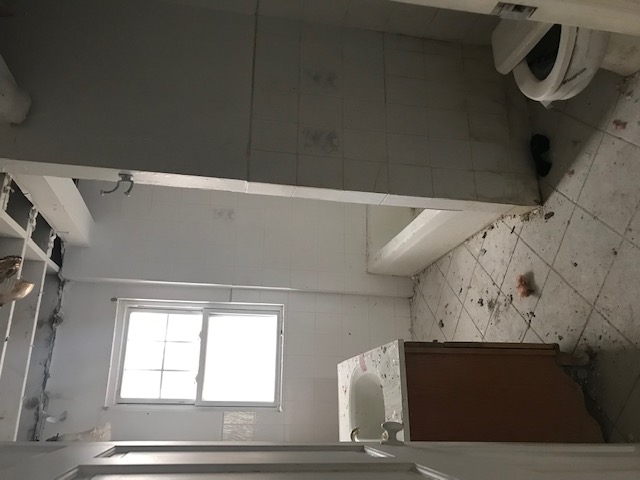 Before — As Found
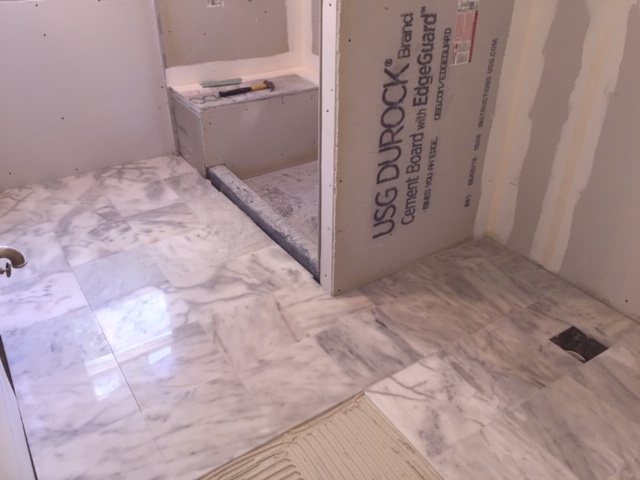 During — Open To Studs
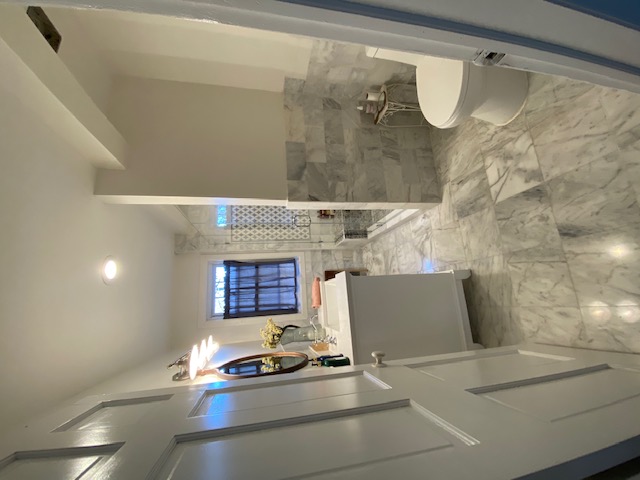 After — Rebuilt
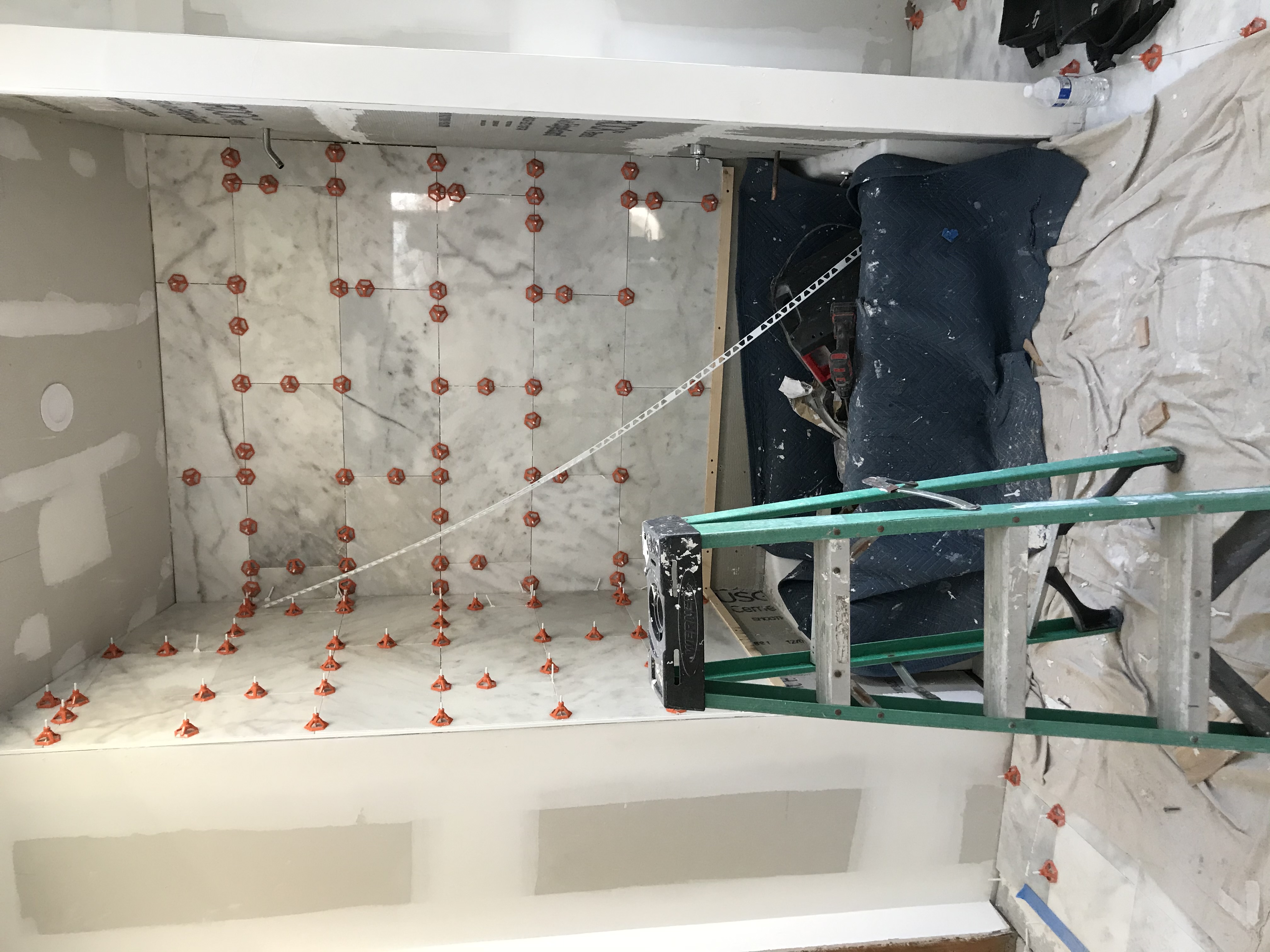 New Pan & Waterproofing